
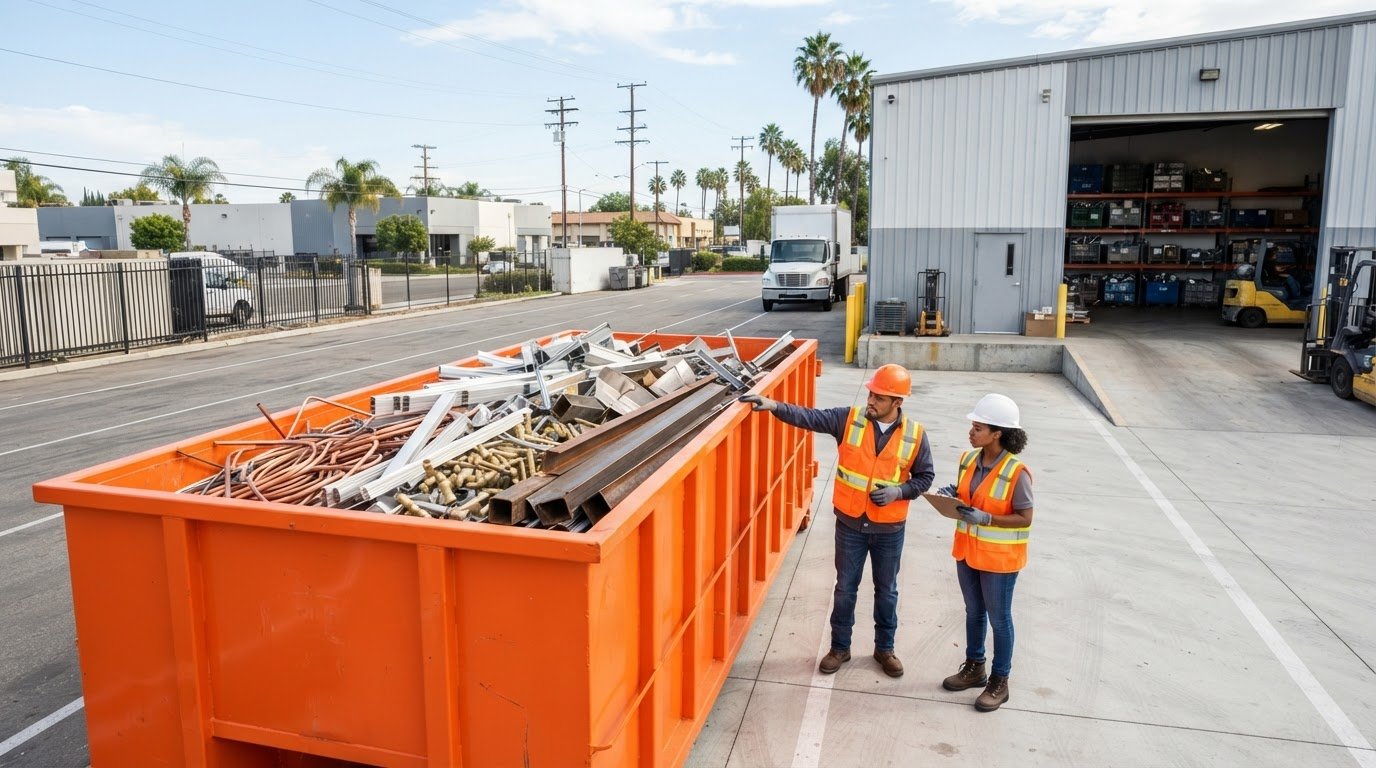
What if the best scrap-metal setup starts with your material and site layout, not the bin itself? Choosing a roll-off bin for scrap metal Westminster businesses can use takes more than estimating volume. Metal types, loading space, truck access, and pickup timing all shape a workable collection plan.
When scrap is building up and commercial space is limited, a simple, well-planned collection point can make daily handling easier. Separating metals and planning placement before collection helps keep material organized and recycling records clear. OC Recycling provides business bins, scrap-metal purchasing, pickup, and commercial recycling programs tailored to high-volume accounts.
This guide explains how to sort common scrap metals, assess access and placement logistics, and plan collection around your business’s scrap flow. You’ll also learn what can affect pickup charges and how documentation can support recycling records and audit readiness. With a little preparation, scrap collection can become a more organized part of day-to-day operations.
Key Takeaways
- Choose a roll-off bin for scrap metal Westminster businesses can use by matching the collection approach to site conditions and the pace of scrap generation.
- Learn how separating copper, aluminum, brass, ferrous metals, and other metals can support more organized handling and recycling.
- Compare business bins, scheduled pickup, and drop-off to see how each option fits your team’s space, material volume, and handling capacity.
- Use five practical planning steps to prepare for collection, from estimating scrap flow to keeping records organized.
- See how OC Recycling’s commercial bins, pickup services, and programs serve Westminster businesses, with recycling locations in Santa Ana, Orange, Costa Mesa, and Huntington Beach.
Roll-Off Bin for Scrap Metal in Westminster, CA: Start with the Site and Scrap
This guide is for businesses in Westminster, California, and nearby Orange County communities. A roll-off bin is a large container delivered to a site for temporary material collection. For a business handling scrap, the right setup depends on more than how much metal accumulates. Material type, generation rate, available space, truck access, and pickup frequency all affect whether onsite collection fits daily operations.
Think of the bin as one part of a collection plan. A fabricator generating metal offcuts steadily may need a designated collection point and a routine for keeping it manageable. A business replacing equipment less often may be better served by planning collection around those projects. OC Recycling provides bins to businesses and commercial recycling programs tailored to business needs, including high-volume accounts. Plan placement and collection around the site and the flow of recyclable material.
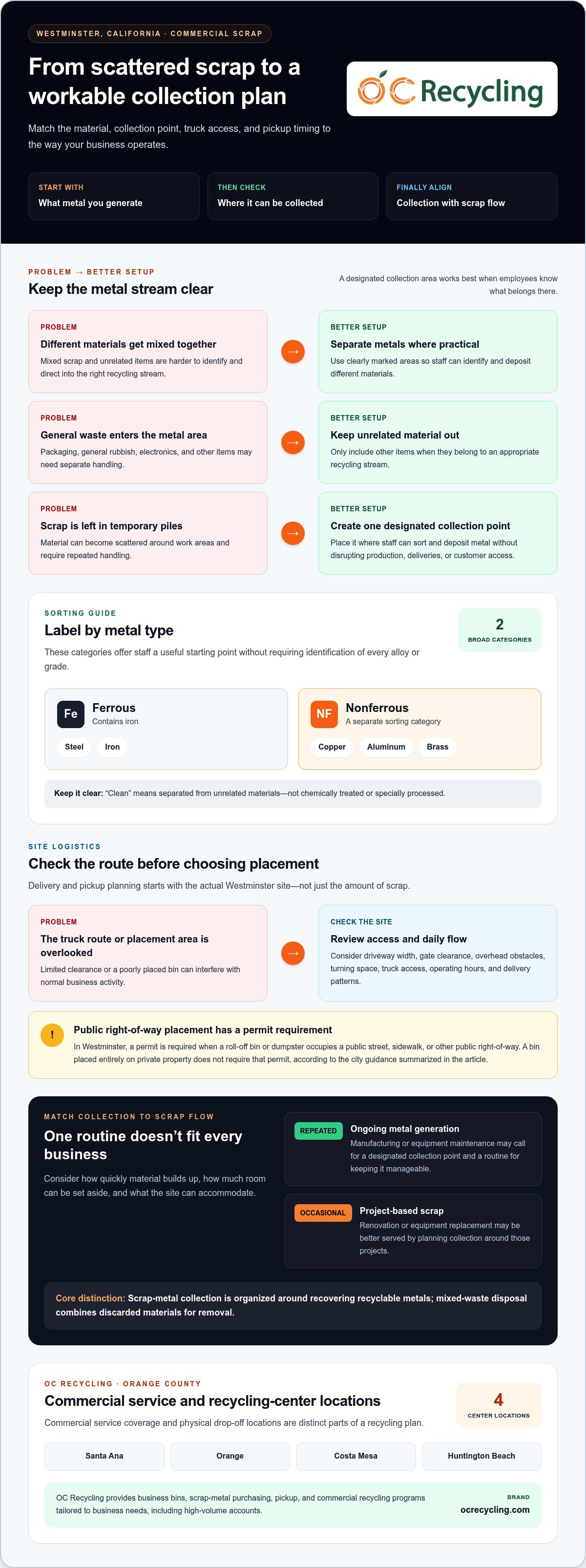
Scrap metal also follows a different path from general rubbish. Scrap-metal collection is organized around recovering recyclable metals, while mixed-waste disposal combines discarded materials for removal. Keeping scrap separate supports cleaner handling and helps direct recyclable materials toward processing. For a broad overview of how scrap metal is sorted and recycled, Wikipedia provides useful general background.
When does a business benefit from onsite scrap-metal collection?
Onsite collection can make sense when metal arises repeatedly from manufacturing, equipment maintenance, renovation, or equipment replacement. Rather than leaving material in temporary piles around a work area, employees can bring it to a designated collection point. This can reduce scattered scrap and repeated handling while making the site easier to manage.
Match the collection point to the workflow. Place it where staff can sort and deposit metal without disrupting production, deliveries, or customer access. Consider how much room the site can set aside and how quickly material builds up. A workable schedule should reflect both the business’s scrap flow and available space, rather than relying on a one-size-fits-all routine.
What makes Westminster, California logistics different?
Delivery and pickup planning starts with the actual Westminster site. Check driveway width, gate clearance, overhead obstacles, turning space, and whether a truck can reach the placement area without blocking routine business activity. Note operating hours and delivery patterns, too, so collection logistics fit the site’s normal flow.
Placement matters. Westminster requires a permit when a roll-off bin or dumpster occupies a public street, sidewalk, or other public right-of-way; a bin placed entirely on private property does not require that permit, according to the city guidance summarized for this topic. Resolve the intended location early, especially if private property offers limited room.
OC Recycling serves Westminster and surrounding Orange County communities, with four physical recycling-center locations in Santa Ana, Orange, Costa Mesa, and Huntington Beach. Service coverage and facility locations are distinct: a Westminster business can plan commercial recycling around its site, while using one of the four centers for drop-off. For a roll-off bin for scrap metal Westminster plan, start with the materials, access route, and placement area, then align collection with the business’s operating needs.
Prepare Scrap Metal for a Business Bin: Sort Materials Before Collection
A designated metal collection area works best when employees know what belongs there. Separation helps keep recyclable material identifiable, supports efficient handling, and gives your business a clearer picture of what it generates. OC Recycling handles copper, aluminum, brass, ferrous metals, and other metals. Sorting these materials by type where practical makes the collection stream easier to manage.
Clean, clearly separated metals are easier to identify and direct toward recycling. “Clean” here means kept apart from unrelated materials, not chemically treated or specially processed. Don’t assume mixed debris belongs in a scrap-metal collection stream. Packaging, general rubbish, electronics, and other items may need separate handling, so keep them out of the designated metal area unless they’re part of an appropriate recycling stream.
Separate ferrous and nonferrous scrap where practical
Ferrous metals contain iron; nonferrous metals are a separate sorting category. Steel and iron are common ferrous examples, while copper, aluminum, and brass are nonferrous examples. These broad categories give staff a useful starting point without requiring them to identify every alloy or grade. Keep visibly different metals in separate, clearly marked areas when the site’s workflow allows.
Copper may be generated as wire, pipe, or other offcuts, and its condition and preparation can matter for recycling. Staff handling copper can use this scrap copper pricing and preparation guide for additional preparation context. For ferrous material, the U.S. Geological Survey’s Iron and Steel Scrap Statistics explains the role of iron and steel scrap as a raw material and discusses recycling’s resource benefits.
Keep the collection area organized and usable
Set simple rules for the collection point so employees know where each material goes. Labels such as “copper,” “aluminum,” “brass,” and “ferrous metals” can reduce guesswork. Give staff a clear alternative for cardboard, electronics, and unrelated site materials so these don’t get mixed into the metal stream. If a piece is difficult to identify, keep it separate until it can be correctly sorted instead of using the whole collection area as a catch-all.
Organization also makes the site more practical. Keep the sorting area accessible to the employees who use it, and establish a routine for moving material there rather than allowing scrap to accumulate around workstations. A tidy collection point supports smoother day-to-day handling and makes it easier to see what’s building up.
Track the material types and approximate volumes collected over time. A simple log can show whether copper, aluminum, brass, or ferrous metals dominate the stream, helping your team plan collection frequency and describe the material clearly. Those records can also support commercial recycling documentation and audit readiness. When planning a commercial recycling program, keep material categories and volume notes together with your collection records.
Compare Scrap-Metal Collection Options for a Westminster Business
The right collection approach depends on how scrap accumulates, how much room your site can dedicate to it, and how your team can handle material before pickup. A business with steady production offcuts has different needs from one clearing metal during occasional maintenance. Compare options by their effect on workflow, not just by the container or vehicle involved.
| Option | Control | Handling effort | Space needs | Suitable material volume |
|---|---|---|---|---|
| Onsite business bin | High control over where scrap is collected | Staff place material in a designated area | Requires an accessible area on site | Recurring or higher-volume flows |
| Scheduled pickup | Collection is organized around an agreed routine | Staff gather and prepare material before pickup | Space needed to stage scrap until collection | Regular, manageable accumulations |
| Recycling-center drop-off | Your team chooses when to transport a load | Business handles loading and delivery | Less ongoing onsite storage may be needed | Suitable loads that can be transported safely |
When does onsite bin placement make sense?
A dedicated business bin can be practical when scrap is generated repeatedly or in substantial quantities. Manufacturing offcuts, maintenance work, or ongoing equipment replacement can create a steady stream that’s easier to manage in one collection point than in temporary piles. OC Recycling provides bins to businesses through commercial recycling programs tailored to business needs, including high-volume accounts.
Site access and collection cadence are important planning inputs. Consider where a bin can sit without interfering with staff, deliveries, or normal operations, and how quickly material gathers. A roll-off bin for scrap metal Westminster businesses are planning should fit the site’s workflow and collection needs. Describe the access, material flow, and available space when organizing the collection plan.
When are pickup or recycling-center drop-off better fits?
Pickup can suit a business that has recyclable metal ready for collection but doesn’t need a permanent onsite collection point. OC Recycling offers pickup for business recycling logistics. Charges may depend on the material type and quantity, so include the materials and expected load in your planning.
Drop-off may fit a business with a suitable load and the capacity to transport it to a recycling center. OC Recycling’s four physical locations are in Santa Ana, Orange, Costa Mesa, and Huntington Beach. Consider transport effort, available staff, and whether the load is sorted and ready before choosing this route.
Use the comparison as a starting point. A business may prefer ongoing onsite collection for regular scrap, while an occasional accumulation may call for pickup or drop-off. Keep metal separate and note the material type and approximate quantity. Those details help organize collection and support clear commercial recycling records. Explore commercial recycling options from OC Recycling to plan a collection approach around your business’s recycling needs.
5 Steps to Plan Scrap Metal Bin Placement in Westminster
A dependable collection plan starts with a clear picture of what your business generates and how the site operates. Before arranging logistics, document site constraints and the expected material mix. An effective commercial collection plan brings together five inputs: scrap volume, metal types, site access, collection timing, and clear records.
- Estimate material flow. Track scrap during a representative operating period, such as a regular production cycle or a defined maintenance project. Note how quickly material accumulates and whether output is steady or arrives in occasional surges. Record approximate quantities consistently, using containers, loads, or another measure your team can repeat. The goal is to describe the flow accurately, not guess at container capacity.
- Identify recyclable metals. List the materials your work produces, such as copper, aluminum, brass, and ferrous metals. Note when several types arise together and whether employees can separate them at the source. A clear material inventory helps shape a suitable collection approach and reduces uncertainty about what will enter the recycling stream.
- Assess placement access. Sketch the proposed collection area and the route to it. Include driveway access, gates, loading zones, overhead clearance, turning room, and employee traffic. Mark obstacles and note when deliveries or production activity make the route busy. A location that appears open on a plan may be difficult to use during an active shift, so assess it under normal working conditions.
- Set collection routines. Consider how production schedules, maintenance cycles, and project phases affect when scrap is ready to move. A renovation may generate a concentrated volume during a short phase, while manufacturing can create a more regular stream. Set an internal routine for checking the collection area and coordinating its readiness. For a roll-off bin for scrap metal Westminster plan, describe access and timing as part of the site’s collection needs.
- Organize responsibilities and records. Assign someone to guide separation, keep the collection point orderly, and record material categories and collection activity. Use a simple log with dates, approximate amounts, and notes about unusual projects or changes in output. Consistent records support internal reporting and help your team understand how its scrap flow changes over time.
Make the plan useful after placement
Keep the site notes, material inventory, access sketch, and collection log together. This gives your team a practical reference when operations change, a new project begins, or collection routines need adjustment. It also creates a clearer record of what the business set aside for recycling and when it was collected.
OC Recycling provides commercial recycling programs, business bins, and pickup, with documentation and traceability for commercial clients. Include those needs in your planning so collection records support your business’s reporting and audit readiness. Plan commercial scrap-metal collection with a clear account of your material mix, site access, and expected collection routine.
Arrange Commercial Scrap-Metal Recycling Bins with OC Recycling
For Westminster businesses, scrap-metal collection works best as part of a wider commercial recycling plan, not as a container decision in isolation. OC Recycling serves Westminster and surrounding Orange County communities with business bins, pickup, scrap-metal purchasing, and commercial recycling programs. Programs can be tailored for high-volume accounts, helping businesses align collection logistics with the amount and types of material they generate.
OC Recycling recycles more types of material than any other local center. That broad capability helps businesses manage multiple recyclable streams, while a clear plan for metal collection keeps scrap organized and records in order. The right setup depends on your material mix, site access, available space, and how your operation generates scrap. Make a roll-off bin for scrap metal Westminster businesses can use part of a site-led plan, based on actual workflow and collection needs.
A local commercial recycling partner for Westminster businesses
Commercial bin placement, pickup, and recycling logistics can work together as one coordinated program. OC Recycling is certified, licensed, and insured, and provides commercial clients with documentation and traceability. Those records can help your business track recycling activity and support audit readiness.
California’s AB 341 policy goal is to divert 75% of solid waste from landfills. Organized recycling practices can help businesses contribute to that broader goal by directing suitable recyclable materials into appropriate streams. OC Recycling’s commercial recycling programs support California’s 75% recycling compliance requirement for businesses. The company operates four physical recycling centers, in Santa Ana, Orange, Costa Mesa, and Huntington Beach.
Start planning your business’s scrap-metal collection
To prepare for a productive collection plan, bring together a few practical details about your operation. Note which metals you generate, how much typically accumulates, and whether the material arrives steadily or during specific projects. Describe the proposed collection area, truck access, gates, turning space, and any operating-hour considerations that affect site logistics. Clear information helps align the plan with actual site conditions and scrap flow.
Also consider how your team separates metals, who oversees the collection area, and what records you want to maintain. OC Recycling can incorporate business bins and pickup into commercial recycling programs, while documentation and traceability support organized recordkeeping. Pickup may incur a charge depending on the material type and quantity, so include those details in your collection planning.
Ready to discuss your commercial scrap-metal collection needs? Share your material types, approximate volume, site access details, and preferred collection approach with OC Recycling. Plan commercial recycling with OC Recycling and take the next step toward an organized, site-aware recycling program.
Turn Your Scrap Plan into a Practical Next Step
A well-planned roll-off bin for scrap metal Westminster setup begins with a clear picture of your business’s materials and site constraints. Use that information to shape a collection approach that fits your workflow, rather than forcing daily operations around a container. Share your metal types, approximate volume, site access details, and collection needs when planning the next step.
OC Recycling provides bins to businesses and commercial recycling programs, and recycles more types of material than any other local center. Its certified, licensed, and insured operations, along with commercial documentation, can support a transparent recycling process. Pickup may incur a charge depending on material type and quantity.
Take the first step toward a collection plan that works for your site and scrap flow. Plan commercial scrap-metal recycling with OC Recycling and put your business’s recycling goals into motion.
Frequently Asked Questions
Is a roll-off bin suitable for scrap metal from a Westminster business?
Yes. A roll-off bin can suit a Westminster business when the scrap flow, available site space, and vehicle access support that collection approach. A site producing metal regularly may benefit from a dedicated collection point, while occasional scrap may call for a different collection routine. OC Recycling provides bins to businesses, with placement planned around the material and site needs.
What size roll-off bin do I need for scrap metal?
There’s no single size that fits every scrap-metal operation. Estimate how much material accumulates over a normal production cycle, note whether it arrives steadily or in project-based surges, and account for the space available at your site. The metal mix matters, too, since different materials can require distinct handling. Use those details to plan a suitable collection approach rather than choosing a container based on a generic capacity estimate.
Can scrap metal be mixed with general construction debris?
How much does scrap-metal bin pickup cost in Westminster?
Pickup charges can depend on the material type and quantity, so there isn’t a single amount that applies to every Westminster business. A load of one metal may involve different logistics from a mixed set of materials or a larger accumulation. To plan collection, note the metals involved and estimate the amount ready for pickup. OC Recycling offers business pickup as part of its commercial recycling services.
Does OC Recycling provide bins to businesses in Westminster?
Yes. OC Recycling provides bins to businesses, including commercial accounts in Westminster. Plan bin placement around the material your business generates and its site operations, rather than treating the bin as a stand-alone disposal solution. A useful starting point is a brief outline of the scrap types, approximate volume, and available placement area. Commercial programs can also be tailored for high-volume accounts.
Can OC Recycling pick up recyclable materials from a Westminster business?
Yes, OC Recycling provides pickup for business recycling, and charges may depend on material type and quantity. Its local coverage includes Westminster and nearby Orange County communities such as Santa Ana, Anaheim, Costa Mesa, Huntington Beach, Orange, Irvine, Garden Grove, Fountain Valley, and Tustin. To plan collection, describe the materials and approximate amount, along with relevant site access details. This helps align the pickup plan with the business’s operating needs.
Where are OC Recycling’s physical recycling centers?
OC Recycling’s four physical recycling centers are in Santa Ana, Orange, Costa Mesa, and Huntington Beach, California. Westminster is part of the company’s local service area. If your team is considering drop-off instead of business pickup, account for transport time and how the materials will be separated and prepared before travel. That distinction helps you plan around the location that fits your operation.
