
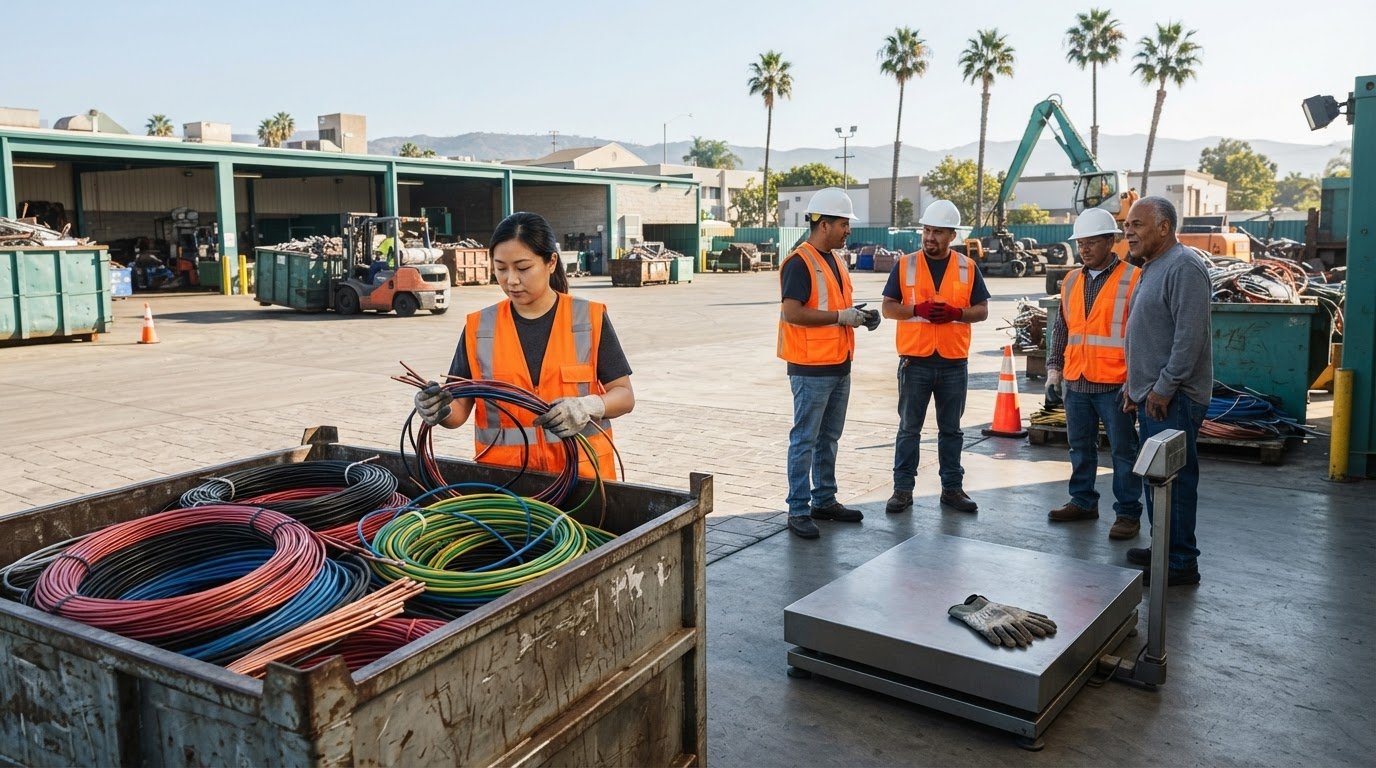
Stripping every inch of insulation before you sell may take more effort than it’s worth. If you’re wondering where to sell insulated copper wire for cash in Orange County, start with the wire’s type and condition, then let its evaluation guide your next step.
It’s reasonable to want a nearby option that accepts wire as-is and gives you a clear sense of how it will be assessed. OC Recycling purchases scrap metal at four Orange County locations for public and commercial sellers, including those in Santa Ana, Anaheim, Costa Mesa, and Huntington Beach.
This guide explains how insulation, copper content, and mixed wire types can affect an evaluation, and when stripping may or may not make sense. You’ll also find practical ways to sort and prepare your material for a visit to OC Recycling. The goal is to bring your wire in ready for evaluation without spending time on unnecessary prep.
Key Takeaways
- Looking for where to sell insulated copper wire for cash in Orange County? OC Recycling purchases scrap metal at four local locations for public and commercial sellers.
- Wire type, copper content, condition, and market conditions can affect its evaluation. Don’t assume every insulated wire earns the same grade.
- Separate visibly different wire types before your visit so the material is easier to assess.
- Stripping insulation may change how wire is categorized, but the extra effort doesn’t guarantee a better net result.
- Gather and contain your wire safely. Remove unrelated debris only when practical, then bring it to an OC Recycling location for evaluation.
Where to Sell Insulated Copper Wire for Cash in Orange County
Insulated copper wire can be evaluated as scrap metal even when the insulation is still on. If you’re searching for where to sell insulated copper wire for cash in Orange County, OC Recycling purchases scrap metal from public and commercial sellers. The payout depends on the wire’s type, copper content, condition, and current market conditions, so no single value applies to every bundle.
Insulation alone doesn’t determine a wire’s grade or value. Buyers need to assess what is under the covering and the overall condition of the material. Two bundles that look similar from the outside may differ in conductor size or copper content. Bringing the wire in for evaluation is more useful than judging by appearance or assuming all insulated cable is treated alike.
As a general guide, insulated copper wire is a copper conductor covered by plastic or another insulating material. The covering protects the conductor during use, but it means the material is not the same category as bare, clean copper. For an overview of copper wire and its insulated and uninsulated forms, see Copper Wire.
What counts as insulated copper wire?
Leftover electrical wire from a project and cable offcuts are common examples, provided they contain copper conductors under an insulating layer. Keep this material distinct from bare, clean copper, where the conductor is exposed. That distinction helps set expectations for evaluation, but it doesn’t mean all insulated wire belongs to one grade. Wire type and condition still matter.
Where can Orange County residents sell it?
OC Recycling purchases scrap metal from individual sellers and commercial accounts at four Orange County locations. Residents and businesses in Santa Ana, Anaheim, Costa Mesa, and Huntington Beach can bring wire in for evaluation, as can sellers from nearby communities. OC Recycling has operated in Orange County for more than 15 years.
Before your visit, gather the wire you plan to sell and keep it separate from unrelated materials. You don’t need to assume the insulation must be removed before the wire can be evaluated. Bring it in intact and let its type and condition inform the assessment.
- Keep categories distinct: Separate insulated wire from bare copper so the materials can be evaluated separately.
- Set expectations realistically: Market conditions can change, and the final payout depends on the specific material, not the label “copper wire” alone.
How Insulated Copper Wire Is Evaluated for Scrap
A scrap evaluation reflects the material type, condition, and current market conditions. Insulated copper wire is assessed as a specific material, rather than treating every copper wire bundle alike. Insulation, conductor size, attached materials, and visible contamination can help distinguish one batch from another. These are general factors that may inform an evaluation, not a fixed grading schedule or a guarantee of how a particular load will be classified.
Because the insulation covers the conductor, the copper content can’t be judged from the outer surface alone. Conductor size matters too: two similar-looking pieces may contain conductors of different thicknesses. The wire’s condition and whether different types have been mixed together can also affect assessment. An organized batch makes it easier to see what you’re bringing in, but sorting doesn’t guarantee a particular grade or payout.
Which details can affect the wire’s grade?
Look for visible differences in the insulation, thickness, and overall condition of the wire. Keep distinct groups apart instead of bundling every piece together. Attached non-copper materials, such as connectors or other components, may complicate sorting because the copper wire needs to be distinguished from what is attached. Don’t cut or remove anything if doing so would be unsafe.
Before your visit, a simple separation can help make the material easier to assess:
- Keep visibly different wire types in separate bundles or containers.
- Set wire with attached components apart from cleaner, more uniform wire.
- Remove loose, unrelated debris only when it’s safe and practical.
This preparation helps present the material clearly without requiring you to identify a technical grade yourself. The evaluation is based on the material brought in, not just a label or estimate written on a box.
Why online copper prices may not match your material
A published copper price may describe general market information or a particular copper category. It may not apply directly to insulated wire, which includes both copper and covering material. The wire’s category and condition matter, and market conditions change. Treat online figures as context, not a promised payout for your bundle. For a broader overview of copper categories and market factors, see this scrap copper prices guide.
If you’re searching for where to sell insulated copper wire for cash, the practical next step is to bring your material in for an in-person evaluation instead of assuming a general online figure will match it. The OSHA safety guidance addresses construction safety programs, a broader workplace-safety topic rather than a wire-grading method. To have scrap wire evaluated locally, bring your sorted material to a local scrap-metal buyer.
Should You Strip Insulated Copper Wire Before Selling?
Removing insulation can change how wire is categorized, but it doesn’t automatically make stripping the best choice. Consider the wire type, quantity, time and effort involved, and how the resulting material will be evaluated. For some sellers, bringing the wire in intact is the simplest route. For others, careful stripping may be worth considering. There’s no universal rule that every insulated wire should be stripped before sale.
Compare the two approaches before you start. This isn’t a payout guarantee. It’s a practical way to weigh preparation against the material you’ll bring in.
- Sell it intact: The effort is low. Gather and contain the wire, then present it in its existing condition for evaluation as insulated material.
- Strip it first: The work can be considerable, especially for a large or difficult-to-handle bundle. Remove the insulation safely and keep the resulting copper separate from scraps and debris.
- Compare the outcome: Stripping may change the material category, but it doesn’t guarantee a better net result. The quantity and type of wire, time spent, and evaluation of the prepared material all matter.
When selling the wire with insulation may make sense
Leaving the insulation on can be practical if you want to avoid extra work or have a modest amount of wire. Bring the material in as it is and have it evaluated in its presented condition. That keeps preparation simple and avoids spending time stripping material before you know how it will be assessed. The evaluation still depends on the wire itself.
Intact wire can also make sense when you’re unsure what kind of conductor is inside or when removing the covering would be difficult. Don’t assume stripping is required just because bare copper is a different material category. If convenience is your priority, bringing the wire as-is lets you get an evaluation without taking on that labor first.
When stripping may be worth considering
Think about stripping only after weighing the wire type, quantity, and effort. A small amount of thin wire may take substantial time to prepare, while a larger, more uniform batch could make the work more manageable. Even then, the category change doesn’t promise a better return. Consider whether the time and safe preparation are worthwhile for the material you have.
Use a suitable, controlled method if you decide to remove insulation. Never burn the covering. Burning can create hazardous smoke and leaves the material in an uncontrolled state. Keep stripped copper separate from insulation and unrelated debris, and avoid tools or methods you can’t handle safely. If the work becomes difficult or risky, stop and bring the wire in intact for evaluation instead.
If you’re deciding where to sell insulated copper wire for cash, stripping isn’t a prerequisite to making a practical choice. Weigh the effort against the material’s evaluation, then choose the option that suits your wire and circumstances.
How to Prepare Insulated Copper Wire for a Local Sale
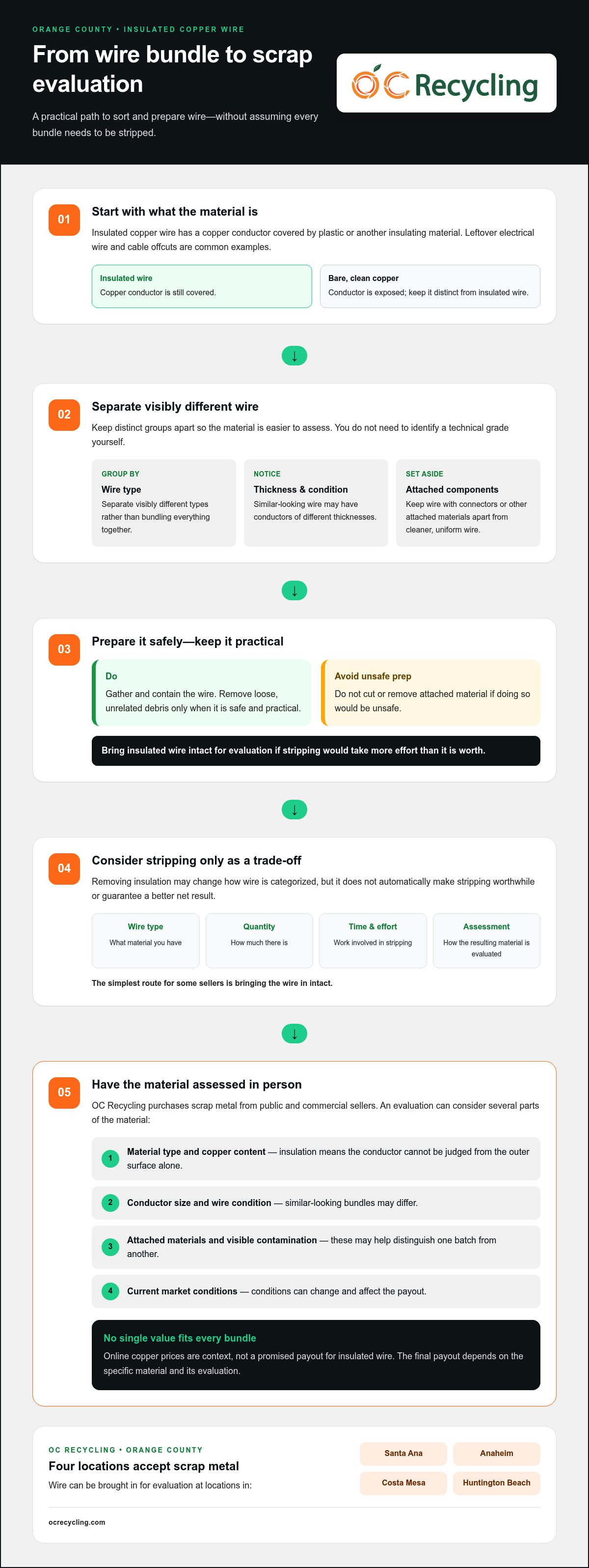
A little organization makes a local sale easier. You don’t need to strip the insulation or identify a technical grade before bringing wire in. Focus on gathering the material, separating obvious differences, and keeping it secure but accessible for evaluation. These steps help present your load clearly without unnecessary preparation.
Simple first-time seller checklist: gather the wire, separate visibly different types, contain it safely, and bring it to a recycling location for evaluation.
Sort and handle the wire safely
Start by collecting the insulated wire you intend to sell. Put visibly different types or conditions in separate bundles or containers. This keeps the material organized but doesn’t guarantee a particular grade. Keep it apart from unrelated scrap so it can be assessed on its own. Remove loose debris only if it’s safe and practical, and leave attached pieces in place rather than risking injury or damaging the wire.
Take care with cut ends. Bundle or contain wire so sharp ends don’t stick out and snag someone during loading or transport. Use a container or secure tie that keeps the material together but still lets staff see what you’ve brought. Don’t burn insulation or use an unsafe removal method to prepare the wire. Stripping isn’t required for this preparation checklist.
What to expect when visiting a recycling location
Bring your organized material to a recycling location and keep each group easy to access. The material is evaluated as presented, and its applicable category is determined during assessment. Sorting helps with clarity, but it doesn’t set the grade or payout in advance. The final payout depends on the evaluation and current market conditions.
For a smoother visit, avoid burying the wire beneath unrelated scrap or packing different materials into one container. If you have several distinct groups, keep them visibly separate so each can be reviewed. You don’t need to arrive with a price estimate or a self-assigned grade. The purpose of preparation is to make the material easy to handle and assess, not to predict the result.
If you’re deciding where to sell insulated copper wire for cash, bring the material in a safe, organized condition and let its evaluation guide the next step. OC Recycling purchases scrap metal for public and commercial sellers at four Orange County locations. Bring your insulated copper wire for evaluation at a convenient location.
Sell Insulated Copper Wire Through OC Recycling in Orange County
If you’re looking for where to sell insulated copper wire for cash in Orange County, OC Recycling is a local scrap-metal buyer serving public and commercial customers. Bring your wire for evaluation at one of four Orange County locations. Whether you’re clearing leftover material from a home project or sorting wire from commercial work, you can organize it clearly without assuming you must strip the insulation first.
OC Recycling has operated in Orange County for more than 15 years. Its local presence serves sellers in and around Santa Ana, Anaheim, Costa Mesa, and Huntington Beach. The wire is evaluated based on what you bring in. Its type and condition, along with current market conditions, inform the assessment, so a general estimate shouldn’t be treated as a guaranteed payout for your bundle.
A local scrap-metal option for Orange County sellers
OC Recycling purchases scrap metal from individual sellers and commercial accounts, providing a local option for insulated copper wire evaluation. The four locations serve sellers across Orange County, including those near Santa Ana, Anaheim, and Costa Mesa. Sorting your wire before arrival helps keep different materials distinct and makes it easier to present the bundle for evaluation.
OC Recycling offers competitive payouts and same-day cash for many recyclable items. These general payment options aren’t a promise of a particular price or same-day payout for insulated copper wire. The amount and payment process for a specific sale depend on the material’s evaluation and applicable conditions.
Take the next step with your insulated wire
Gather your wire, keep visibly different types separate, and contain it safely for transport. You don’t need to assign it a grade yourself or remove the insulation just to bring it in. Present the sorted material for evaluation and use the assessment to understand how it’s categorized. This gives you a straightforward next step without investing time in preparation that may not be necessary.
Use the location page to find an OC Recycling facility that works for your Orange County visit. Bring your insulated wire in a safe, accessible condition and have it evaluated on site. Find an OC Recycling location and plan your visit.
Make Your Next Step a Simple One
You don’t have to settle every question about grade or preparation before taking action. An in-person evaluation gives you a clearer basis for deciding how to handle similar wire in the future, including whether extra sorting or stripping is worthwhile for your situation. Start with the material you have, keep it safely contained, and let its assessment guide your next move.
If you’re still deciding where to sell insulated copper wire for cash, choose a convenient local visit and bring your wire for evaluation. OC Recycling offers a practical way to turn scrap metal into a resource rather than letting it sit unused. Find an OC Recycling location and bring your insulated copper wire for evaluation.
Frequently Asked Questions
Where can I sell insulated copper wire for cash in Orange County?
OC Recycling purchases scrap metal at four Orange County locations. If you’re searching for where to sell insulated copper wire for cash, bring your organized material in for evaluation. OC Recycling serves sellers in Santa Ana, Anaheim, Costa Mesa, Huntington Beach, Orange, Irvine, Garden Grove, Westminster, Fountain Valley, and Tustin. Review the website’s location information before setting out, and keep wire separate from other scrap so it’s easier to present.
Can I sell copper wire with the insulation still on?
Yes, insulated wire can be brought in for evaluation without stripping every piece first. For example, leftover cable from a renovation can be presented with its covering intact rather than requiring extra preparation at home. The assessment depends on the material’s type and condition, so avoid assigning it a grade or assuming a particular result. If pieces look different, keeping them in separate groups can help distinguish the material during the visit.
How much is insulated copper wire worth per pound?
There isn’t one dependable per-pound figure that applies to every insulated-wire batch. A number you find online may describe another copper category or reflect market conditions that have since changed. For example, a quote for clean, bare copper shouldn’t be treated as the value of a covered conductor. The practical way to learn what your material is worth is to have the specific wire evaluated in its current condition.
Is it better to strip copper wire before selling it?
Not necessarily. The best choice depends on how much wire you have, what type it is, and how much safe preparation it would take. If you have a small bundle of mixed offcuts, bringing it in intact may be simpler than spending time stripping each piece. If you’re considering removal, use a controlled method and never burn the insulation. Stripping changes the material presented, but doesn’t guarantee a better outcome.
What should I do with mixed types of insulated copper wire?
Separate pieces that visibly differ in thickness, covering, or attached components, and keep unrelated scrap apart. You don’t need to identify a technical grade. The goal is simply to present distinct materials clearly. For instance, place cleaner, similar-looking cable in one container and wire with attached components in another. If you can’t tell the types apart, don’t guess or cut into them. Bring them as they are for evaluation.
Can I get same-day cash for insulated copper wire?
OC Recycling offers same-day cash for many recyclable items, but that doesn’t guarantee same-day payment for every insulated-wire sale. The material’s evaluation and the transaction determine the outcome, including any applicable payment timing. Avoid planning around a specific amount or payment time before your wire has been assessed. For a smoother visit, keep the bundle accessible and review OC Recycling’s website location information before you travel.
