
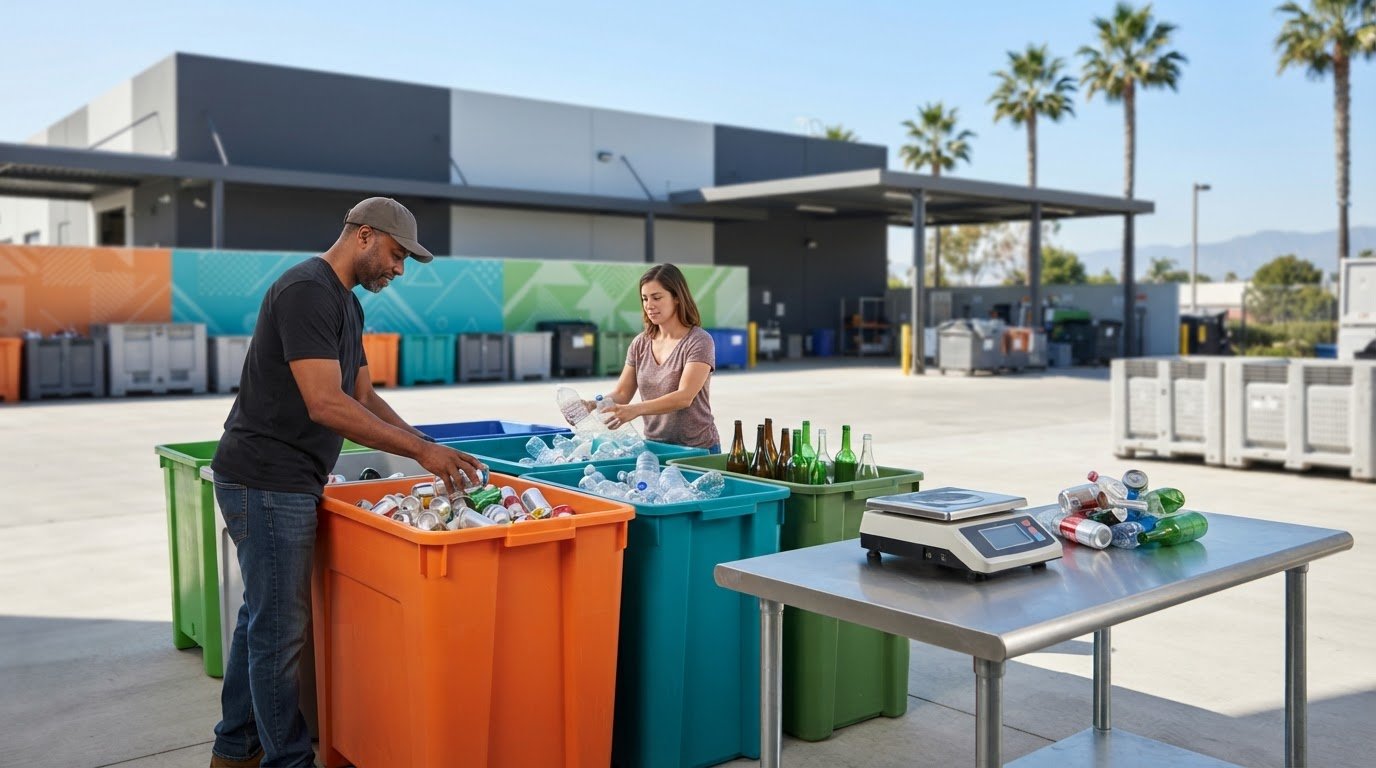
That small CRV charge on your drink isn’t just another fee: it’s a refundable value you can recover when you return an eligible container. California redemption value can feel confusing when rules vary by container size and material, but the basics are straightforward: most eligible containers under 24 ounces carry a 5-cent value, while those 24 ounces or larger carry a 10-cent value.
It’s common to wonder which bottles and cans qualify, or whether a recycling center counts them individually or weighs them. This guide explains how CRV works, which containers are eligible, how refunds are calculated, and what to know about redemption by count versus weight. It also covers newer eligible items, including certain wine and spirits containers, so you can avoid overlooking containers that may qualify. For Orange County residents, OC Recycling offers CRV redemption at four local locations. With a little preparation, you can sort your containers, understand what to bring, and make redemption a simpler part of your recycling routine.
Key Takeaways
- Learn how california redemption value eligibility depends on both the beverage and its container, not packaging material alone.
- Understand when you can request payment by count and when a larger load may be paid by weight.
- Use a simple preparation routine to sort containers, review eligibility, and reduce surprises at redemption.
- See how OC Recycling provides a local CRV redemption option for Orange County residents.
What Is California Redemption Value, and Why Do Shoppers Pay It?
California Redemption Value (CRV) is a refundable value charged when you buy an eligible beverage container and recoverable when you return that container through an accepted option.
The purchase-to-return cycle is the key to understanding the charge. You pay CRV when you purchase a covered beverage, then you can recover the container’s value by returning an eligible container for redemption. California redemption value isn’t a general sales tax on the drink. It’s tied to the container and the opportunity to redeem it. If you don’t return an eligible container, you don’t receive that value back.
Why is CRV charged when you buy a beverage?
CRV is collected at the point of sale on covered beverage containers. It’s separate from the shelf price of the beverage itself, so the amount you see for the drink and the CRV amount represent different parts of the purchase. Your receipt may help you identify the CRV charge.
The program gives consumers a financial reason to return eligible containers instead of leaving them behind or throwing them away. Bringing containers back for redemption supports recycling and helps reduce litter. The incentive applies when you return containers that qualify through an accepted redemption option. A package that looks recyclable isn’t automatically eligible for a CRV refund. Eligibility depends on program rules, which this guide explains below.
For shoppers, the distinction is straightforward: you pay the charge with the purchase, but it isn’t simply part of the beverage’s shelf price. You may get the container value back later, provided you return an eligible item and follow the redemption process.
Is California Redemption Value a tax or a refundable deposit?
For everyday shopping, it’s most useful to think of CRV as a container-related charge that can be refunded through redemption, rather than as a tax you claim back on a tax return. CalRecycle describes the program in terms of a charge paid when buying eligible beverages and a refund available when containers are redeemed. The refund is connected to returning containers, not filing paperwork about your purchase.
People often use “deposit” as shorthand because the value is paid upfront and can be recovered later. However, California’s official program name is California Redemption Value, and the refund depends on meeting the program’s eligibility and redemption requirements. A CRV line on a beverage receipt doesn’t mean every package in your recycling bin has redeemable value. Identify qualifying beverage containers and take them to an accepted option.
For additional background on the program’s history and framework, see this overview of the California Redemption Value (CRV) program. The practical takeaway is simple: CRV is collected with eligible beverage purchases, and you can recover it by redeeming eligible containers.
Which Beverage Containers Qualify for California CRV?
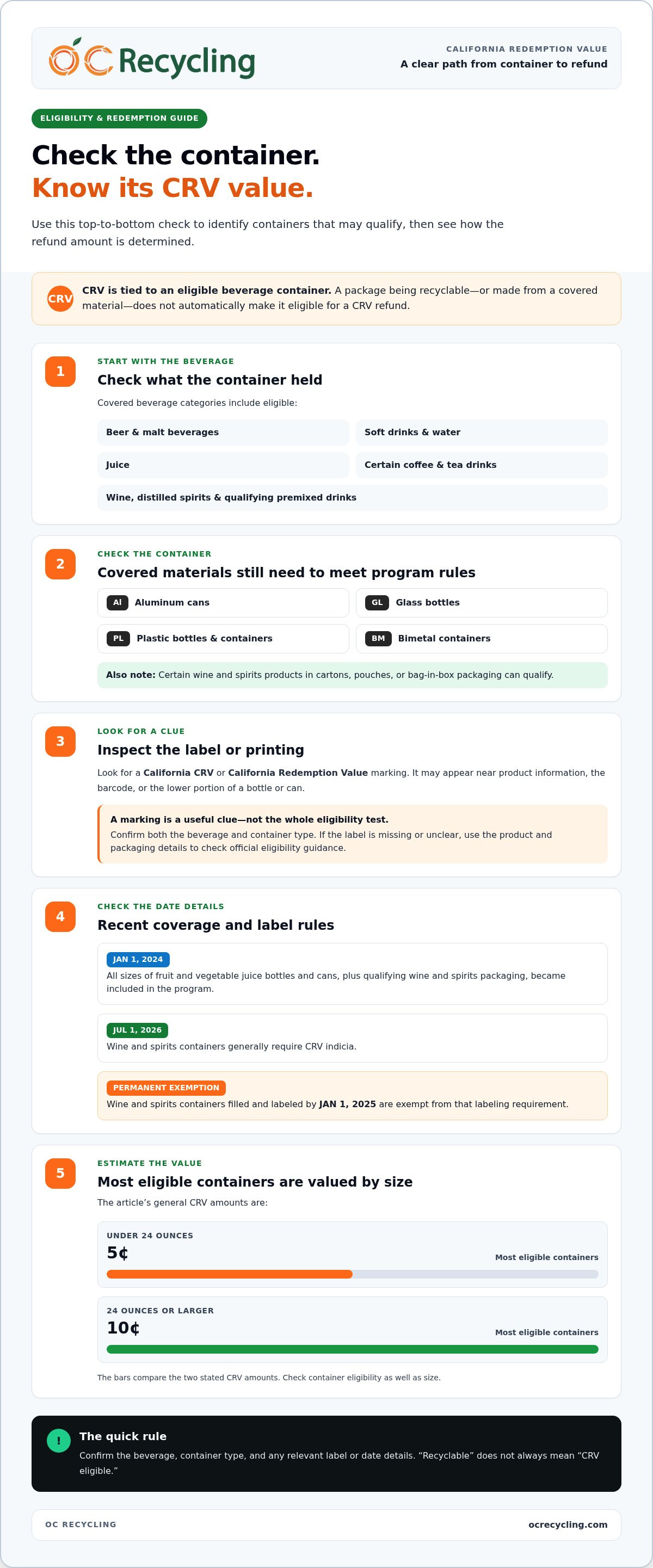
Eligibility depends on more than what a container is made of. California’s program covers specified beverages in aluminum, glass, plastic, and bimetal containers, but a package made from one of these materials doesn’t automatically qualify. Check both the beverage category and the container’s program marking before setting it aside for redemption.
What materials and beverage categories are covered?
CalRecycle’s program includes eligible containers for beverages such as beer and malt beverages, soft drinks, water, juice, and certain coffee and tea drinks. Program coverage also includes wine and distilled spirits, including qualifying premixed wine and spirit drinks. Since January 1, 2024, the program has included all sizes of fruit and vegetable juice bottles and cans, as well as qualifying wine and spirits packaging.
Eligible materials include:
- Aluminum: qualifying beverage cans.
- Glass: qualifying beverage bottles.
- Plastic: qualifying beverage bottles and containers.
- Bimetal: qualifying containers made from more than one metal.
Some wine and spirits products come in cartons, pouches, or bag-in-box packaging rather than conventional bottles. Those formats can qualify under the program, so don’t assume the shape or packaging style rules them out. Material alone isn’t proof of eligibility, though. Some beverages and containers are excluded under program rules. For unusual or borderline items, compare the product with CalRecycle’s Beverage Container Recycling Program guidance rather than relying on appearance alone.
How can you tell whether a container is CRV eligible?
Start by checking the label or printing on the container. Look for a California CRV or California Redemption Value marking, often near the product information, barcode, or lower portion of a bottle or can. Treat the marking as a useful clue, then confirm that the beverage and container type meet the program’s eligibility rules.
Label rules changed for wine and spirits. Beginning July 1, 2026, those containers generally require CRV indicia. However, wine and spirits containers filled and labeled by January 1, 2025, are permanently exempt from that labeling requirement. A missing marking alone may not settle whether an older container qualifies. For other newly covered beverage containers, labeling may also be an imperfect guide when packaging or product information is unclear.
If a label is damaged, missing, or hard to read, identify the beverage and packaging type and consult CalRecycle’s official eligibility guidance. Don’t treat “recyclable” as the same thing as “CRV eligible.” A container might be recyclable through another route without qualifying for a CRV refund. Checking eligibility before sorting helps you avoid mixing nonqualifying items with containers you plan to redeem.
Once you’ve identified likely eligible containers, prepare them for CRV redemption in Orange County by keeping them separate from other recyclables.
How Is a California CRV Refund Calculated?
Your refund depends on both the eligible containers you return and the redemption method used. By count, the calculation applies a value to each qualifying container. By weight, the center weighs the material instead, so the final amount isn’t simply the per-container value multiplied by an estimated item count.
Per-container refunds versus redemption by weight
For a counted return, each eligible container is assigned the applicable CRV value based on its size and type. CalRecycle allows consumers to request payment by count for up to 50 containers of each material type per visit: aluminum, glass, plastic, and bimetal. Above 50 of one material, the center may decide whether to pay by count or weight.
For example, a counted return of 10 eligible containers under 24 ounces would total 50 cents at the standard rate. Ten eligible containers in the 24-ounce-or-larger category would total $1. These examples show the arithmetic, not a guaranteed payout. The containers must qualify, and the center’s procedures and program rules determine how a return is handled. By weight, a batch is weighed rather than individually counted, and the applicable weight-based rules determine the payment. Keeping materials sorted helps the return get assessed correctly.
What CRV rates should California residents expect?
The table shows the published per-container rates as of October 2026. The standard size distinction applies to eligible containers; certain wine and spirits packages have a separate value. Check CalRecycle’s official program information for current rules, since program eligibility and rate details can change.
| Eligible container or packaging | Size or condition | CRV value by count |
|---|---|---|
| Standard eligible beverage container | Less than 24 ounces | 5 cents each |
| Standard eligible beverage container | 24 ounces or larger | 10 cents each |
| Box, bladder, or pouch containing wine, distilled spirits, wine cooler, or distilled spirit cooler | Qualifying package | 25 cents each |
These are count-based values, not a per-pound rate table. If a return is processed by weight, don’t use the figures above to estimate a total from the number of containers. The weight-based calculation follows a different method. The california redemption value you can recover also depends on whether the items meet eligibility requirements and are accepted for redemption.
Before making a larger trip, sort containers by material and keep the groups separate. This makes it easier to apply the count limit for each material and understand whether a larger group may be handled by weight. If you’re bringing more than 50 containers of one material, account for the possibility that the return may be processed by weight.
How to Prepare for CRV Redemption in Orange County
A little preparation can make a CRV visit easier and help you avoid bringing items that don’t qualify. Before heading out, separate likely eligible beverage containers from other recyclables, check uncertain items against current program guidance, and review the instructions for your redemption location. Procedures can differ by center, so plan around the specific location you choose.
What should you sort and check before leaving?
Keep eligible containers identifiable and organize them by material where practical. This makes it easier to assess your return, especially if you’re bringing a larger group. Separate questionable items instead of mixing them with containers you know are eligible. A recyclable package does not necessarily qualify for CRV, and unclear labels can make an item harder to identify.
Use this quick preparation sequence:
- Sort the load. Separate beverage containers from non-eligible recyclables, then group aluminum, glass, plastic, and bimetal containers where practical.
- Check eligibility. Review the beverage type and packaging against current CRV guidance, particularly for specialty formats or containers with unclear markings.
- Review center instructions. Check the destination’s current procedures for handling and presenting containers. Local practices may affect how the center accepts and processes a return.
Don’t assume that rinsing or crushing is required, or that every center follows the same preparation rules. Follow the instructions for the redemption option you choose. If a container is damaged or its label is difficult to read, keep it apart from clearly identifiable items so it can be assessed appropriately.
How can Orange County residents find a redemption option?
Orange County residents can use CalRecycle’s recycling center locator to look for nearby redemption options by city or ZIP code. For example, someone in Santa Ana can search for nearby locations rather than assume a center elsewhere in the county is the most convenient. Review the selected center’s location details and procedures before making the trip.
OC Recycling serves customers across Orange County, with four local locations. Communities in the area include Santa Ana, Anaheim, Costa Mesa, Huntington Beach, Orange, Irvine, Garden Grove, Westminster, Fountain Valley, and Tustin. Use this CRV recycling center guide to plan where to redeem eligible containers. Sorting your load and reviewing the destination’s instructions can make the visit more straightforward, whether you’re bringing a few containers or a larger batch.
Ready to redeem eligible containers? Choose OC Recycling for CRV redemption and plan your visit with your containers sorted and center procedures in mind.
Redeem California CRV Containers with OC Recycling
Turning eligible containers into a redemption is straightforward: identify what qualifies, review current program rules, then choose a location that fits your plans. OC Recycling provides CRV redemption for Orange County residents and commercial customers. The company purchases and processes CRV containers at four locations across Orange County.
Redemption depends on the containers themselves and current program requirements. A container’s material or appearance alone doesn’t establish eligibility, and a center’s procedures can affect how it handles a return. Preparing your load helps you arrive with a clearer idea of what you’re bringing and what to expect from the process.
What can customers expect from a local CRV redemption service?
A redemption center provides a place to bring eligible beverage containers for processing under California’s CRV program. OC Recycling purchases and processes CRV containers, giving customers in Orange County a local option for redemption. The value you may recover depends on which containers qualify and the method used to assess your return.
Before visiting, separate likely eligible containers from other recyclables and review the location’s instructions. Don’t assume every location follows identical procedures or handles containers in the same way. Preparing your load helps you understand what you’re bringing and avoid mixing in items outside the program.
What is the next step for redeeming your containers?
Use this quick decision path to prepare:
- Identify your containers. Review the beverage type, packaging, and markings to determine which items may qualify.
- Check current rules. Consult California program guidance if eligibility or a container label is unclear.
- Choose a location. Review location and operating information before traveling, then follow that location’s instructions for presenting your containers.
This approach keeps the process practical: confirm eligibility first, then plan the visit around a convenient redemption location. Since program rules and center procedures may change, reviewing the latest information before you travel is a useful final step.
OC Recycling provides CRV redemption at four Orange County locations. Visit the OC Recycling website to review its CRV redemption information and plan your visit with eligible containers ready to bring in.
Make Your Next Redemption Easier
A simple habit can make california redemption value easier to reclaim: keep beverage containers you think may qualify in a separate place as you use them. When it’s time to redeem, you’ll have a more organized load and can check uncertain items before they get mixed in with other recyclables. This also makes it easier to plan a visit around your schedule.
For your next step, review OC Recycling’s CRV redemption information and plan your visit using location details and center instructions. Bring containers you’ve identified as eligible, and let the redemption process determine which items can be accepted. Sorting as you go makes it easier to get started.
Find your next step for CRV redemption with OC Recycling and turn your sorted containers into a practical recycling routine. A well-prepared return helps keep eligible beverage packaging in the recycling stream.
Frequently Asked Questions
What does California Redemption Value mean?
California Redemption Value, or CRV, is the value attached to eligible beverage containers that can be recovered through redemption. You pay it when purchasing a covered beverage, then return qualifying containers through an accepted option to request the value back. Keep eligible beverage containers separate from ordinary household recycling so you can identify them easily when you’re ready to redeem them.
Is California Redemption Value a tax?
CRV is best understood from the shopper’s perspective as a charge on eligible beverage containers that may be refunded through redemption, not as a general sales tax reclaimed on a tax return. CalRecycle describes the program as collecting a charge when covered beverages are purchased and refunding value when eligible containers are redeemed. The refund depends on returning qualifying containers, not simply on keeping the purchase receipt.
How much is CRV in California in 2026?
As of 2026, standard eligible containers under 24 ounces have a 5-cent CRV, while containers 24 ounces or larger have a 10-cent CRV. Qualifying boxes, bladders, or pouches containing wine, distilled spirits, wine coolers, or distilled spirit coolers carry a 25-cent value. These are per-container rates; a return processed by weight is calculated differently. Review current CalRecycle guidance for updates before redeeming.
Which bottles and cans qualify for CRV in California?
Eligibility covers specified beverages in aluminum, glass, plastic, and bimetal containers. Covered examples include qualifying drink cans and bottles, juice containers, and certain wine and spirits packages. Don’t assume every recyclable bottle, can, carton, or pouch qualifies: the beverage and packaging must meet program rules. If the label is missing or the container is an unusual format, use CalRecycle’s eligibility guidance to help determine whether it can be redeemed.
Can you redeem CRV containers by weight?
Yes, eligible containers may be redeemed by weight in applicable situations. Consumers can request payment by count for up to 50 containers of each material type per visit. For more than 50 of one material, the center may choose whether to pay by count or weight. For example, a large batch of aluminum cans may be weighed instead of counted individually, so the final calculation won’t match an estimated per-container total.
Can I get CRV back without a receipt?
Generally, redemption is based on the eligible containers you bring, rather than a receipt proving where or when you bought them. The center assesses the containers under applicable program rules and its procedures. Keep containers identifiable, and separate items whose eligibility is uncertain. If a particular container’s marking is unreadable or missing, review current CalRecycle guidance before including it in your redemption load.
Where can I redeem California CRV containers in Orange County?
Orange County residents can use CalRecycle’s center locator to find nearby redemption options, then review the selected center’s location details and procedures before traveling. OC Recycling provides CRV redemption for local customers. Its Orange County communities include Santa Ana, Anaheim, Costa Mesa, Huntington Beach, Orange, Irvine, Garden Grove, Westminster, Fountain Valley, and Tustin. Review current operating information when planning your visit.
