
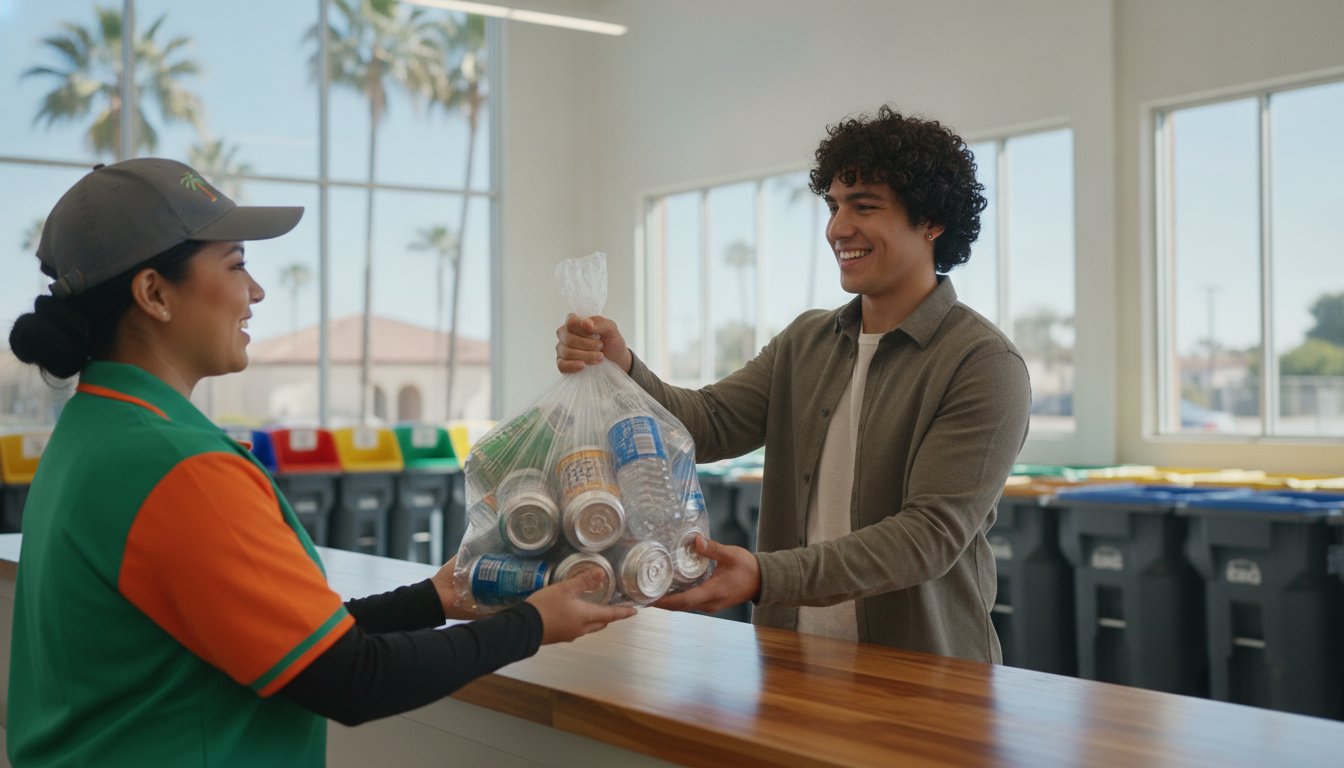
What if that extra charge on your grocery receipt was actually a hidden savings account waiting for you to claim it? Most shoppers feel a sting of frustration when they see those added cents at the checkout line, often dismissing them as just another unavoidable tax. If you’ve ever looked at your drink and wondered, what does ca crv mean on bottles, it’s time to stop viewing those letters as a cost and start seeing them as a reliable source of instant cash.
We know how frustrating it is to feel like you’re losing money on items that end up in the trash. This guide promises to clear up that confusion by detailing exactly which containers qualify for a payout under the latest 2026 regulations. You’ll learn the current rates for standard containers and the new 25-cent redemption for wine and spirit boxes. We’ll also show you how to skip the gritty scrap yard experience by visiting a professional, certified redemption center in Orange County that prioritizes your time and provides transparent, same-day payouts.
Key Takeaways
- Gain a clear understanding of what does ca crv mean on bottles and how this state-mandated program turns your everyday beverage waste into immediate cash.
- Identify the full range of eligible containers, including the latest 2026 updates for wine, spirits, and large juice containers that many people mistakenly throw away.
- Master the current payout structure to ensure you receive the full 5-cent, 10-cent, or 25-cent value for every eligible item you bring in.
- Learn the professional sorting techniques that will help you move through the redemption process quickly and efficiently at our modern facilities.
- Discover the benefits of partnering with a premier, certified recycling leader in Orange County that offers same-day cash and a clean, safe environment.
Defining CA CRV: The Basics of California Redemption Value
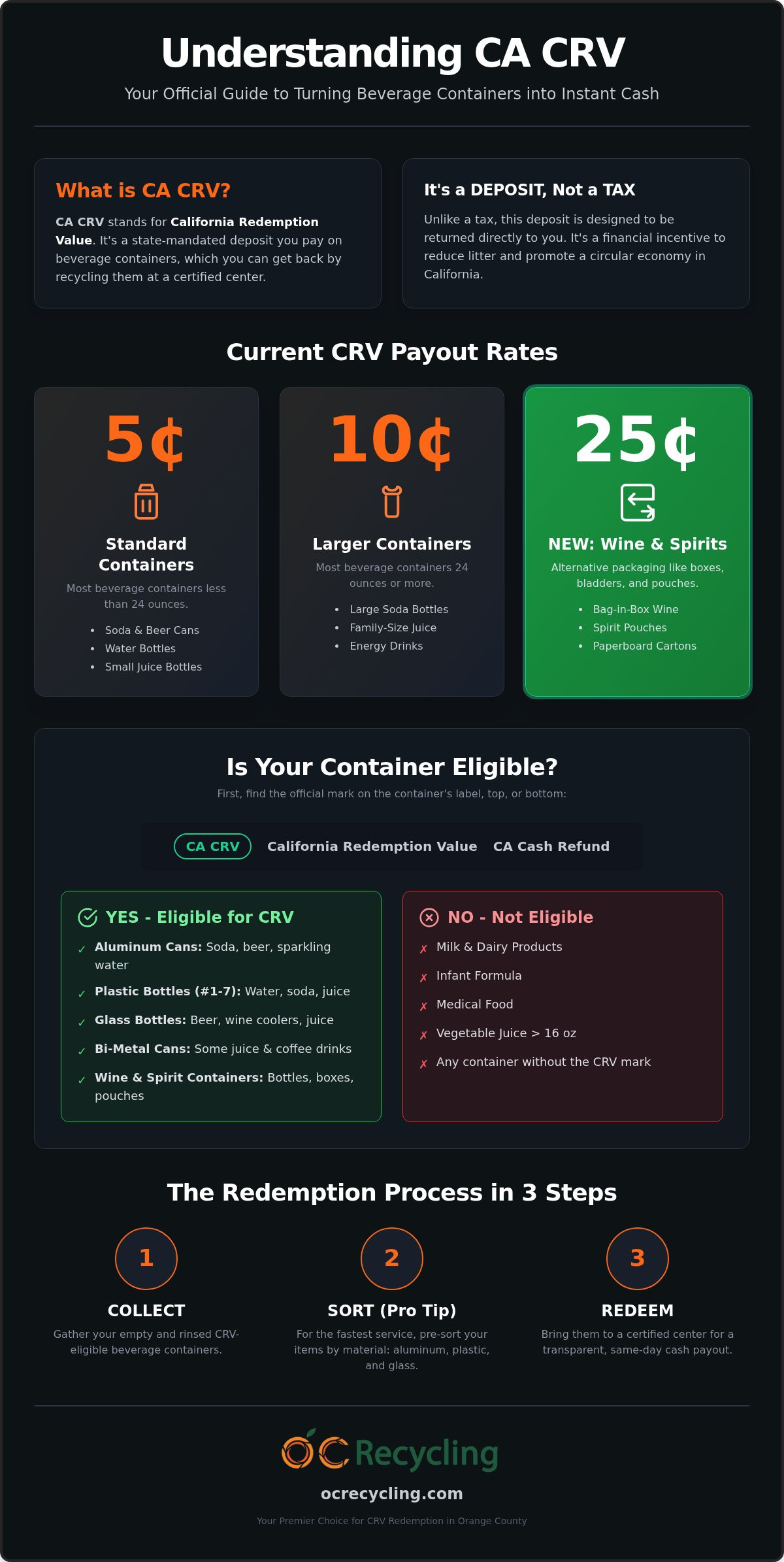
If you’ve ever looked at the bottom of a soda can or the side of a water bottle, you’ve likely seen the letters “CA CRV.” But what does ca crv mean on bottles exactly? Simply put, it stands for California Redemption Value (CRV). This state-mandated program was established in 1986 with a clear dual purpose: to drastically reduce litter across our beautiful California landscape and to promote high-volume recovery of recyclable materials. By attaching a small monetary value to each container, the state ensures that these materials are diverted from landfills and processed for reuse.
Think of the CRV as a temporary holding fund for your money. It is a financial incentive for environmental responsibility that rewards you for participating in the state’s circular economy.
The Difference Between a Tax and a Deposit
Many shoppers mistake the CRV for a permanent tax, but there’s a vital distinction. When you purchase a beverage, you’re paying a prepaid deposit rather than a fee that disappears into a government budget. This is why you see it as a separate line item on your grocery receipt. Unlike a tax, this deposit is designed to be returned directly to your pocket once you return the empty container to a certified facility. CalRecycle manages these funds at the state level, ensuring that the money flows from the bottler to the consumer and back into the recycling infrastructure. It’s a circular system where your initial payment is essentially a loan to the environment that you can collect at any time.
Why the CA CRV Label Matters in 2026
In 2026, the CA CRV label is more important than ever because it serves as your official ticket to a cash refund. Without this mark, a container isn’t part of the program, even if the material is technically recyclable. As of July 1, 2026, new labeling requirements have fully integrated wine and distilled spirit containers into the system. This means that bottles, pouches, and boxes which were previously ineligible now carry the same cash value as a standard soda can. Furthermore, 2026 standards have clarified the requirements for larger juice and vegetable containers, ensuring consumers can easily identify which bulk items are worth money.
Finding the mark is easy once you know where to look. Depending on the packaging, the label might be:
- Embossed: Stamped directly into the aluminum or glass surface.
- Printed: Integrated into the plastic label or ink-jetted onto the shoulder of the bottle.
- Indicia: Look for phrases like “CA CRV,” “California Redemption Value,” or “CA Cash Refund.”
Checking for these labels ensures you don’t accidentally throw away money. As the program continues to expand to include more packaging styles, staying vigilant about these markings is the best way to maximize your returns at a professional, community-focused recycling center.
Decoding the Labels: What Containers Are Eligible for Cash Back?
Identifying which items in your recycling bin are actually worth money is the first step toward a successful payout. While many people ask, what does ca crv mean on bottles, the more practical question is: which specific containers qualify? The core of the program remains focused on the most common beverage materials found in every household. Aluminum cans used for soda, beer, and sparkling water are the most frequently redeemed items. Plastic bottles labeled with resin codes #1 through #7, primarily PET and HDPE, are also high-volume qualifiers. Glass bottles for both carbonated and non-carbonated drinks remain a staple of the program, along with bi-metal containers often used for specialty juices or energy drinks.
For a comprehensive and up-to-date list of every specific beverage category covered by the state, you can consult the Official CRV Program Information. Keeping track of these categories ensures you never lose out on the deposit you’ve already paid at the register.
Recent Expansions: Wine, Spirits, and Pouches
The program underwent a massive transformation on January 1, 2024, when wine and distilled spirit containers were officially added to the eligibility list. This expansion introduced a high-value “25-cent” category specifically for alternative packaging styles. This includes boxes, bladders, pouches, and paperboard cartons containing wine or spirits. It’s a significant shift that turns previously “trash” items into valuable recyclables. However, you should remember that certain liquids remain excluded from the program. Milk, medical food, and infant formula containers do not carry a CRV, regardless of their material type. If you are unsure if your collection qualifies, our team at OC Recycling can provide a quick, professional assessment at any of our four locations.
The 2026 Juice Container Update
A critical milestone arrived on July 1, 2026, regarding labeling and eligibility for juice products. Under these updated regulations, 100% fruit juice containers of 46 ounces or larger are now firmly included in the redemption program. Similarly, vegetable juice containers over 16 ounces now require the CA CRV label to be eligible for a refund. This update addresses a long-standing gap in the program, ensuring that large-format family juice bottles are finally redeemable for cash.
During this transition period, you might still find older stock in your pantry that lacks the formal “CA CRV” stamp. It is important to check these items carefully; wine and spirits containers filled and labeled before January 1, 2025, are permanently exempt from the labeling requirement but may still be eligible for redemption by weight. Identifying these subtle differences is the mark of a savvy recycler who maximizes every trip to a certified center.
Calculating Your Payout: Current CRV Rates in 2026
Understanding what does ca crv mean on bottles is only half the battle; knowing the exact dollar value of your collection is what puts money back in your pocket. As of July 2026, the payout structure remains straightforward but includes important new categories that many residents overlook. For standard individual containers like soda cans or small water bottles under 24 ounces, the rate is 5 cents each. If you are recycling larger containers of 24 ounces or more, that value doubles to 10 cents per unit. The California Department of Resources Recycling and Recovery (CalRecycle) establishes these fixed rates by state law to maintain absolute transparency and ensure every resident receives a fair, standardized return on their environmental investment.
A significant addition to the 2026 payout landscape is the high-value category for wine and distilled spirit packaging. Regardless of their physical size, boxes, bladders, pouches, and paperboard cartons containing wine or spirits now command a 25-cent redemption value. You can verify these specific figures by checking the Current CRV Rates provided by the state. This tiered system ensures that different material volumes and types are compensated appropriately, turning your household recycling into a tangible financial asset.
Redeeming by Count vs. Redeeming by Weight
You have a legal right to choose how your materials are processed, a detail often missed at less professional facilities. For smaller loads, you can request to be paid by count for up to 50 containers of each material type (aluminum, glass, plastic, or bi-metal). This is ideal if you have a specific number of high-value items, like 10-cent large bottles or 25-cent spirit pouches. However, when you bring in bulk loads, switching to weight-based payouts is much faster and more efficient. Certified centers use state-approved conversion factors to calculate how many containers are in a pound, ensuring your payout matches the CRV minimums even when individual counting isn’t practical.
Maximizing Your Bulk Payouts in Orange County
Efficiency is the key to a higher payout, especially for commercial accounts or dedicated home recyclers. Sorting your materials by type before you arrive results in a faster, more accurate transaction. It’s vital to distinguish between “scrap value” and “redemption value.” While scrap metal purchasing depends on fluctuating market prices for raw materials, CRV is a guaranteed state deposit. At OC Recycling, we utilize a modern, professional approach to handle both. Our facilities feature precision weighing systems that provide transparent results for large-scale drop-offs. By keeping your PET plastic separate from your HDPE jugs and aluminum cans, you ensure our team can apply the correct weight-based rates instantly, getting you in and out with your cash in record time. For a deeper look at how to approach crv recycling in Orange County to maximize your 2026 payouts, our dedicated guide walks you through every strategy for both standard and high-value containers.
The Redemption Process: How to Turn Bottles into Instant Cash
Understanding what does ca crv mean on bottles is the first step toward reclaiming your money, but the real reward comes when you convert that knowledge into liquid assets. The redemption process doesn’t have to be a complicated or messy chore. By following a streamlined, professional approach, you can transform your recycling routine into a highly efficient revenue stream for your household or business. We’ve refined the process into four simple, actionable steps that prioritize your time and maximize your returns.
- Step 1: Collect and Sort: Group your containers by material type before you arrive. Keeping aluminum, plastic, and glass in separate bags ensures a fast-paced and methodical transaction.
- Step 2: Prepare the Load: Ensure all containers are empty and free of heavy debris. You don’t need to rinse them perfectly, but removing excess liquid prevents mess and weight discrepancies. While you should remove caps from glass, caps can stay on PET plastic bottles.
- Step 3: Choose a Premier Partner: Visit a certified, high-volume redemption center like OC Recycling. Choosing an established leader guarantees you’re working with a fully licensed facility that adheres to every state regulation.
- Step 4: Collect Your Cash: Once our team verifies your count or weight, you’ll receive a same-day cash payout. It’s a direct, transparent, and rewarding conclusion to your recycling efforts.
Finding a Certified Center in Santa Ana and Anaheim
Selecting a local, licensed center is critical for securing the full, legal CRV rate without hidden fees or processing delays. OC Recycling operates four convenient, modern locations across Orange County, specifically serving the Santa Ana and Anaheim communities with professional reliability. Our facilities are designed to provide peace of mind, offering a clean and safe environment that stands in stark contrast to traditional, gritty scrap yards. When you visit, remember that California state law requires a valid driver’s license or vehicle license plate number for any CRV transactions exceeding $100. This standard compliance measure ensures a secure and transparent experience for everyone involved.
Preparing Your Load for a Faster Experience
If you want to minimize your wait time and move through the facility with industrial precision, organization is your best tool. Using clear, sturdy bags for different material grades allows our staff to process your load instantly. Many people ask if they should crush their cans; the good news is that both crushed and uncrushed containers are fully eligible for redemption. For those managing large-scale drop-offs or bulk commercial needs, utilizing our CRV recycling center Santa Ana guide can help you prepare for a seamless high-volume transaction. We take pride in being a reliable partner that values your time. If you’re ready to experience the premier choice for recycling in Southern California, visit OC Recycling today for an unmatched customer experience.
Why OC Recycling is Your Premier Choice for CRV Redemption
Our reputation as the premier choice in the region stems from our comprehensive capabilities. We don’t just process beverage containers; we offer an extensive range of recycling solutions designed to meet every need. Our facilities are organized to handle multiple material streams with industrial precision, including:
- CRV Redemption: Fast, accurate payouts for all eligible glass, plastic, and aluminum.
- Scrap Metal Purchasing: Competitive market rates for both ferrous and non-ferrous metals.
- Electronics Recycling: Safe and compliant disposal of your old tech and e-waste.
- Commercial Bin Placement: Scalable logistics solutions for businesses of all sizes.
A Full-Service Solution for Residents and Businesses
We take professional pride in being a reliable partner for both individual residents and large-scale corporate clients. Whether you’re bringing in a single bag of household cans or coordinating industrial-scale scrap recovery, our facilities are equipped to handle the load with precision. For our commercial partners, we provide specialized services like certified product destruction and data destruction. These offerings ensure that sensitive materials are handled with the highest level of security and documented compliance, providing the peace of mind that modern businesses require.
Local businesses in Santa Ana and Anaheim trust our logistics expertise because we value their time as much as they do. Our team manages commercial bin placements with methodical efficiency, allowing companies to focus on their core operations while we handle the environmental standards and recovery processes. This commitment to excellence has made us the most trusted name for commercial recycling in Orange County. Contractors and property managers looking to recycle scrap steel from job sites or renovation projects can also rely on our full-service facilities for transparent, competitive payouts on ferrous materials.
Visit Us Today for Same-Day Cash
There’s no reason to let redeemable items clutter your home or workspace when they represent instant cash. With four convenient locations across Orange County, a professional recycling experience is always within reach. Our friendly, expert-led staff is ready to help you sort your materials and ensure you receive every cent you’re owed. Every container featuring a CA CRV label is a financial asset that belongs in your pocket, not the landfill.
Now that you understand exactly what does ca crv mean on bottles and how the 2026 regulations work, it’s time to turn that knowledge into a same-day cash payout. Visit us today and discover why we remain the most trusted, ethically driven recycling partner in the community. We’re ready to provide the fast, transparent, and welcoming service you deserve.
Turn Your Recyclables Into Immediate Rewards
You now have a comprehensive understanding of what does ca crv mean on bottles and how to navigate the expanded 2026 redemption landscape. By identifying the correct labels and organizing your collection by material type, you’ve turned a routine chore into a reliable source of supplemental income. Whether you’re redeeming standard aluminum cans or the high-value 25-cent wine and spirit pouches, every container represents a guaranteed state deposit that belongs back in your wallet. It’s a simple, effective way to contribute to a circular economy while being paid for your effort.
Choosing a professional partner is the final step in maximizing your recycling returns. We’ve spent over 15 years perfecting a clean, modern, and highly efficient redemption experience that values your time and safety. As a fully licensed and CalRecycle compliant leader, we provide the peace of mind that comes with transparent weighing and industrial precision. Our facilities offer a polished environment that makes recycling accessible for everyone.
Visit OC Recycling today for the fastest CRV redemption in Orange County! With four convenient locations in Santa Ana, Anaheim, and surrounding areas, our friendly staff is ready to provide you with same-day cash for all your CRV containers. We look forward to helping you make the most of your recycling efforts.
Common Questions About California Redemption Value
Is CA CRV the same as a sales tax?
No, the CA CRV is not a sales tax. It is a state-mandated deposit that you pay at the point of purchase and reclaim when you return the container to a certified facility. Sales taxes go to the state’s general fund, but the CRV is a circular fund designed to incentivize high-volume material recovery and reduce litter across our communities.
Can I redeem bottles that don’t have the CA CRV label?
Most containers must display the label to be eligible for a cash refund. If you’ve been wondering what does ca crv mean on bottles, that label serves as your official proof of deposit payment. A permanent exemption exists for wine and distilled spirit containers filled and labeled by January 1, 2025, which can be redeemed even without the specific indicia if they meet other material requirements.
Do I need to take the caps off my plastic bottles before recycling?
You don’t need to remove the caps from your plastic (PET) bottles before bringing them to our facilities. Keeping the caps on actually helps ensure the material is processed efficiently through modern sorting systems. However, you should remove caps and any metal rings from glass bottles to prevent contamination during the glass recycling and melting process.
What is the maximum number of bottles I can redeem by count?
You can redeem up to 50 containers of each material type, such as aluminum, plastic, glass, and bi-metal, by count per transaction. If you bring more than 50 of a single material, the center will transition to a weight-based payout for the remainder of that load. This state regulation is designed to keep lines moving while ensuring accuracy for smaller batches.
Are milk cartons or juice boxes eligible for CRV in 2026?
Milk cartons remain excluded from the program, but the rules for juice and alternative packaging have expanded significantly. As of 2024, 100% fruit juice containers larger than 46 ounces and vegetable juice containers over 16 ounces are eligible for redemption. Additionally, wine and spirit boxes, bladders, or pouches now carry a high-value 25-cent redemption rate regardless of their size.
What happens if a bottle is crushed or the label is missing?
Crushed containers are perfectly acceptable for redemption at any certified center. If a label is missing, the container can still be redeemed if the material is clearly identifiable as a CRV-eligible item. In these cases, the transaction is typically processed by weight rather than by count to ensure you still receive your fair payout based on state-approved conversion factors.
How much is a pound of aluminum cans worth in California?
The value of a pound of aluminum cans is determined by the number of individual cans in that pound multiplied by the 5-cent or 10-cent CRV rate. California law requires certified centers to use specific weight conversion factors to calculate this value. This system ensures that even when you don’t count every individual can, you receive the full state-mandated redemption value for your entire load.
Where can I find the nearest CRV redemption center in Orange County?
OC Recycling operates four professional, clean facilities across Orange County to serve your redemption needs. You can find our convenient locations in Santa Ana and Anaheim, where our team provides same-day cash payouts. We pride ourselves on offering a modern alternative to traditional scrap yards, focusing on speed, transparency, and customer safety for every guest.
