
Did you know that relying solely on a kitchen magnet to test your metal could be costing you hundreds of dollars in potential profit? Many sellers in Orange County feel a sense of dread when they pull up to a scale, worried that their high-grade alloys will be misidentified as lower-value materials. It’s true that the stainless steel scrap value fluctuates weekly based on global nickel markets, but the real secret to a premium payout lies in your ability to distinguish between 304, 316, and specialty grades like 17-4 PH before you even leave your job site.
We understand that the complex world of industrial recycling can feel opaque, especially with California’s strict 2026 recordkeeping requirements and new compliance standards. This comprehensive guide provides you with the professional tools and insider knowledge needed to transform your haul from a confusing pile of metal into a streamlined source of revenue. You’ll discover actionable strategies to sort your materials effectively, master the nuances of non-magnetic alloys, and navigate the specific requirements of top-tier facilities in Santa Ana and Anaheim. By the end of this article, you’ll have a clear roadmap to securing the highest market rates and the convenience of same-day cash payouts at a reliable local partner like OC Recycling.
Key Takeaways
- Learn how to distinguish between common 304 and premium 316 grades to ensure you receive the highest possible payout for your materials.
- Discover the “clean vs. dirty” pricing gap and how removing non-metal attachments can double your per-pound rate in minutes.
- Understand how global nickel trends and the London Metal Exchange (LME) directly dictate the daily stainless steel scrap value in Orange County.
- Identify the benefits of working with a professional, local buyer that uses state-certified scales and offers same-day cash payouts at four convenient facilities.
- Gain actionable tips for preparing large-scale commercial hauls and utilizing professional bin placement services to streamline your recycling process.
Understanding Stainless Steel Scrap Value: More Than Just Steel
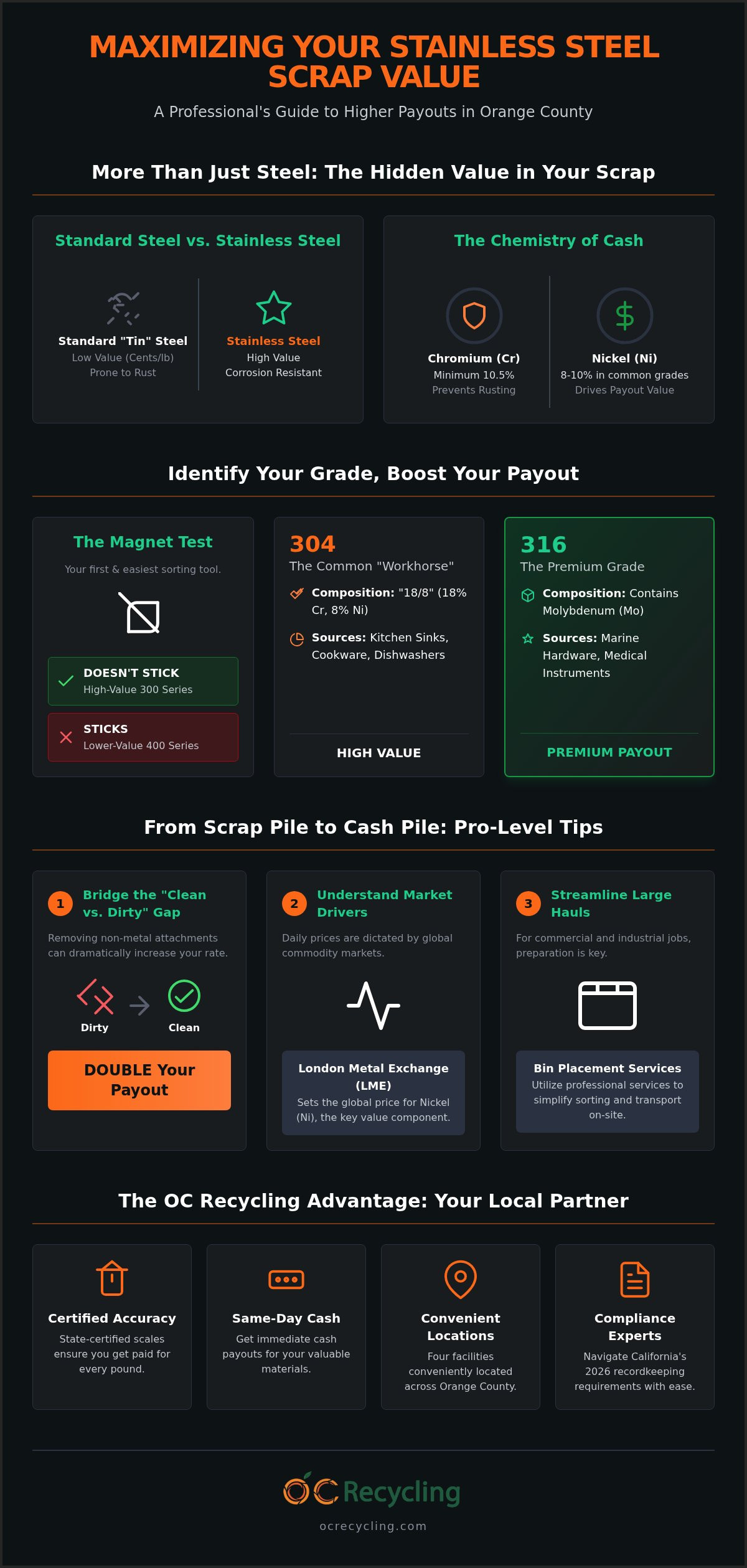
Many people assume all steel is created equal, but in the professional recycling world, stainless steel sits in a category of its own. While standard iron or “tin” scrap is often bought for just a few cents on the pound, the stainless steel scrap value is significantly higher because of the rare metals hidden within the alloy. Unlike carbon steel, which rusts when exposed to the elements, stainless steel is engineered to resist corrosion through a precise blend of chromium and nickel. Stainless steel scrap is a high-value non-ferrous commodity primarily because of its high nickel content. This chemical makeup is also why most high-grade stainless scrap is non-magnetic, a key indicator that professional buyers look for during the sorting process.
The Chemistry of Cash: Chromium and Nickel
To be classified as stainless, the metal must contain a minimum of 10.5% chromium. This element creates a thin, invisible layer of oxide that prevents rusting. However, the real cash element for recyclers is nickel. Most common scrap belongs to the category of austenitic stainless steel, which typically contains 8% to 10% nickel. Because nickel is an expensive global commodity traded on the London Metal Exchange, its presence instantly elevates the scrap’s worth. Choosing to recycle these alloys isn’t just financially smart; it’s environmentally responsible. Producing new stainless steel from recycled scrap requires significantly less energy and generates fewer emissions than mining and refining raw virgin ore.
Common Sources of Stainless Steel Scrap
Identifying where to find this valuable material is the first step toward a larger payout. In Orange County, scrap comes from three primary sectors:
- Residential: Look for old kitchen sinks, high-end dishwasher interiors, heavy-duty cookware, and modern patio grills.
- Industrial: This includes chemical storage tanks, commercial food processing equipment, and specialized piping from local manufacturing plants.
- Construction: Many modern builds in Santa Ana and Anaheim utilize stainless steel for architectural cladding, durable handrails, and decorative fixtures.
How to Identify Stainless Steel Grades (304 vs. 316)
Identifying the right grade is the difference between a standard payout and a premium one. While all stainless contains chromium, the concentration of other elements creates a clear value hierarchy. 316 stainless is often considered the “gold standard” due to its superior corrosion resistance and rare metal content. Meanwhile, 304 stainless, frequently referred to as “18/8” because of its 18% chromium and 8% nickel content, is the most common variety found in residential kitchens. If your material is magnetic, you’re likely dealing with the 400 series. These alloys lack the nickel content found in the 300 series, making them significantly less valuable at the scale when calculating your stainless steel scrap value.
The Magnet Test: Your First Line of Defense
Grab a basic hand magnet to begin your sorting process. If the magnet doesn’t stick at all, you’ve likely found high-value austenitic scrap. A “weak pull” or slight attraction often indicates a lower-grade alloy or a piece that’s been cold-worked during manufacturing. According to the American Iron and Steel Institute, steel is one of the most recycled materials on the planet, and sorting it correctly ensures these resources return to the supply chain efficiently. Occasionally, high-quality stainless can become slightly magnetic after being bent or machined, so look for other visual cues if you’re unsure about the pull.
Identifying 316 Stainless in Marine and Medical Scrap
In coastal areas like Newport Beach or Huntington Beach, 316 stainless is incredibly common. It’s the preferred choice for marine hardware and medical instruments because it contains molybdenum. This specific element boosts the stainless steel scrap value by providing extra protection against salt and chemicals. Look for industrial stamps like “S31600,” “316,” or “CF8M” on valves, fittings, and surgical tools. If you find these markings, keep those pieces separate from your 304 pile to ensure you’re paid for the premium alloy content.
For industrial materials without clear stamps, you can perform a spark test using a hand grinder. High-value 300-series stainless produces short, reddish sparks that don’t carry far from the wheel. In contrast, the 400-series produces longer, yellowish-orange sparks similar to carbon steel. Once you’ve sorted your haul, bringing it to a professional facility like OC Recycling ensures your efforts are rewarded with accurate grading and transparent weights. Taking five minutes to categorize your metal by grade is the most effective way to protect your profit margin.
Market Drivers: Why Stainless Steel Prices Fluctuate in 2026
The “Nickel Premium” Explained
Scrap yards don’t just guess at a price. They calculate a “melt value” based on the specific percentage of precious alloys within your metal. Since 300-series stainless relies heavily on nickel, its price moves in lockstep with LME nickel trading. In contrast, the 400-series lacks significant nickel content, so its value tracks more closely with the price of iron. If you monitor 2026 market trends, you’ll notice that even a small percentage shift in nickel can significantly impact your total stainless steel scrap value. Savvy sellers watch these indicators to time their visit to OC Recycling. This ensures they drop off their haul when the “nickel premium” is at its peak.
Local Economic Factors in Orange County
Global trends set the baseline, but local demand determines the final payout. Orange County’s robust manufacturing hubs in Irvine and Anaheim create a constant need for high-quality secondary raw materials for local fabrication. Our proximity to the Ports of Long Beach and Los Angeles plays a crucial role too. When export demand is high, local scrap becomes more valuable to processors looking to fill shipping containers for international transit.
Regional factors like Southern California fuel costs also influence the bottom line. Rising transport and processing fees can eat into margins; this is why local yards often offer better rates than national chains. A local leader like OC Recycling understands these regional market nuances. We maintain lower overhead through efficient, community-focused operations. This allows us to provide more competitive pricing and the convenience of same-day cash payouts that national corporations often struggle to match. It’s about providing a transparent, modern service that values your time as much as your metal.
Securing the best stainless steel scrap value requires more than just showing up at the yard; it demands a strategic approach to preparation. The single most effective way to increase your payout is by understanding the “Clean vs. Dirty” price gap. A “clean” load consists of pure stainless steel with no attachments. If your material still has plastic handles, rubber gaskets, or wood trim, it’s classified as “dirty” and carries a much lower rate. Taking five minutes to strip these contaminants can often double your per-pound payout, making your hourly return on labor incredibly high.
Removing Non-Metal Attachments
You don’t need an industrial workshop to prepare your haul. A basic toolkit including a screwdriver, pliers, and a reciprocating saw is usually enough to de-contaminate most residential and commercial items. Be particularly vigilant for “heavy” contaminants that add weight but lower the grade, such as lead weights in marine hardware or concrete-filled structural pipes. You should also watch for “irony” stainless, which is stainless steel permanently attached to regular carbon steel. If you can’t separate the two, keep these pieces in a separate pile so they don’t downgrade your entire load of clean austenitic scrap.
Optimizing for the Scale
Efficiency at the scale saves you time and ensures you’re paid correctly for every ounce. Never mix your metals. It’s vital to separate your scrap copper prices Santa Ana materials from your stainless steel to avoid confusion during the weighing process. Pack your vehicle logically by grouping similar grades together. If you have a mixture of 304 and 316, use separate bins or boxes so the weighmaster can process them as distinct transactions. Routine drop-offs are also better than hoarding; holding onto metal for too long increases the risk of being caught in a sudden market dip.
For large-scale renovation or demolition projects, hauling individual loads is often inefficient. If you’re managing a significant volume of metal, consider professional help to streamline the process. You can request commercial bin placement from OC Recycling to have a dedicated container delivered directly to your job site, ensuring your high-value scrap is organized and ready for transport without the extra labor of multiple trips.
Where to Sell Stainless Steel in Orange County: The OC Recycling Advantage
Choosing the right facility is the final step in securing the best stainless steel scrap value for your efforts. Many yards operate in the shadows of industrial zones; however, we’ve built a reputation as the premier choice for Southern California residents and commercial partners. With four convenient facilities across Santa Ana, Anaheim, Costa Mesa, and Huntington Beach, professional recycling is never more than a short drive away. We’ve spent 15 years refining a process that prioritizes your time and ensures you walk away with the highest possible payout. If you’re still researching where to sell metal in Orange County and want a comprehensive overview of your options under the latest 2026 regulations, our dedicated guide covers everything from CRV redemption to large commercial hauls.
Transparency is the cornerstone of our operations. Every one of our facilities features state-certified scales equipped with clear digital readouts. You won’t have to guess about your weights or worry about hidden deductions. Because we understand that cash flow is vital for both homeowners and businesses, we offer same-day cash payouts. Waiting for a check in the mail is a thing of the past here. You bring the metal, we weigh it with precision, and you leave with money in your pocket immediately.
A Modern, Professional Recycling Experience
We’ve intentionally moved away from the gritty feel of traditional scrap yards to provide a clean, organized, and safe environment. Our expert staff is trained to handle everything from a single kitchen sink to complex industrial hauls. They can help you identify specific grades on the spot, ensuring your 316 marine hardware isn’t accidentally mixed with lower-grade materials. This commitment to professional standards is why we’ve remained a staple of the Santa Ana community for over a decade and a half. We treat every visitor as a valued partner, providing the peace of mind that comes from working with a fully licensed and compliant leader.
Beyond Stainless: Your One-Stop Orange County Shop
Efficiency is about more than just a fast scale; it’s about handling all your recycling needs in a single visit. You can combine your stainless haul with CRV bottle recycle near me redemption, electronics recycling, or even specialized commercial services like certified product destruction Anaheim. This comprehensive approach is ideal for local manufacturers and demolition contractors who need to protect their brand liability while clearing out excess inventory. If you’re managing a large industrial project, we also offer professional bin placement to keep your site organized from start to finish. Visit an OC Recycling location today for a fair, fast payout and see why we are the trusted leader in Orange County recycling.
Secure Your Maximum Payout Today
You now possess the professional knowledge needed to identify high-grade alloys and prepare your haul for the highest possible return. By accurately distinguishing between 304 and 316 grades and stripping away non-metal contaminants, you ensure that the stainless steel scrap value you receive reflects the true market worth of your materials. These small steps in preparation translate directly into more money in your pocket at the scale.
At OC Recycling, we make the final step of your recycling journey effortless, secure, and transparent. With four convenient locations across Orange County and state-certified scales for 100% accuracy, you’ll never have to worry about being underpaid. We take great pride in our 15-year history of serving the local community with modern, organized facilities and reliable same-day cash payouts. It’s time to turn your cluttered job site or garage into immediate revenue.
Get Today’s Top Scrap Payout at OC Recycling and experience the professional difference of working with a trusted industry leader. Your next successful haul is just a short drive away, and we’re ready to help you maximize every pound.
Frequently Asked Questions
Is all stainless steel non-magnetic?
No, only certain grades of stainless steel are non-magnetic. Austenitic steels like the 300 series are typically non-magnetic; however, ferritic and martensitic alloys like the 400 series contain a high percentage of iron and will stick to a magnet. It’s also possible for high-grade stainless to develop a slight magnetic pull if it’s been cold-worked or bent during manufacturing. Always use a magnet as a starting point for sorting your pile.
What is the most valuable grade of stainless steel scrap?
Grade 316 is generally the most valuable common variety because it contains molybdenum for superior corrosion resistance. Specialty aerospace or medical alloys like 17-4 PH can command even higher rates due to their complex chemical composition. The stainless steel scrap value for these premium grades is driven by high nickel content. Keeping these separated from your standard 304 loads ensures you capture the maximum possible payout at the scale.
How can I tell the difference between aluminum and stainless steel?
You can distinguish between the two by checking their weight and performing a simple spark test. Stainless steel is much heavier and denser than aluminum; it also produces short, reddish sparks when touched with a grinder. Aluminum is lightweight and won’t produce any sparks at all. Additionally, stainless steel often has a slightly more polished or “blue” tint compared to the duller, silver-white appearance of raw aluminum surfaces.
Do I need to clean my stainless steel before bringing it to OC Recycling?
You aren’t required to clean it, but doing so significantly increases your payout. “Clean” stainless is free from plastic, rubber, wood, and non-metal attachments. If these items remain, your haul is classified as “dirty” scrap, which carries a lower price to account for the weight of the contaminants. Taking a few minutes to remove handles or gaskets transforms your material into a premium commodity that’s ready for immediate payout at our facilities.
Why is the price of stainless steel scrap lower than copper?
The price difference is primarily due to the scarcity and purity of the base metals. Copper is a pure element that’s expensive to mine and refine; it’s essential for electrical infrastructure. In contrast, stainless steel is an iron-based alloy. While it contains valuable nickel and chromium, the bulk is still iron, which is abundant. This makes the stainless steel scrap value lower than copper but still significantly higher than regular steel.
Can I recycle stainless steel appliances like dishwashers?
Yes, you can recycle stainless steel appliances, but you should verify which parts are actually high-grade metal. Many modern dishwashers have stainless steel tubs but plastic exteriors or painted steel frames. You should remove any motors, pumps, and heavy plastic components before arriving. Bringing only the clean stainless steel shells ensures you get a premium rate rather than receiving a lower “mixed appliance” price for the entire unit.
What documents do I need to sell scrap metal in California?
Under California’s 2026 regulations, you must provide a valid, government-issued photo ID like a driver’s license or passport. Recyclers are now required to record your legal name, date of birth, and residence address for every transaction to comply with enhanced anti-theft standards. These records help maintain industry transparency and protect the community. Our team handles this documentation quickly to ensure your visit remains efficient while meeting all state-mandated compliance requirements.
How often do stainless steel scrap prices change?
Prices can change daily or weekly depending on the volatility of the London Metal Exchange. Factors like global nickel supply, international trade policies, and regional manufacturing demand all influence the current rate. We monitor these market shifts constantly to provide our customers with the most competitive and transparent pricing possible. If you have a large load, it’s smart to call ahead and check the current status before your visit.
