
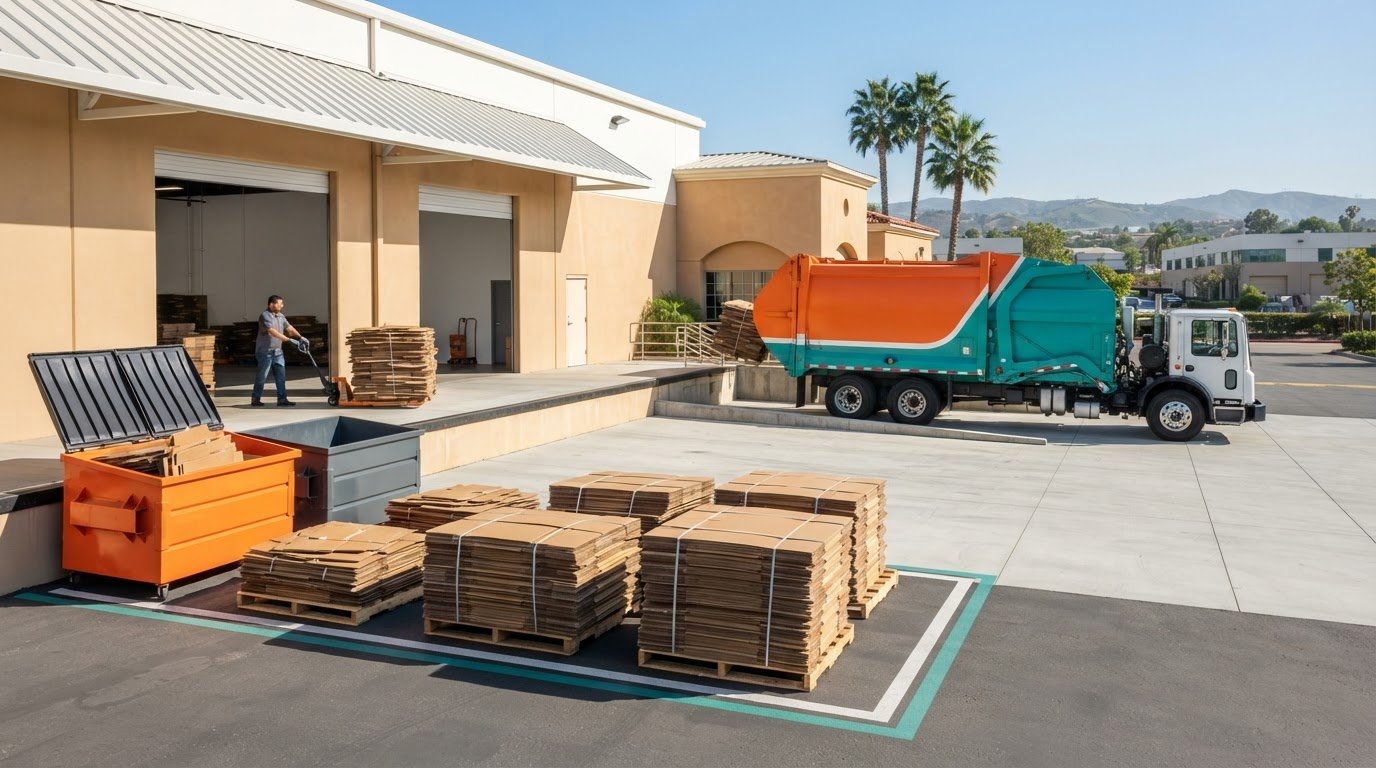
A cardboard pile becomes a space problem before it becomes a recycling problem. For Orange businesses, cartons can quickly crowd a stockroom, loading area, or warehouse. Setting up commercial cardboard recycling Orange businesses can rely on means planning more than collection: staff need clear sorting steps, and flattened boxes need a practical place to go before they take over valuable space.
A useful routine should be straightforward for your team and suited to the way your site operates. This guide explains how to prepare cardboard, organize sorting and staging, and plan logistics around your business’s material flow and available space.
OC Recycling provides commercial cardboard and paper recycling, bin placement, and hauling management for businesses in Orange and across Orange County. A clear handling plan, combined with practical site logistics, can help cardboard recycling fit into day-to-day operations.
Key Takeaways
- Build commercial cardboard recycling Orange around your business’s cardboard volume, staging space, and site layout.
- Understand the basic path from separating cardboard at your site to collection, sorting, and material recovery.
- Choose an internal staging and collection approach that fits your space and the amount of staff handling required.
- Give staff simple preparation steps: separate cardboard, keep it dry, and remove obvious non-cardboard packing materials where practical.
- OC Recycling’s commercial cardboard and paper recycling, bin placement, and hauling management can support a site-specific routine.
Why Commercial Cardboard Recycling Matters for Orange, California Businesses
Shipping cartons can arrive daily and accumulate in receiving areas, stockrooms, and warehouse aisles. When boxes compete with inventory, equipment, or clear paths for staff, cardboard is no longer a minor cleanup task. A planned recycling stream gives employees a consistent way to handle cartons and helps keep back-of-house operations orderly.
Commercial cardboard recycling is the separation of cardboard generated by a business so it can be collected and directed toward recovery and reuse. Planning that stream means identifying where cartons appear, how much temporary storage the site can spare, and how material will move out. That differs from household curbside recycling, which is organized around residential collection rather than a workplace’s receiving volume, staff routines, and site layout.
For Orange businesses, a dedicated approach to commercial cardboard recycling Orange can make material handling clearer and reduce recyclable cardboard mixed into general waste. It can also ease disposal pressure and keep shared work areas tidier. The practical goal is a routine staff can follow, not another pile that simply moves from one corner to another.
What Counts as Commercial Cardboard Recycling?
Corrugated cardboard, commonly used for shipping cartons, has two flat outer layers with a wavy, fluted layer between them. This construction gives boxes strength while keeping them relatively lightweight. For a general overview of cardboard types and uses, see What is Cardboard?
In a workplace, corrugated cartons from deliveries are distinct from mixed office paper such as documents and printer paper. Both are paper-based materials, but they often come from different work areas and are handled as separate streams. Common cardboard sources include shipping and receiving docks, stockrooms, ecommerce packing stations, and product packaging areas.
Why Orange Businesses Need a Dedicated Cardboard Plan
Cardboard volume often follows the pace of deliveries. A busy receiving day can fill a small staging area quickly, while flattened boxes still need a designated place that doesn’t block work. Without clear instructions, employees may leave cartons wherever space opens up or mix them with other waste, making later handling less efficient.
A consistent stream connects receiving, storage, and removal in one straightforward workflow. Staff know where cartons belong, managers can keep staging areas organized, and the business can plan recycling logistics around its material flow. The result is a more predictable routine suited to the demands of a commercial site.
How Commercial Cardboard Moves from an Orange Business to Recycling
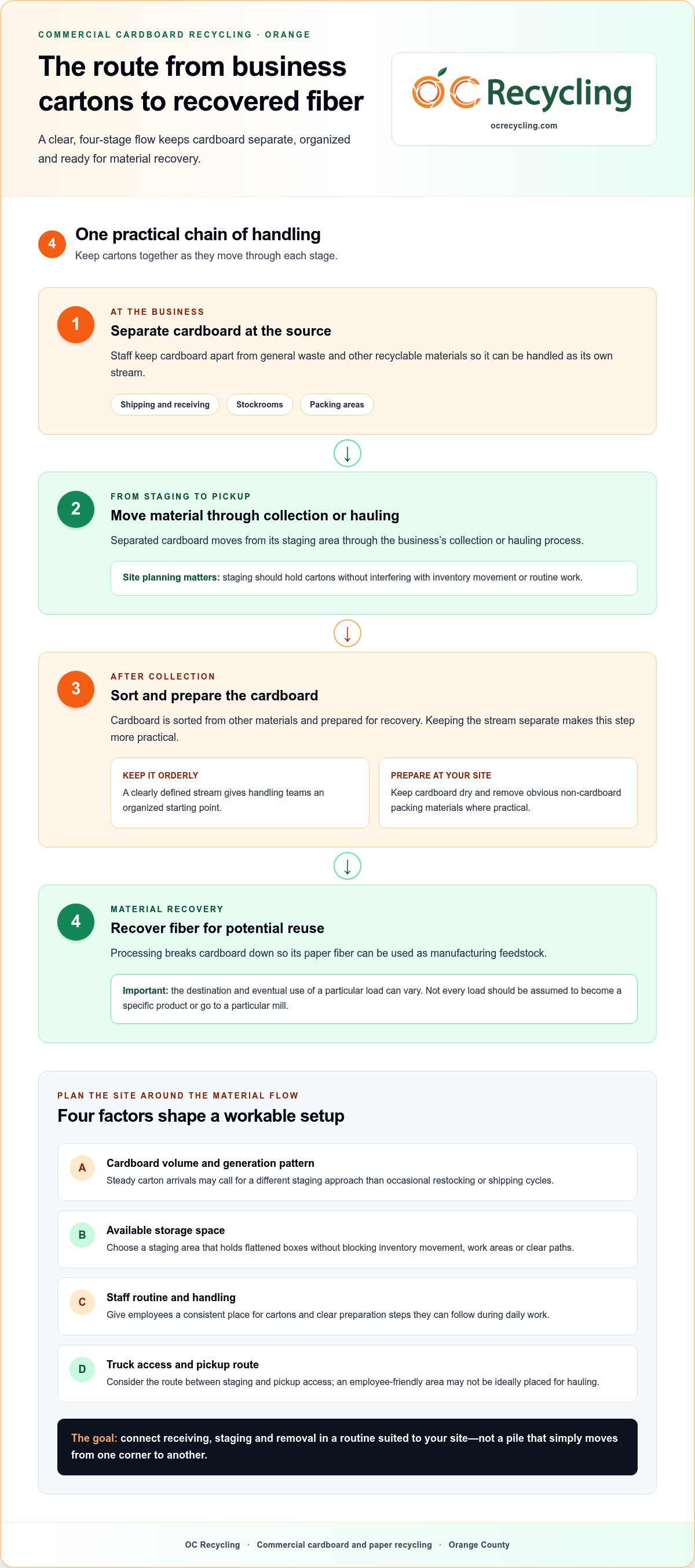
Once a business separates cardboard, the material follows a practical chain of handling. The collection and hauling arrangement depends on the site setup, but the general sequence is straightforward:
- Separation at the business: Staff keep cardboard apart from general waste and other recyclable materials so it can be handled as its own stream.
- Collection or hauling: The separated material moves from its staging area through the business’s collection or hauling process.
- Sorting and preparation: Cardboard is sorted and prepared for material recovery. Keeping it separate from mixed waste makes this step more practical.
- Fiber recovery: Recovered cardboard fiber can be used as manufacturing feedstock, though the destination and use of a particular load can vary.
In short, commercial cardboard recycling moves separated material from a business through collection, sorting, and preparation so its fiber can be recovered for potential reuse. That journey is easier to manage when cartons stay together rather than being mixed with unrelated waste. Mixed material can require extra handling to separate, while a clearly defined stream gives staff and hauling teams an organized starting point.
From Separated Cardboard to a Usable Fiber Stream
After collection, cardboard may be sorted to distinguish it from other materials and prepared for recovery. At a high level, processing breaks the material down so its paper fiber can be used as manufacturing feedstock. Processing steps and eventual use depend on the material and downstream handling. Businesses can support the process by keeping their stream orderly, without assuming every load becomes a specific product or goes to a particular mill.
What Affects Commercial Cardboard Handling?
Logistics should reflect how cardboard is generated and how the site functions. A business that receives cartons steadily may need a different staging approach from one that produces most of its cardboard during occasional restocking or shipping cycles. Available space matters too: staging should hold material without interfering with inventory movement or routine work.
Truck access is another planning factor. A staging area that’s easy for employees to use may be poorly placed for hauling, so consider the route between storage and pickup access. These details shape a workable site plan for commercial cardboard recycling Orange without relying on a standard collection frequency, container size, or turnaround time.
Review cardboard volume, generation patterns, storage space, and site access together to identify a practical arrangement. OC Recycling provides commercial cardboard and paper recycling, commercial bin placement, and hauling management. Explore commercial cardboard and paper recycling as part of your planning.
Commercial Cardboard Recycling Options: Match the Setup to Your Orange Site
There isn’t one commercial recycling setup that fits every Orange business. A retailer with steady deliveries and a tight stockroom faces different constraints from a warehouse with room to stage larger quantities. Start with two practical questions: how quickly does cardboard build up, and where can your team keep it without disrupting work? The answers help determine whether internal staging is workable or commercial bin placement and hauling support better fit the site.
Use this comparison to identify which approach aligns with your business. It’s a planning guide, not a ranking: the right arrangement depends on cardboard flow, staff routines, and available space.
| Planning factor | Internal staging | Commercial bin placement and hauling |
|---|---|---|
| Best fit | Sites with manageable cardboard volume and a suitable staging area. | Businesses with larger or recurring material streams that need a dedicated site setup. |
| Space needs | Requires a defined indoor or outdoor area that won’t obstruct daily operations. | Requires an appropriate footprint for bin placement and practical access at the site. |
| Staff handling | Employees gather and stage cartons as part of their work routine. | Staff still separate material, while the bin and hauling arrangement supports site handling. |
| Logistics considerations | Consider how material moves from work areas to staging and how it will be handled later. | Plan placement around material volume, access, and the site’s layout. |
Decision rule: Match the service approach to the cardboard your site generates and the space it can dedicate to staging.
When On-Site Staging Can Work
Internal staging can suit a business with a clear, accessible area where cartons won’t interfere with receiving, inventory, or employee movement. Assign responsibility so staff know where cardboard belongs and who keeps the staging area orderly. This approach depends on the space staying usable as material builds up, not on assuming a particular collection schedule.
When Commercial Bin Placement Can Help
A dedicated commercial bin setup can help when cardboard is generated regularly or internal staging alone doesn’t work well for the site. Plan placement around the available footprint, vehicle access, and the amount of material moving through the business. OC Recycling provides commercial bin placement and hauling management alongside cardboard and paper recycling for commercial accounts in Orange County, including Orange.
For commercial cardboard recycling Orange businesses can plan around their own material flow, OC Recycling brings local experience serving Orange County. Consider how cardboard volume and site capacity fit together, then explore commercial bin placement and hauling support.
Prepare Cardboard for Recycling at Your Orange Business
A clear preparation routine helps staff handle cardboard consistently and prevents it becoming a mixed, hard-to-manage pile. Keep instructions simple and visible near the collection point. The goal is to separate cardboard, keep it dry, and make it easier to stage for your business’s recycling arrangement.
Use this staff-friendly sequence:
- Separate cardboard at the source. Place shipping cartons and other cardboard in the designated area instead of mixing them with general waste or other recycling streams.
- Remove loose packing materials. Take out obvious non-cardboard items, such as foam inserts or bubble wrap, where practical. Keep those materials out of the cardboard stream.
- Check that cardboard is dry. Store it where it’s protected from moisture as much as the site allows. Damp material can be harder to handle and keep orderly.
- Flatten boxes when safe and feasible. Breaking down empty cartons reduces the space they take up and makes the stack easier to organize. Don’t force a box flat if doing so creates a handling risk.
- Place prepared material in the designated spot. Keep the area accessible for staff and consistent with the site’s recycling setup.
Keep guidance focused on these basic steps rather than assuming every commercial program handles all materials the same way. Clear separation and a tidy staging area make the stream easier for employees to manage.
Set Up a Clear Cardboard Collection Point
Choose a spot staff can reach as cartons come off the receiving dock or packing area, without blocking walkways, workstations, or routine movement. Mark it clearly so employees can distinguish cardboard from trash and other recyclable materials at a glance. Consider access and safe handling: stacks should be organized so staff can place and retrieve cartons without creating an obstruction.
The collection point should fit the rhythm of the workplace. A location that’s convenient during deliveries but gets in the way of daily operations won’t support a dependable routine. Make the designated area easy to recognize and keep it orderly as material accumulates.
Create a Repeatable Staff Routine
Assign responsibility for breaking down boxes and maintaining the collection area. A simple checklist posted nearby can make expectations clear for new and existing staff:
- Keep cardboard separate from trash and other recycling.
- Remove obvious non-cardboard packing materials where practical.
- Keep cardboard dry and flatten boxes when safe and feasible.
- Leave the staging area organized and accessible.
Consistent preparation supports a practical commercial cardboard recycling Orange routine. Commercial bin placement and hauling management can complement that routine by supporting your site and material flow. Plan commercial cardboard recycling for your Orange business with OC Recycling.
Arrange Commercial Cardboard Recycling in Orange with OC Recycling
Once your team has a clear way to separate and stage cartons, arrange a commercial solution that fits the site. OC Recycling provides cardboard and paper recycling for commercial accounts across Orange County, including businesses in Orange. Commercial bin placement and hauling management bring material handling and site logistics into the same plan.
A business’s cardboard stream is shaped by more than total volume. Receiving patterns, available staging space, staff movement, and vehicle access all affect how material can be managed. A workable plan takes those details into account rather than relying on a generic setup.
A Local Commercial Recycling Partner for Orange County
OC Recycling is a locally rooted recycling company serving commercial accounts across Orange County and the wider Southern California area. The company has operated in Orange County for more than 15 years and has four locations across the county. Businesses in Orange can work with a local company on a commercial cardboard recycling routine suited to their site.
OC Recycling’s commercial cardboard and paper recycling can be paired with commercial bin placement and hauling management. This helps businesses plan where cardboard is staged and how its movement fits into site operations. The goal is a practical arrangement shaped around the business, not a one-size-fits-all prescription.
Plan a Cardboard Solution Around Your Business
Before arranging service, gather a few useful details about your operation. You don’t need a complicated audit to start. A clear picture of how cardboard appears and where it can be staged gives the planning process a practical foundation.
- Estimate material flow: Note the main sources of cardboard, such as deliveries, stock replenishment, or packing activity, and whether material accumulates steadily or in bursts.
- Review site space: Identify a staging area that keeps material organized without obstructing work, inventory movement, or access around the property.
- Plan logistics: Consider how cartons will move from the point where they’re generated to the staging area, and how site access affects commercial bin placement and hauling.
These details help OC Recycling plan commercial bin placement and hauling management around your project and site logistics. The arrangement can account for material flow and available space without assuming a standard schedule or setup. Clear preparation also helps staff understand how the recycling routine fits into daily work.
Ready to put a practical plan in place? Share your cardboard needs and site considerations with OC Recycling to discuss a commercial approach for your business in Orange.
Contact OC Recycling about commercial cardboard recycling
Turn Your Cardboard Plan into a Practical Routine
A well-planned recycling routine should work with the pace of your business, not interrupt it. Decide how cardboard will move through your site, who will oversee the process, and what kind of support fits your operation. These choices can turn commercial cardboard recycling Orange businesses need into a clear, manageable part of daily work.
OC Recycling offers commercial cardboard and paper recycling with bin-placement support, helping businesses plan logistics around their project and site. Bring a simple picture of your cardboard flow and available space to the conversation to explore an approach that suits your operation.
Contact OC Recycling about commercial cardboard recycling to take the next step toward a more organized workplace routine. A thoughtful plan can make cardboard easier to manage and help your team keep valuable work areas clear.
Frequently Asked Questions
Is commercial cardboard recycling different from residential recycling?
Yes. The cardboard may be similar, but businesses often need to plan around recurring deliveries, workplace storage, and how material moves through the property. A household collection calendar isn’t automatically suited to a receiving dock or stockroom. Commercial cardboard recycling can be planned around each business’s operations in Santa Ana, Anaheim, Costa Mesa, Huntington Beach, Orange, Irvine, Garden Grove, Westminster, Fountain Valley, and Tustin.
Can businesses recycle cardboard and office paper together?
Sometimes, but don’t assume they belong in the same container. Corrugated shipping boxes and office paper can be handled as separate material grades, depending on the recycling arrangement. For example, cartons may come from a warehouse while printer paper comes from offices on another floor. Clear labels at each collection point help staff sort correctly. Follow the material instructions for the specific commercial setup.
Can wet cardboard be recycled?
It depends on the cardboard’s condition and the recycling arrangement. A box exposed to a small splash is different from one that is soaked, breaking apart, or visibly contaminated. Keep staged cartons away from rain and leaking areas where practical. If a piece is badly deteriorated, separate it from clean material instead of automatically placing it with the main cardboard stack.
Is cardboard with tape still recyclable?
A shipping box with some attached packing tape may still be manageable, but avoid adding tape and other non-cardboard materials unnecessarily. Remove loose tape, plastic wrap, or foam if practical; there’s no need to spend excessive time stripping every carton. For example, staff can remove a large plastic sleeve before flattening a box. Specific acceptance instructions depend on the commercial recycling arrangement.
Do businesses need to flatten cardboard boxes before recycling them?
Flattening is useful when it can be done safely, but the best routine depends on the space and work involved. A small retail team may flatten boxes as it unpacks deliveries, while a site handling bulky cartons may need a designated process to prevent clutter. Staff should avoid using equipment or handling methods they aren’t trained for. A consistent approach can make staging easier without creating a safety issue.
How much does commercial cardboard recycling cost in Orange, California?
There isn’t one price that applies to every business. Service costs can depend on the amount of cardboard, site layout, handling needs, and logistics involved. To make planning more useful, note the main sources of cartons, how quickly material accumulates, where it could be staged, and any access constraints. This gives the commercial recycling plan a practical starting point without assuming a standard charge.
What happens to cardboard after a recycling company collects it?
After collection, commercial cardboard is generally consolidated and sorted, then prepared as fiber material for further processing. The route and eventual use can vary with the load and downstream market, so a business shouldn’t assume its cartons will become a particular item or go to a named facility. Keeping cartons separate from unrelated waste can make the material stream more straightforward to handle after it leaves the site.
