
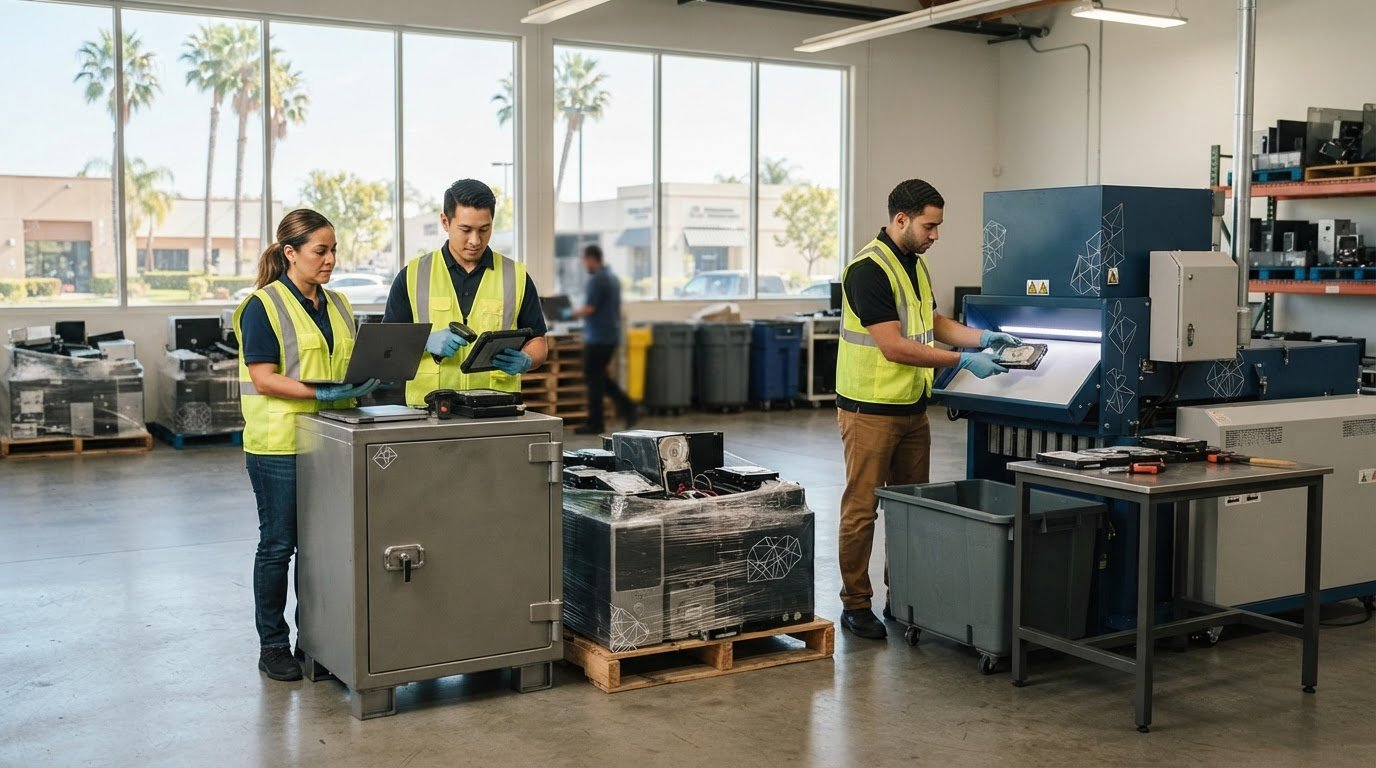
Deleting files from a retired laptop doesn’t prove its data is gone. For businesses seeking certified data destruction Westminster, confidence comes from understanding how devices are handled and what documentation confirms the work, not simply from a vendor’s use of the word “certified.”
It’s reasonable to ask whether deleted information could be recovered and whether a provider’s certification claim covers the process you need. This guide explains what certified data destruction does and doesn’t mean, and outlines practical questions to ask about media-specific methods, custody procedures, and certificates of destruction. You’ll also find steps for preparing devices and records before arranging service.
Data security and electronics recycling are related decisions, but recycling alone doesn’t explain how information is handled first. OC Recycling offers commercial data destruction alongside electronics recycling and serves Westminster and other Orange County communities, including Santa Ana, Anaheim, Costa Mesa, Huntington Beach, Orange, Irvine, Garden Grove, Fountain Valley, and Tustin. For commercial destruction services, the company provides certificates of destruction. Confirm the available methods for your devices, what the certificate documents, and whether the service arrangements fit your location and needs.
Key Takeaways
- Learn how certified data destruction Westminster differs from ordinary file deletion and what to clarify about a provider’s process.
- Match the destruction or sanitization approach to the media type, device condition, reuse plans, and your organization’s policy.
- Compare providers by asking which devices they accept, what documentation they provide, and how they handle downstream disposition.
- Prepare for service by following provider instructions and creating an inventory that connects device identifiers with internal ownership records.
- OC Recycling offers commercial data destruction and certificates of destruction. Confirm available methods, certificate details, accepted devices, and Westminster service logistics.
Certified data destruction in Westminster, CA: what the service covers
Replacing office technology doesn’t automatically remove the information stored on it. A computer may still contain business files, employee or customer records, saved credentials, or copies left behind after routine deletion. Data remanence describes how information can persist on storage media even after users believe they have erased it. Secure end-of-life handling helps businesses address that risk before equipment moves to reuse, recycling, or another destination.
For offices, IT teams, schools, and other organizations upgrading equipment, data destruction is a distinct security step, not another name for electronics recycling. The right approach depends on what the device stores and what will happen to it next. Make the data-handling decision separately from the downstream disposition decision, then confirm how the provider connects those steps.
What does certified data destruction mean for a business?
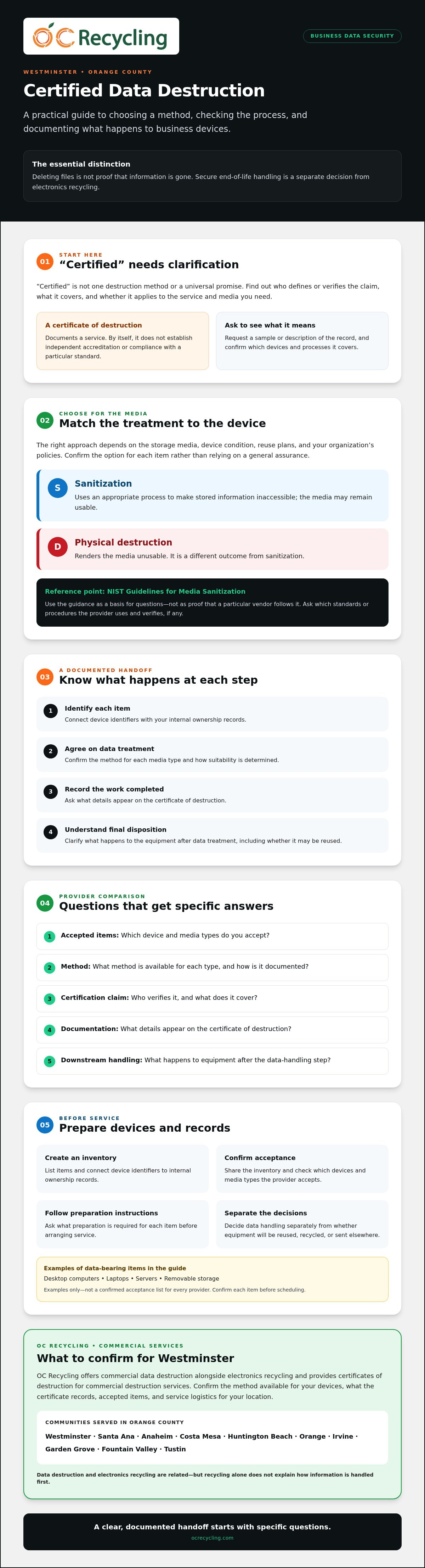
“Certified” isn’t a single destruction method or a universal promise. Ask who defines or verifies the claim, what the certification covers, and whether it applies to the service and media you need. A provider-issued certificate of destruction documents a service; by itself, it doesn’t establish independent accreditation or compliance with a particular standard. Request a sample or description of the record, and ask which devices and processes it covers.
Which devices and data-bearing items may need secure handling?
Potential examples include desktop computers, laptops, servers, and removable storage. This isn’t a confirmed list of what every provider accepts. Media type, device condition, and whether equipment may be reused can affect which destruction options are suitable. Before scheduling certified data destruction Westminster, send the provider an inventory and confirm acceptance, available methods, and preparation instructions for each type of item.
Clear answers are more useful than broad claims such as “secure” or “certified.” Ask:
- Which device and media types do you accept?
- What method is available for each type, and how is it documented?
- Who verifies any certification claim, and what does it cover?
- What details appear on the certificate of destruction?
OC Recycling offers data destruction alongside electronics recycling and provides certificates of destruction for commercial destruction services. Confirm the method available for your devices and what the certificate records. A clear, documented handoff helps your organization make an informed decision before sensitive equipment leaves its control.
How certified data destruction works: sanitization, destruction, and records
A documented service should make clear what happens to each data-bearing item from intake through final disposition. The process may include identifying devices, applying an agreed data treatment, recording the work completed, and explaining what happens to the equipment afterward. Ask the provider to describe each step for your specific media rather than relying on a general assurance that devices are handled securely.
The appropriate approach depends on the storage media, its condition, whether it may be reused, and your organization’s policies. NIST’s Guidelines for Media Sanitization provide a useful reference for discussing media sanitization. Treat the citation as a basis for questions, not proof that a particular vendor follows the guidance. Ask which standards or procedures, if any, the provider uses and verifies.
How does data sanitization differ from physical destruction?
Sanitization uses an appropriate process to make stored information inaccessible, potentially allowing the media to remain usable. Physical destruction renders the media unusable. These are different outcomes, not interchangeable descriptions. Whether reuse is possible matters to equipment disposition and your internal asset decisions. Ask which method applies to each device type, how the provider determines suitability, and whether the device can be reused afterward.
For certified data destruction Westminster, request an explanation for each device type when your inventory includes different media or conditions. Don’t assume one method suits a laptop, a server drive, and removable storage alike. Clarify how items are identified at intake and how completed work is linked to them in the provider’s records.
What should a certificate of destruction document?
OC Recycling provides certificates of destruction for commercial destruction services, but confirm the document’s contents directly with the provider. Ask whether it lists the service date, materials processed, and scope of work completed. Find out whether it identifies individual items or summarizes a batch, and how it records exceptions or items not processed.
Keep the certificate with your asset inventory and disposition records so your organization can connect the documented service to the equipment it retired. A clear record supports internal review, but it doesn’t replace understanding the method, scope, or handoff. Before arranging service, confirm accepted devices, available methods, documentation details, and Westminster logistics. You can review OC Recycling’s data destruction information as a starting point for those questions.
Compare certified data destruction providers serving Westminster
When comparing providers for certified data destruction Westminster, focus on process details rather than words such as “secure,” “certified,” or “environmentally responsible.” Ask how each device is identified from handoff through processing, what records connect the completed work to your inventory, and where the equipment goes afterward. The answers should explain both the data-security step and downstream disposition. Recycling alone doesn’t prove data was destroyed.
| What to compare | Questions to ask | What a useful answer clarifies |
|---|---|---|
| Method | What method is available for each media type and condition? | How the process fits your reuse plans and internal policy. |
| Accepted media | Which devices and storage media do you accept? | Whether your full inventory is eligible, including damaged or unsupported items. |
| Documentation | What does the certificate or service record include? | How the completed scope and processed materials are recorded. |
| Service area and logistics | Can you serve our Westminster site, and what handoff options are available? | Whether service arrangements fit your location, volume, and schedule. |
| Downstream disposition | What happens to equipment after data handling? | Whether items are reused, recycled, or otherwise directed, and how that is explained. |
Which questions reveal a provider’s actual process?
Ask the provider to walk through the steps from device handoff to completed work and final disposition. Find out which staff or outside partners handle devices, how items are identified or tracked, and what records you’ll receive. Don’t assume a particular custody procedure is included. Request written instructions for exceptions, such as damaged media, items the provider can’t process, or differences between the inventory and delivered devices.
How can businesses assess certifications and compliance claims?
Ask who issued a claimed certification, what activities and locations its current scope covers, and what evidence the provider can share. NIST SP 800-88 and NAID AAA can be useful reference points for questions, but don’t assume either is a requirement or that a provider follows them. Confirm claims directly. The FTC Disposal Rule explains disposal requirements for consumer report information covered by the rule. Consult your compliance staff or legal counsel about obligations specific to your organization.
Before choosing a provider, confirm that its methods, accepted media, documentation, and Westminster service logistics fit your needs. Specific written answers make it easier to compare options and plan electronics recycling after data handling is complete.
Prepare devices and records for data destruction in Orange County
A clear inventory and confirmed handoff plan help your team protect sensitive information and reconcile devices afterward. Before arranging certified data destruction in Westminster, check the provider’s instructions, confirm which materials it accepts, and verify whether it can accommodate your location. Don’t transport equipment until you understand the available pickup or drop-off options and any handling requirements.
What should an organization do before handing over devices?
Use this preparation sequence, adjusting it to the provider’s directions and your organization’s retention and approval policies:
- Approve the disposition. Confirm that records, files, and other information aren’t subject to an internal retention hold or approval process before equipment is released.
- Build an asset inventory. Record identifiers such as asset tags, serial numbers where available, device type, and internal owner or department. Keep a copy for your own records.
- Flag special items. Identify removable media, damaged equipment, and devices with sensitive information or special handling requirements. Ask the provider how to prepare these items.
- Confirm scope and logistics. Check which materials are accepted, what service options are available for your site, and how the provider wants items organized for handoff.
- Follow specific instructions. Don’t remove components or attempt erasure unless your policy or the provider directs you to do so. Changes can affect processing or make inventory matching harder.
For mixed batches, label items so they match your inventory, and ask how the provider will handle anything that doesn’t match the submitted list. Resolve questions about damaged or unsupported media before the equipment leaves your control.
How should teams manage the service record after destruction?
After service, compare the certificate of destruction and any accompanying records against the submitted inventory. Check for discrepancies, missing items, or exceptions, and ask the provider to clarify them. Certificate contents vary, so confirm in advance what information will be documented. Keep the final records according to your organization’s retention and audit practices.
Data destruction and electronics recycling are connected but distinct steps. Confirm separately what happens to equipment after data handling, including whether reusable materials and electronic waste are directed to appropriate downstream disposition. Keep that information with the service record so your organization can document the equipment’s full lifecycle.
OC Recycling offers commercial data destruction and certificates of destruction. Before scheduling, confirm accepted devices, preparation instructions, service options, and whether arrangements fit your Westminster site. Discuss commercial data destruction with OC Recycling to clarify next steps for your equipment and records.
Arrange certified data destruction in Westminster with OC Recycling
OC Recycling serves commercial customers across Orange County with data destruction and electronics recycling. For commercial destruction services, the company provides certificates of destruction. Its more than 15 years of local operation offers Westminster businesses a local option, while the right service arrangement still depends on your devices, documentation needs, and site logistics.
Before arranging certified data destruction Westminster, share a basic inventory and confirm the service details directly. Ask:
- Which device and media types can the service accept, and are there volume limits or other requirements?
- What destruction methods are currently available for each type of media?
- What information will the certificate of destruction include, and how will the completed work be documented?
- Can OC Recycling serve your Westminster location, and what collection or drop-off arrangements and scheduling requirements apply?
- How will data destruction connect with electronics recycling for this particular batch of equipment?
These questions clarify two related but distinct steps. Data destruction addresses information stored on devices. Electronics recycling concerns the equipment’s downstream disposition after data handling. Confirm how the provider handles each step for your items, and ask what happens if a device is damaged, unsupported, or outside the agreed scope. This gives your team a clearer basis for coordinating the handoff and matching service records to your asset inventory.
When is product destruction a separate requirement?
Data destruction focuses on information stored on media; it doesn’t necessarily address branded or proprietary physical products. If your organization also needs those items destroyed, ask about that requirement separately. OC Recycling offers certified product destruction, a different service from data destruction. Learn more about its certified product destruction service in Anaheim and confirm whether it fits the materials you need handled.
Prepare your device inventory, note any special handling concerns, and contact OC Recycling to discuss your commercial data destruction requirements. Confirm available methods, accepted equipment, certificate details, and Westminster service logistics so you can agree on a suitable next step.
Make your next equipment handoff clear and documented
Reliable data destruction starts with specific answers. Confirm which method suits your devices, what the service record will document, and how equipment will be handled after the data-security step. A current inventory, clear provider instructions, and a checked certificate help your team connect retired assets with their final disposition.
For businesses seeking certified data destruction Westminster, OC Recycling offers commercial data destruction and certificates of destruction. The company serves Westminster and other Orange County communities. Before arranging service, confirm accepted devices, available methods, certificate details, and logistics for your site.
Ready to discuss your organization’s requirements? Discuss your business data destruction needs with OC Recycling and clarify a suitable next step. With the right questions and records in place, your team can move forward with clearer expectations.
Frequently Asked Questions
What is certified data destruction?
Certified data destruction is a documented service for handling data stored on devices, with the provider explaining the method and records supplied. The word “certified” doesn’t identify one universal method or, by itself, prove independent accreditation. Ask who verifies any certification claim, what it covers, and what the service certificate records. For a business, the goal is a clear account of what happened to its data-bearing equipment.
Is deleting files enough before recycling a business computer?
Deleting files alone may not make the information inaccessible. Files can remain on storage media after deletion, so businesses should ask about an appropriate sanitization or destruction process before a computer is recycled or otherwise dispositioned. The suitable approach depends on the media, its condition, and whether the device may be reused. Confirm the provider’s method and documentation rather than assuming routine file deletion is sufficient.
How do data sanitization and physical destruction differ?
Data sanitization uses an appropriate process to make stored information inaccessible, and the media may remain usable afterward. Physical destruction renders the media unusable. They aren’t interchangeable promises. Ask which approach is available for each device and whether reuse is possible after processing. Your organization’s asset plans and policies can guide the decision, but confirm provider capabilities for the specific media and equipment condition before scheduling.
What should a certificate of destruction include?
Certificate contents vary, so ask the provider what its document records. Details to confirm include the service date, materials processed, and scope of work completed. Ask whether devices are identified individually or recorded as a batch, and how exceptions are documented. After service, match the certificate against your asset inventory and retain it with your organization’s disposition records according to internal audit and retention practices.
Does OC Recycling offer certified data destruction in Westminster?
Yes. OC Recycling offers commercial data destruction and provides certificates of destruction for commercial destruction services. The company serves Westminster and other Orange County communities. Before arranging service, confirm accepted devices, methods available for your media, certificate details, and the collection or drop-off arrangements and scheduling requirements for your Westminster location.
Can data destruction and electronics recycling be handled together?
They can be coordinated as related steps, but they are distinct services. Data destruction addresses information stored on devices, while electronics recycling concerns downstream equipment disposition. Ask the provider how both steps apply to your batch, which items are accepted, and what records document the work. Confirm the disposition plan separately so your team understands what happens to equipment after its data has been handled.
What should a Westminster business prepare before scheduling data destruction?
Prepare an asset inventory with device identifiers and internal ownership records, and flag removable media, damaged equipment, or items needing special handling. Check internal retention and approval requirements before releasing devices. Then confirm accepted materials, service options for your Westminster site, and provider-specific preparation instructions. Don’t remove components or attempt erasure unless your policy or provider directs you to do so. Keep the inventory for later record matching.
