
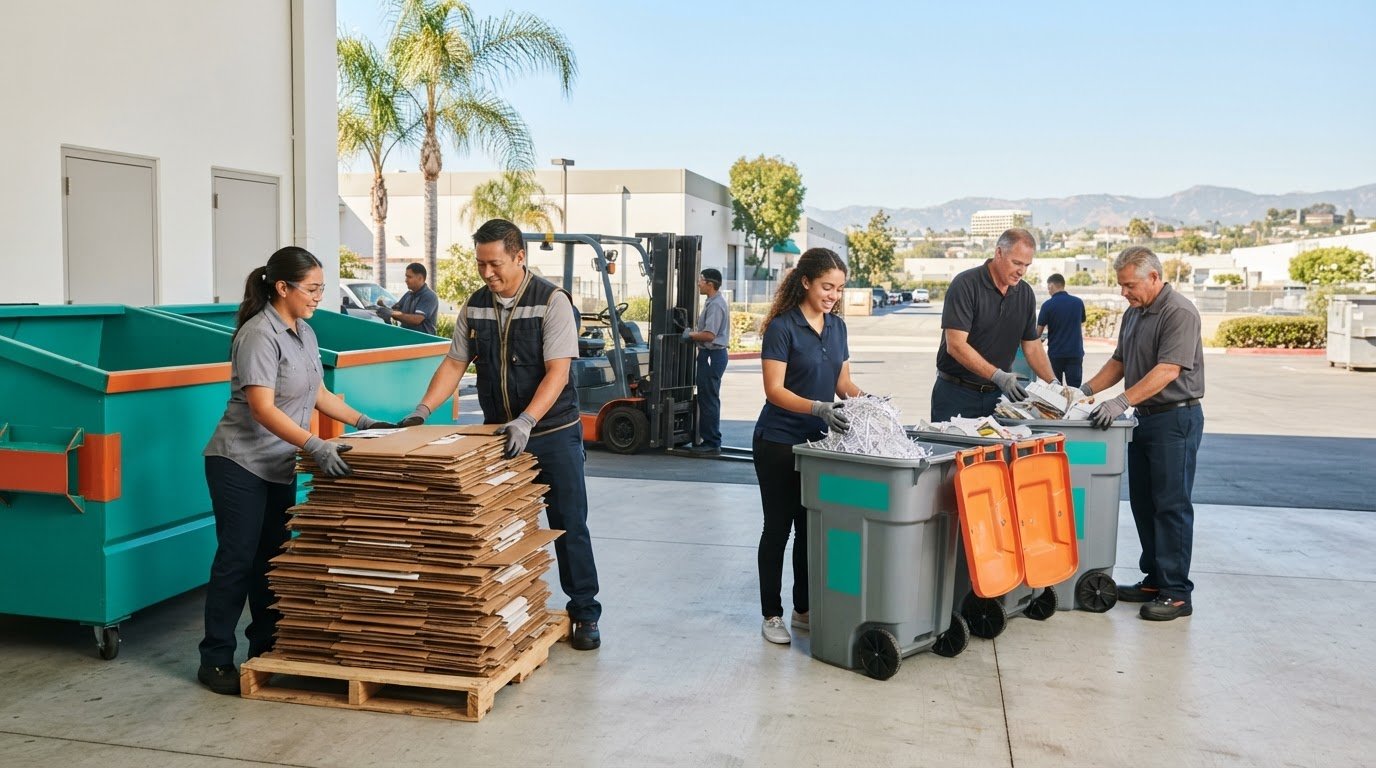
For businesses exploring commercial paper recycling Garden Grove options, boxes, office paper, and unclear sorting habits can quickly turn valuable workspace into a staging area. The answer isn’t simply adding another bin. It’s matching each material stream to a routine that fits your workplace, storage space, and the way materials move through the site.
Recycling needs to be consistent, but collection logistics also have to work with the space and volume your team manages. Start by identifying the paper and cardboard your workplace produces, then decide how employees will separate and stage those materials.
This guide explains how to organize paper and cardboard streams, compare the service and logistics considerations that shape a workable routine, and plan a next step with OC Recycling. OC Recycling provides commercial paper and cardboard recycling and commercial bin placement for businesses in Garden Grove and across Orange County, including Santa Ana, Anaheim, Costa Mesa, Huntington Beach, Orange, Irvine, Westminster, Fountain Valley, and Tustin.
Key Takeaways
- Map the paper and cardboard your workplace generates to build a recycling routine around actual material streams.
- For commercial paper recycling Garden Grove businesses should weigh site space, staging, and collection logistics together.
- Use simple sorting guidance and an orderly staging area to help employees handle paper consistently.
- Decide whether your business needs a paper recycling routine alone or one that also handles cardboard.
- OC Recycling provides commercial paper and cardboard recycling with commercial bin placement for Orange County businesses.
Commercial Paper Recycling in Garden Grove: What Businesses Need to Plan
Commercial paper recycling in Garden Grove involves collecting and preparing paper and cardboard generated by businesses so those materials can enter a recycling process rather than being handled as mixed waste. For an office, retailer, or workplace with recurring packaging, the plan should account for what is generated, where employees can sort it, and how it can be staged without disrupting daily operations.
This is a business materials routine, not residential curbside collection. A workplace has its own staff, waste areas, storage limits, and patterns of paper generation. A useful setup fits those conditions instead of assuming a household container and routine will work for a commercial site.
Which Garden Grove businesses may generate recyclable paper?
Paper and cardboard appear in different ways across local businesses. Offices may produce documents and packaging from supplies. Retailers may handle cartons as stock arrives, and other workplaces may accumulate paper packaging through routine deliveries. These are examples, not a checklist for every site. The mix and volume depend on the business’s daily work.
That difference matters in practice. A steady stream of flattened cartons can take up floor space, while smaller amounts of office paper may be easier to organize in a designated collection area. Note where materials arise, how often employees handle them, and whether the current waste area can hold them neatly. A dependable routine helps keep recyclables out of walkways, storage zones, and general waste areas.
Paper recycling versus mixed commercial waste
Separating paper and cardboard from mixed commercial waste gives employees a clearer routine: they can identify the paper stream, place it in its designated area, and keep it apart from materials managed through different recycling processes. Paper and cardboard are separate from electronics, metals, and CRV materials, which each need their own sorting and handling approach.
Material identification is the practical starting point. It helps a business distinguish recurring paper and packaging from electronics, metals, and CRV items, organize storage by stream, and plan around the materials its operations actually generate.
Keep the system straightforward. List the paper and cardboard types your team regularly handles, choose a defined staging location, and give employees clear instructions about where each stream belongs. Material handling requirements can vary, so establish the material guidance for your recycling arrangement. A general overview of the paper recycling process can help explain how collected fiber is prepared and processed.
With those basics in view, Garden Grove businesses can assess their actual paper flow instead of relying on guesswork. Next, consider how the material mix, available site space, and collection logistics fit together.
How Commercial Paper and Cardboard Recycling Works
A workable process has four steps: identify the paper and cardboard your business generates, separate those materials from other streams, stage them neatly, and coordinate recycling logistics around your site. The details vary by workplace, but a clear sequence gives employees a routine they can repeat and helps keep materials from becoming an afterthought in a busy waste area.
Organized material separation makes workplace recycling easier to manage because employees know what belongs where and the business can plan around distinct material streams.
Separate paper and cardboard at the source
Set up clearly marked collection areas where paper and cardboard are generated or handled. An office can place a paper collection point near the area where staff handle routine documents. A receiving or stock area may be a natural place to gather cardboard. Keep these streams apart from unrelated recyclables, such as electronics, metals, and CRV materials, so employees have a straightforward sorting routine.
Keep the staging area orderly and, where practical, protect paper and cardboard from moisture and avoidable contamination. Flattening cartons can make them easier to stack, while containing loose paper helps prevent it from spreading through the work area. Follow the material guidance for your recycling arrangement.
Plan collection around the workplace
Before arranging logistics, walk through the site and note where paper and cardboard accumulate, how materials move through the workplace, and what space is available for temporary staging. Choose a location that employees can access without interfering with daily work. Consider whether materials build up steadily or arrive in larger batches, such as after deliveries or periodic office cleanouts.
Commercial bin placement can help align recycling logistics with the site’s layout. Position collection capacity where it supports the way employees handle materials and where staged paper and cardboard can remain organized. OC Recycling provides commercial paper and cardboard recycling alongside commercial bin placement, connecting material handling with practical site planning for businesses in Garden Grove and across Orange County.
For commercial paper recycling Garden Grove businesses can prepare by outlining their material streams, staging locations, and basic handling routine. Give employees simple instructions: which area is for paper, which is for cardboard, and what should stay separate. Clear directions reduce guesswork and make the system easier to follow as staff and daily activity change.
OC Recycling’s local operations are rooted in Santa Ana, and the company has served Orange County for more than 15 years. If your workplace is planning a more organized paper and cardboard routine, explore OC Recycling’s commercial recycling support.
How to Evaluate Commercial Paper Recycling for a Garden Grove Business
The right arrangement depends on the materials your workplace generates and how easily staff can handle them. Before deciding whether to plan for paper alone or paper and cardboard together, observe what builds up during regular operations and where it accumulates. This gives you a practical basis for planning site logistics instead of relying on assumptions about volume or service capacity.
Match the recycling arrangement to material volume
Track recurring materials across a typical work period. An office may mainly handle everyday paper, while a retailer or receiving area may generate more packaging as products arrive. Some workplaces produce both streams; others generate little of one or the other. Note where and when materials arise, and whether they appear steadily or in noticeable batches.
Use those observations to define the scope of your setup. If paper is the main recurring stream, focus on a routine for that material. If cardboard also takes up regular space, plan a combined paper and cardboard arrangement. The goal is to fit your operations, not add handling steps for materials your workplace rarely generates.
Compare site logistics and staff routines
Service fit also depends on the path materials take through your site. Consider how close a collection area can be to the places where paper and packaging arise, how much room is available for staging, and how staff will keep streams organized. Consider commercial bin placement alongside these factors so the site layout and material volume guide where collection capacity belongs.
A good commercial recycling fit matches the material mix, staging space, collection access, and staff routine.
| Planning factor | What to assess | How it informs the setup |
|---|---|---|
| Material types | Does the business regularly generate paper, cardboard, or both? | Helps determine whether to plan for paper alone or include cardboard. |
| Site space | Where can materials be staged without interfering with work? | Identifies a practical location for organized collection and bin placement. |
| Collection logistics | Can materials move conveniently from work areas to the staging point? | Highlights access and layout considerations for a manageable routine. |
| Internal handling | Who sorts recurring materials, and are instructions clear? | Clarifies responsibilities and helps reduce confusion around collection areas. |
Review the factors together rather than in isolation. A staging spot with room to spare may still be inconvenient if employees must carry materials across the site. A convenient location may need clearer sorting instructions to stay orderly. Assigning responsibility for routine handling also helps prevent paper and cardboard from being left in unrelated waste areas.
For businesses assessing commercial paper recycling Garden Grove, this comparison provides a useful starting point for planning material streams and logistics. OC Recycling provides commercial paper and cardboard recycling and commercial bin placement, helping businesses plan around their workplace layout and recurring recycling needs.
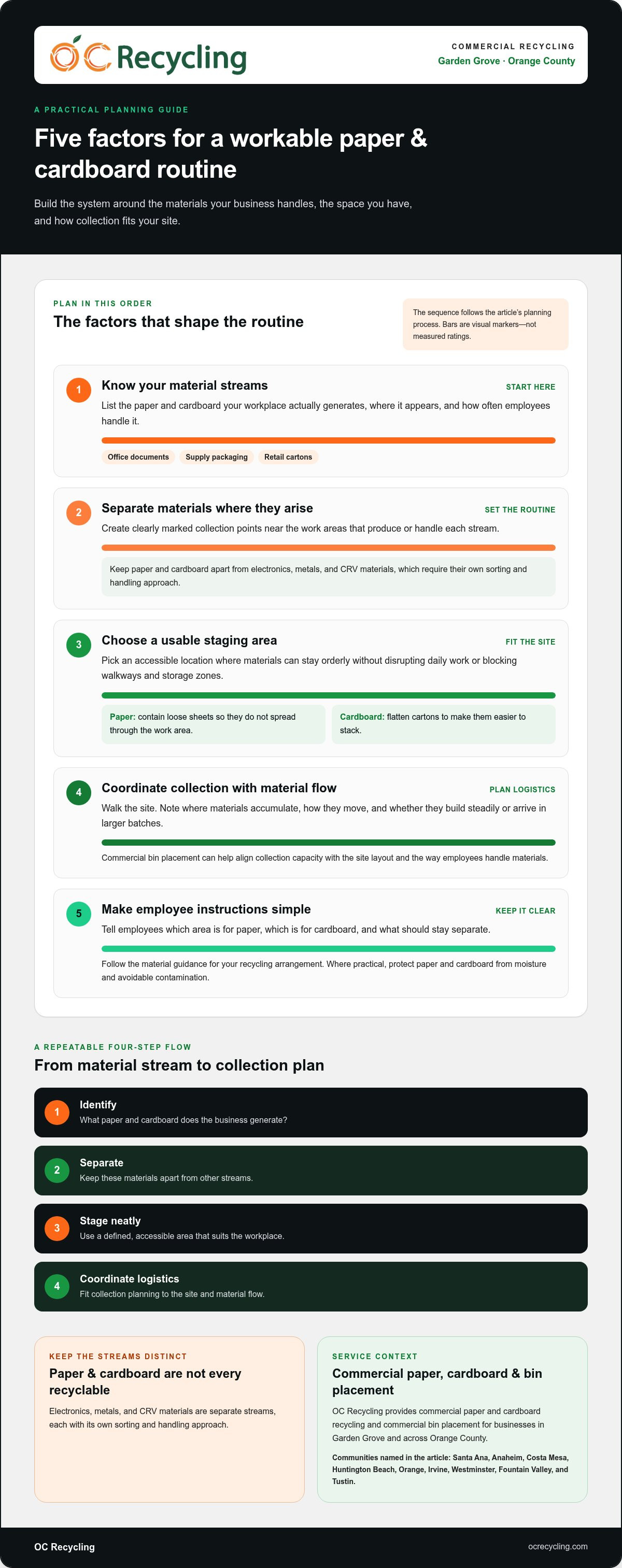
Prepare Your Garden Grove Workplace for Paper Recycling
A recycling routine works best when employees can follow it without stopping to interpret complicated instructions. Prepare by tracing where paper and cardboard enter daily operations, deciding how each stream will be sorted, and choosing a staging area that fits the site. These steps give staff and cleaning teams a clear, repeatable system before materials begin to pile up.
Create a simple paper and cardboard sorting routine
Start with a short walkthrough of the work areas. Identify where paper is handled, where packaging arrives, and where those materials can be collected conveniently. Then make sorting expectations visible and consistent across departments, so employees know whether paper and cardboard belong together or should be placed separately.
- Identify the sources: Note the work areas where paper and cardboard regularly appear.
- Set sorting points: Choose practical collection locations near those activities.
- Label clearly: Use plain wording that distinguishes paper and cardboard from unrelated waste streams.
- Share responsibilities: Tell employees and cleaning teams how materials should be handled and where they go next.
Keep instructions brief enough to remember during a busy shift. A simple sign and a consistent expectation across work areas can be easier to maintain than detailed directions that differ from department to department. Review the setup when workflows change or materials repeatedly end up in the wrong area.
Plan for bins, access, and staging space
Map the route from collection points to a designated staging area. Choose locations that are convenient for employees while keeping materials out of walkways, work zones, and other active spaces. Consider how paper and cardboard will be moved, who handles that task, and whether the staging area can remain orderly as materials accumulate.
Commercial bin placement can support this plan by aligning collection capacity with material locations and workplace layout. Thoughtful placement makes the sorting routine easier to use and keeps the recycling area distinct from general waste and other recycling streams. OC Recycling offers commercial bin placement alongside paper and cardboard recycling, helping Garden Grove businesses plan logistics around their sites.
Use this checklist to put the setup into action:
- List the paper and cardboard materials generated in each work area.
- Mark where employees should place each stream.
- Choose a staging area with practical access that doesn’t disrupt operations.
- Keep paper and cardboard organized and apart from unrelated materials.
- Explain the routine to employees and cleaning teams, then make the instructions easy to see.
As you prepare for commercial paper recycling Garden Grove operations, connect the sorting plan to the way your workplace actually runs. Manufacturers considering broader workplace practices may also find useful context in Benefits of Recycling for Garden Grove Manufacturers.
Ready to put your workplace plan into practice? Arrange commercial paper recycling and bin placement with OC Recycling.
Arrange Commercial Paper Recycling in Garden Grove with OC Recycling
A clear plan makes it easier to move from workplace sorting to a commercial recycling arrangement. OC Recycling serves commercial accounts in Garden Grove and across Orange County, providing paper and cardboard recycling and commercial bin placement to support business needs. Share a concise picture of your materials and site to focus the plan on your operations.
What to include when planning a commercial recycling arrangement
Before discussing logistics, gather a few useful details about how your workplace handles paper and cardboard. A complicated audit isn’t necessary. Walk through the areas where materials appear and estimate how much accumulates to describe the day to day situation clearly.
- Material types: Describe the paper and cardboard generated through regular work, such as office paper, incoming packaging, or shipping cartons.
- Approximate volume: Note how much builds up over a typical operating period and whether it accumulates steadily or in batches.
- Site layout: Identify where materials arise, where they could be staged, and how employees move them through the workplace.
- Logistics priorities: Outline access considerations, internal handling responsibilities, and the collection workflow that would fit your site.
These details connect the recycling plan to actual business activity. For example, a workplace that receives frequent deliveries should consider where packaging can be gathered without blocking receiving or storage areas. A site with limited staging space may prioritize a convenient location and a simple routine that keeps materials organized. Commercial bin placement can then be planned in relation to material volume, access, and layout.
A local next step for Garden Grove businesses
OC Recycling brings more than 15 years of Orange County experience to commercial recycling, with local operations rooted in Santa Ana. For a Garden Grove business, that local presence comes with paper and cardboard recycling and commercial bin placement. The plan can account for what materials you generate, where they collect, and how they can be managed on site.
Keep your notes focused on recurring materials and the practical realities of your facility. Clear information about paper, cardboard, approximate volume, staging space, and access creates a useful starting point for planning a commercial recycling arrangement with OC Recycling.
Ready to take the next step? Visit OC Recycling to explore commercial recycling options for paper and cardboard recycling at your Garden Grove business.
Turn Your Recycling Plan into a Routine That Lasts
Give the recycling plan an owner. Assign someone to notice when work patterns change, gather staff feedback, and keep sorting instructions current. Small adjustments can help the routine stay practical as teams, deliveries, or workspace needs shift. That ongoing attention turns a one time setup into a system employees can rely on.
For commercial paper recycling Garden Grove businesses, a useful arrangement fits the way the workplace operates and remains manageable over time. Bring your site observations and priorities into planning, then shape a routine that supports day to day work.
Explore commercial paper and cardboard recycling and commercial bin placement with OC Recycling to plan a more organized paper recycling routine for your business.
Frequently Asked Questions
What types of paper can a business recycle commercially?
Start by identifying recurring paper streams such as office printing paper, envelopes, and paper packaging, along with cardboard from deliveries. The materials a workplace generates do not automatically determine what belongs in a recycling stream, so inventory material types rather than assuming every grade is handled alike. This gives your team a useful basis for organizing business paper recycling and its handling requirements.
How does commercial paper recycling work for a Garden Grove business?
Commercial paper recycling in Garden Grove starts by identifying the materials a business generates, then organizing their collection and handling around the site. Observe a representative work period and note whether paper arises from office tasks, incoming supplies, or another recurring activity. That record clarifies where materials originate and helps inform a workable business arrangement.
Can cardboard be included with commercial paper recycling?
Yes. OC Recycling offers commercial cardboard and paper recycling, so a business can plan around both material streams. Whether cardboard appears mainly in a receiving area or throughout the workplace, noting its source and accumulation pattern helps staff manage it deliberately. Keep the streams identifiable in your internal routine and include both paper and cardboard in your recycling plan.
How should a business prepare paper and cardboard for recycling?
Keep materials tidy, dry where practical, and separate from unrelated waste. Assign a staff member or team to keep signs legible and notice when the collection area becomes disorganized. This oversight can catch routine problems, such as paper being placed in the wrong area or cardboard being left outside its designated space. Follow the handling requirements for the recycling arrangement.
Can OC Recycling provide bins for commercial paper recycling?
Yes. OC Recycling offers commercial bin placement to support business recycling logistics. Before planning placement, consider how staff move materials through the site, where a bin can be accessed, and how its location fits with normal workplace activity. Sharing those layout priorities helps make bin placement part of a practical site plan rather than an afterthought that creates extra handling for employees.
How can a business plan paper recycling when it has limited storage space?
With limited storage, focus on avoiding unnecessary travel and clutter. Place collection points near the areas where paper or packaging is generated, then identify a central staging spot that doesn’t block work or access routes. Track which materials take up the most room and when they build up. Those observations can help shape a workable arrangement around your site’s needs.
Does OC Recycling serve commercial recycling customers in Garden Grove?
Yes. OC Recycling serves commercial accounts in Garden Grove and across Orange County. Its local commercial footprint also includes Santa Ana, Anaheim, Costa Mesa, Huntington Beach, Orange, Irvine, Westminster, Fountain Valley, and Tustin. Businesses in these communities can use commercial paper and cardboard recycling and bin placement to plan a workplace recycling routine.
