

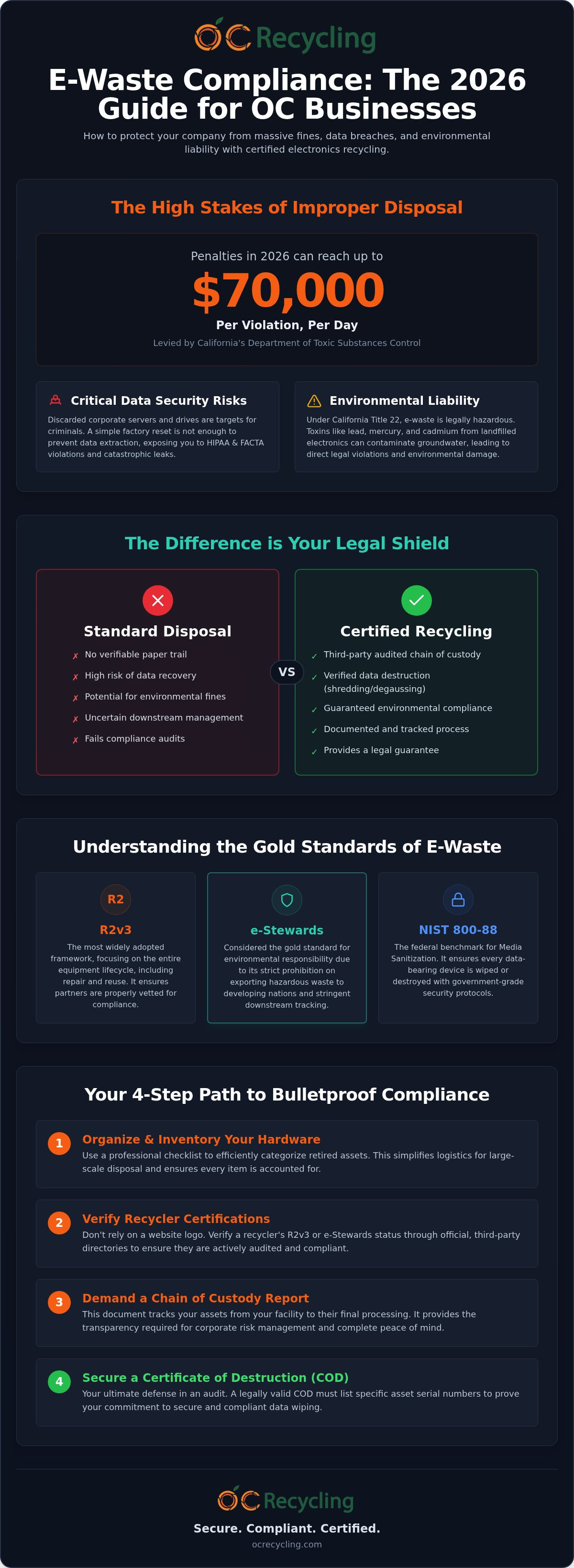
In 2026, California’s Department of Toxic Substances Control can levy penalties of up to $70,000 per violation, per day, for improper electronics disposal. For Orange County businesses, the stakes have never been higher. You’re likely managing a growing mountain of retired hardware while worrying about the sensitive data hidden on those old drives. Choosing certified e-waste recycling isn’t just a green initiative anymore; it’s a critical legal shield for your enterprise.
We understand that your time is valuable and compliance can feel like a moving target. It’s frustrating to keep up with shifting laws like the new 2026 battery-embedded waste fees or the complexities of current R2v3 standards. This guide will show you how to protect your company from data breaches and environmental liability through professional, local recycling solutions. We’ll preview the essential steps to secure a certificate of destruction for your next audit and explain how streamlined logistics can handle your bulk tech upgrades with total transparency and professional reliability. By the end of this guide, you’ll have a clear roadmap to manage your electronics with the confidence of a market leader.
Key Takeaways
- Identify the critical differences between standard disposal and third-party audited processes that guarantee total environmental and data safety.
- Uncover why the R2v3 and e-Stewards standards are the essential benchmarks for any modern business upgrading its technology in 2026.
- Master the process of certified e-waste recycling to shield your company from massive fines and the reputational damage of a data breach.
- Follow our professional inventory checklist to efficiently organize your hardware and simplify the logistics of large-scale tech disposal.
- Learn how to secure a formal certificate of destruction to satisfy strict compliance audits and prove your commitment to secure data wiping.
What is Certified E-Waste Recycling and Why Does It Matter?
To understand why modern enterprises prioritize compliance, we must first address a foundational question: What is E-Waste? In the professional world, certified e-waste recycling refers to a rigorous, third-party audited chain of custody that guarantees every component is handled with absolute environmental and data security. While standard recycling might involve simply tossing a monitor into a bin, certified processes involve systematic tracking, verified destruction, and documented downstream management. It’s the difference between hoping for the best and having a legal guarantee.
In 2026, the distinction between “recycling” and “certified recycling” has become a vital business boundary. The California Department of Resources Recycling and Recovery (CalRecycle) has expanded its reach, now including battery-embedded products in its strict fee and disposal structures. Orange County businesses are frequent targets for compliance audits because of our region’s high density of tech-driven firms. If your company can’t produce a verifiable paper trail for retired assets, you’re vulnerable to the state’s aggressive enforcement protocols.
The Environmental Impact of Improper Disposal
When electronics end up in local landfills, they don’t just sit there. Toxic heavy metals like lead, mercury, and cadmium can leach into the soil, eventually contaminating Southern California groundwater supplies. Under California Title 22, e-waste is legally classified as a hazardous material. This classification means that “landfilling” electronics isn’t just a poor environmental choice. It’s a direct violation of state law that can lead to massive fines and long-term liability for your organization. Professional recycling ensures these materials are recovered and repurposed, keeping toxins out of our local ecosystem.
Data Security: The #1 Corporate Driver
Many managers mistakenly believe that a factory reset or a simple disk format clears their liability. It doesn’t. In 2026, hardware-based data theft has surged as criminals specifically target discarded corporate servers and laptops to extract residual sensitive information. Certified e-waste recycling ensures that data-bearing devices undergo physical shredding or high-level degaussing that renders data unrecoverable. This level of security is non-negotiable for staying compliant with HIPAA and FACTA regulations. It protects your proprietary information and customer databases from the catastrophic cost of a leak, providing the institutional stability your clients expect.
Understanding the Standards: R2, e-Stewards, and Data Security
Selecting a partner for certified e-waste recycling requires more than just checking a box. You need to understand the rigorous frameworks that govern the industry to ensure your firm remains compliant with California’s E-Waste Recycling Act. Two primary certifications dominate the field: R2v3 and e-Stewards. The R2v3 standard is the most widely adopted framework; it focuses on the entire lifecycle of electronic equipment, including repair and reuse. In contrast, e-Stewards is often regarded as the gold standard for environmental and social responsibility because of its strict prohibitions on exporting hazardous waste to developing nations. For data security, the NIST 800-88 Guidelines for Media Sanitization serve as the federal benchmark. It ensures that every hard drive or flash chip is handled with the precision required for government-grade security. Before signing a service contract, always verify a recycler’s credentials through official directories; a logo on a website isn’t a substitute for active, audited status.
R2 vs. e-Stewards: Which One Do You Need?
The primary difference between these standards lies in how they handle downstream accountability. R2v3 requires recyclers to vet their partners, but e-Stewards demands even more stringent tracking of every component until it reaches its final destination. Many high-growth tech firms in Irvine and Anaheim prioritize R2 certified partners because the standard effectively balances high-efficiency processing with robust compliance. Regardless of the specific certification, you must demand a documented chain of custody report. This report tracks your assets from the moment they leave your facility until they are fully processed, providing the transparency needed for corporate risk management and peace of mind.
Certificates of Destruction (COD)
A legally valid Certificate of Destruction is your ultimate defense during a regulatory audit. To be effective, a COD must list specific asset serial numbers, the exact method of destruction, and the date the service was performed. You’ll need to choose between electronic wiping and physical destruction based on your internal risk tolerance. For high-stakes assets, physical shredding is the only way to be 100% certain data is gone. We provide specialized Certified Product Destruction to safeguard your brand’s reputation from the risks of gray-market reselling. If you’re ready to clear out your storage room, you can schedule a professional e-waste pickup to receive these critical compliance documents.
The Risks of Uncertified Electronics Disposal
Choosing a cut-rate disposal service might seem like a smart budget move, but skipping certified e-waste recycling is a high-stakes gamble with your company’s future. When you hand over retired hardware to an unvetted hauler, you’re essentially handing over your data and your legal standing. The risks aren’t just theoretical; they’re financial, legal, and reputational. In 2026, regulatory bodies are more aggressive than ever in tracking down the sources of improperly discarded tech. If your company logo is found on a device in an illegal dump, the fallout is immediate and public.
Financial Penalties for California Businesses
Enforcement trends in Orange County have shifted toward zero-tolerance for corporate negligence. Under the Electronic Waste Recycling Act, the California Department of Toxic Substances Control (DTSC) can levy fines of up to $70,000 per violation, per day. If the state determines the non-compliance was willful, those penalties can skyrocket to 300% of the original fine. This is driven by the “cradle-to-grave” principle, a legal standard where the original owner of the waste remains responsible for its ultimate fate. “Free” recycling services often pose the highest risk because they lack the audited infrastructure to handle hazardous materials correctly, frequently resulting in illegal “landfilling” that triggers these massive state actions.
Security Vulnerabilities in the Supply Chain
The most devastating risk is a data breach through the “gray market” electronics trade. Uncertified recyclers often export intact drives without performing a verified wipe, selling them to buyers who can easily recover sensitive corporate intelligence. Consider a hypothetical scenario: a Costa Mesa financial firm discards a batch of servers through a non-certified vendor. Six months later, a leaked customer database surfaces online, traced back to a drive found in an overseas tech graveyard. The cost of such a breach, including legal fees, notification costs, and lost trust, far outweighs any savings from cheap disposal. To prevent this, the EPA advises companies to partner with certified electronics recyclers who follow strict sanitization protocols. You can further protect your brand’s integrity by using Certified Product Destruction Anaheim to ensure proprietary hardware is physically destroyed beyond any hope of recovery.
Planning Your E-Waste Pickup: A Checklist for OC Companies
Organizing a large-scale tech refresh requires more than just muscle; it requires a methodical approach to logistics and security. When your company prepares for certified e-waste recycling, the goal is to minimize downtime while maximizing compliance. A disorganized pickup can lead to lost assets or, worse, misplaced data drives that haven’t been wiped. By following a structured plan, you ensure that every piece of hardware is accounted for from the moment it leaves your desk until it reaches our secure facility.
- Step 1: Inventory your assets. Create a detailed list of every computer, server, tablet, and peripheral. Documenting serial numbers at this stage makes the final audit much smoother.
- Step 2: Segregate data-bearing devices. Keep laptops and servers separate from general scrap metal. This ensures that items requiring high-level data destruction aren’t mixed with non-sensitive peripherals.
- Step 3: Choose a local partner. Working with a team that has deep roots in Orange County reduces transit time and environmental impact.
- Step 4: Schedule a bin placement. For massive office cleanouts or corporate relocations, professional bin placement is the most efficient way to manage high volumes of material without cluttering your workspace.
Logistics for Santa Ana, Anaheim, and Irvine
Coordinating tech upgrades across multiple sites in Santa Ana, Anaheim, or Irvine can be a logistical headache. We simplify this process by offering streamlined pickup services that handle everything from a single pallet to a full fleet of retired workstations. If your cleanout includes non-electronic components like copper wiring or aluminum racking, you can take advantage of the best Scrap Metal Prices Orange County has to offer. This allows you to offset some of your disposal costs while ensuring every material is repurposed according to modern sustainability standards. For demolition sites or major headquarters moves, our heavy-duty bins provide a secure, organized collection point that keeps your project on schedule.
Preparing Devices for Secure Transport
Secure transport begins before the truck even arrives. We recommend palletizing your electronics and using high-quality shrink wrap to prevent shifting or damage during transit. Clearly label each pallet with its contents and destination to maintain a transparent chain of custody. Before the scheduled pickup, verify if your facility requires specialized loading dock access or if our drivers will need to navigate freight elevators. Keeping your hardware in a locked, secure area on-site prevents unauthorized access during the staging phase. If you’re ready to clear out your warehouse with a partner you can trust, schedule your commercial bin placement today to get started with the premier choice in local recycling.
Secure E-Waste Solutions at OC Recycling
With over 15 years of operational excellence in Southern California, OC Recycling stands as the premier choice for enterprises seeking institutional stability and professional pride. We’ve built our reputation on providing a sense of security through rigorous, clean, and modern standards. Whether you’re managing a small office or a large-scale corporate headquarters, our four convenient facilities in Santa Ana, Anaheim, Costa Mesa, and Huntington Beach ensure that expert-led service is always within reach. By choosing our team for certified e-waste recycling, you’re partnering with a leader that values your time and prioritizes your company’s protection above all else.
While many organizations view retired hardware as a mounting liability, we help you transform those assets into a legitimate revenue stream. Our industrial-grade processing allows us to offer competitive payouts for bulk electronics and scrap metal. Instead of paying for storage or risking unverified disposal, your company can benefit from the intrinsic value of the materials within your tech. This shift from a cost center to a profit opportunity is a hallmark of a well-oiled corporate recycling strategy that rewards environmental responsibility with financial gain.
Why Orange County Trusts OC Recycling
Our commitment to 100% compliance with California environmental laws provides the peace of mind you need to focus on your core business. We don’t just process waste; we provide transparent reporting and secure data wiping that satisfies the most stringent audits. For many of our commercial partners, the speed of our service is the deciding factor. We offer same-day cash payouts for eligible electronics and scrap metal, ensuring your logistics are as efficient as they are profitable. Our facilities are designed for quick consumption of large-scale loads, moving your inventory through the destruction process with methodical precision.
Get a Custom Commercial Quote
Managing your retired hardware is more than a simple logistical task; it’s a vital part of your brand’s security and legal compliance. You now understand how certified e-waste recycling shields your organization from the surging fines of 2026 and the devastating risks of hardware-based data theft. By prioritizing R2v3 or e-Stewards standards, you’re choosing a path of professional reliability and environmental stewardship that reflects your company’s core values.
Turning your tech liability into a revenue stream is simple with a partner who understands the local landscape. We offer same-day cash for bulk recyclables and provide the certified data and product destruction you need to pass any audit with confidence. With four local Orange County locations in Santa Ana, Anaheim, Costa Mesa, and Huntington Beach, we’re ready to streamline your next cleanout with modern, efficient standards. Don’t leave your company’s reputation to chance. Contact OC Recycling for a Certified E-Waste Quote Today and experience the peace of mind that comes with industry-leading standards. We’re here to help you build a more sustainable and secure future for your business.
Frequently Asked Questions
What electronics are considered hazardous waste in California?
California law classifies electronics containing lead, mercury, cadmium, or hexavalent chromium as hazardous waste. This includes desktop computers, laptops, CRT monitors, and LCD screens. Under Title 22 of the California Code of Regulations, these items are prohibited from being tossed in standard trash bins. Our facilities in Santa Ana and Anaheim specialize in the legal management of these materials to keep toxins out of the Southern California groundwater supply.
What is the difference between R2 and e-Stewards certification?
R2v3 is a global standard that emphasizes the repair and reuse of electronics to extend their lifecycle. In contrast, e-Stewards is often called the gold standard for its absolute ban on exporting hazardous waste to developing nations. Both certifications are vital components of certified e-waste recycling. We help Orange County firms choose the right standard to meet their specific corporate social responsibility goals and legal requirements.
How do I know if my data has been permanently destroyed?
The only way to be certain your data is gone is to obtain a formal Certificate of Destruction (COD). This document serves as your legal proof that devices were processed according to NIST 800-88 benchmarks. It includes serial numbers for every disk and details the exact method of destruction. Whether we use physical shredding or high-level degaussing, this paper trail is your ultimate defense during a compliance audit.
Do you provide on-site data destruction in Orange County?
We specialize in secure transport and facility-based destruction to ensure the highest level of security for our Orange County partners. Processing your assets at our industrial-grade facilities in Santa Ana or Anaheim allows for the most rigorous auditing and destruction protocols. This method provides the institutional stability and transparency required for complex corporate tech upgrades, ensuring your data is handled through certified e-waste recycling with professional reliability.
Can my business get paid for recycling old computers and servers?
Your business can absolutely turn retired hardware into a revenue stream. We offer competitive payouts and same-day cash for bulk computers, servers, and other high-value electronics. By aggregating these materials at our local facilities, we’re able to pass the commodity value back to our commercial clients. This approach transforms a storage problem into a financial benefit for companies in Costa Mesa, Irvine, and the surrounding cities.
What happens to the materials after they are recycled at OC Recycling?
After arriving at our facilities, materials are meticulously sorted and prepared for industrial reuse. We act as a consolidation point, adding value by cleaning and preparing metals, plastics, and fibers for global commodity markets. This process supports a circular economy where your old server racks and wiring are transformed into raw materials for new products. It’s a transparent, environmentally conscious cycle that keeps Southern California clean and sustainable.
Is a Certificate of Destruction required by law for my business?
While California law doesn’t explicitly mandate the “certificate” document for every item, it does require businesses to prove their waste was managed legally. A Certificate of Destruction is the professional industry standard for meeting these requirements. It shields your organization from the “cradle-to-grave” liability inherent in the Electronic Waste Recycling Act. Without this documentation, your firm remains vulnerable to massive fines if your hardware is ever found in an illegal dump.
How do I schedule a bulk e-waste pickup for my Anaheim office?
Scheduling a pickup for your Anaheim office is a straightforward process. You can start by contacting our team for a custom quote tailored to your inventory size. We offer professional bin placement for large-scale office cleanouts and corporate relocations, ensuring your logistics are handled with precision. Our drivers coordinate the hauling of your assets directly to our secure local facilities, providing a seamless transition that respects your team’s valuable time.
