
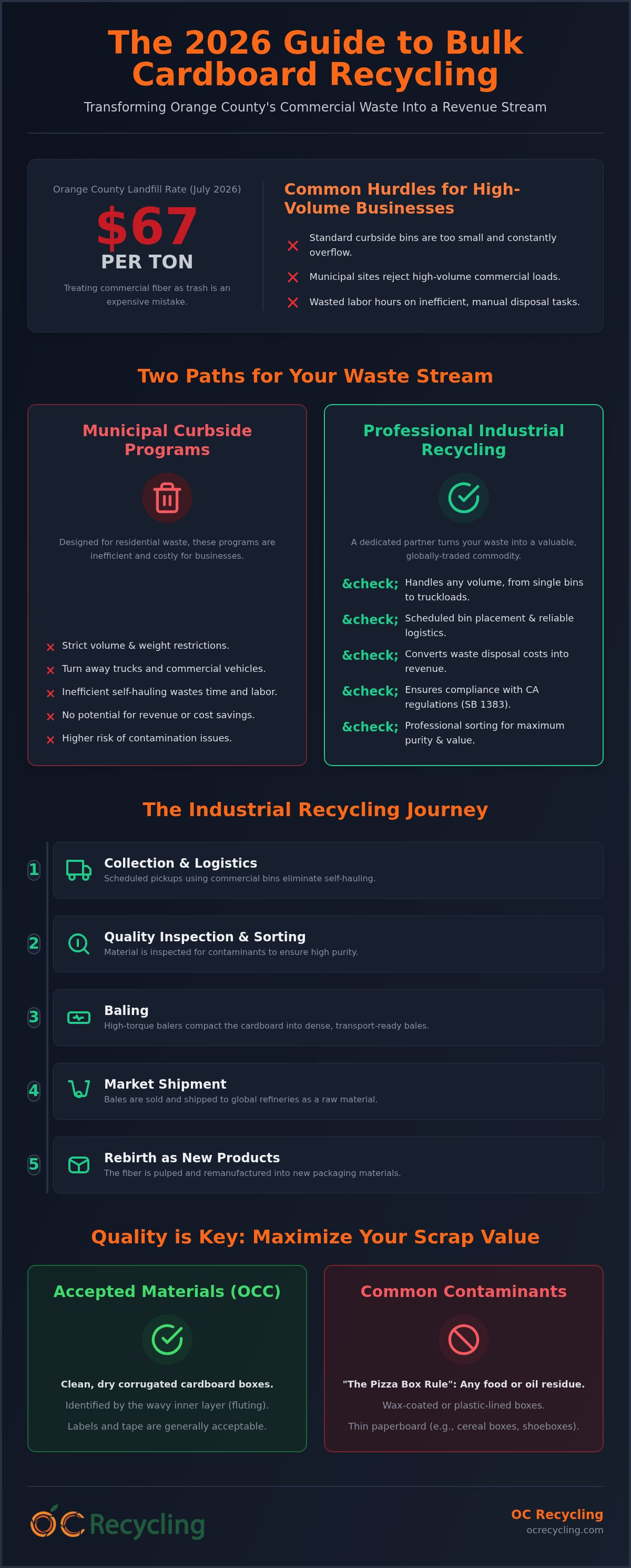
Did you know that as of July 2026, Orange County landfill disposal rates have climbed to $67 per ton? This significant jump means that treating your commercial fiber as trash isn’t just inefficient; it’s expensive. If you’re struggling with standard curbside bins that are far too small for your daily output, or finding that municipal sites reject your high-volume loads, you need a dedicated strategy for bulk cardboard recycling Orange County. It’s a common struggle that leads to wasted labor costs and missed opportunities for scrap value.
This 2026 guide is designed to help you master your waste stream by partnering with a professional industrial leader. We’ll show you how to streamline your logistics, ensure total compliance with California’s latest SB 1383 and SB 343 regulations, and maximize the efficiency of your disposal. From commercial bin placement to processing high-tonnage fiber, you’ll discover how to transform a messy operational hurdle into a polished, environmentally conscious revenue stream. We’ll explore the logistics of industrial-grade recycling and the steps your business can take to secure its bottom line today.
Key Takeaways
- Understand the critical differences between limited municipal curbside programs and professional industrial processing for high-volume corrugated fiber.
- Learn how to avoid rising landfill costs by transitioning to a revenue-positive model with a premier local recycling partner.
- Master efficient warehouse workflows that minimize waste volume and significantly reduce staff labor hours spent handling bulky waste.
- Discover how professional bin placement and scheduled logistics for bulk cardboard recycling Orange County eliminate the burden of self-hauling.
- Identify the technical standards for “clean” OCC to ensure your materials meet 2026 global refinery requirements and maximize potential scrap value.
Beyond the Blue Bin: The Reality of Bulk Cardboard Recycling
Most businesses start their journey by realizing that the standard blue bin is completely overmatched by their daily output. Bulk cardboard recycling Orange County involves the systematic processing of high-volume corrugated fiberboard that far exceeds what residential programs are built to handle. In the industry, this material is known as Old Corrugated Containers (OCC). It isn’t just paper trash; it’s a globally traded commodity that serves as a primary raw material for new packaging. By focusing on corrugated fiberboard recycling, your company moves beyond simple disposal into a sophisticated supply chain that supports local sustainability.
Every ton of fiber diverted from regional landfills, like the Frank R. Bowerman site, preserves local capacity and saves your business from the rising $67 per ton disposal fees that now impact Orange County operations. When your warehouse generates several tons of waste per month, you need an industrial partner rather than a city utility. This professional approach ensures your materials are processed efficiently and kept out of the waste stream.
Why Residential Programs Reject Commercial Loads
Local municipal sites in Irvine or Anaheim are designed for homeowners, not logistics managers. These Neighborhood Satellite centers often enforce strict volume restrictions that turn away box trucks or trailers immediately. Liability and zoning regulations usually prevent public facilities from accepting industrial-scale waste due to safety concerns and equipment limitations. Even if you manage to gain entry, the common 10-minute visit limit makes it impossible to unload a significant commercial haul. It’s a frustrating, time-consuming process that pulls your staff away from more productive tasks.
The Economic Case for Professional Fiber Management
Shifting your perspective from waste disposal to resource recovery is the first step toward a more profitable operation. Just as scrap metal prices in Orange County fluctuate based on global market demand, the value of high-quality fiber changes constantly. Professional centers provide the transparency you need to understand these market shifts. OC Recycling acts as a vital consolidation point for Southern California fiber markets, offering the industrial-grade infrastructure required to turn your bulky waste into a streamlined asset. By working with a dedicated partner, you gain access to the scale and speed that public programs simply cannot provide.
The Industrial Process: How Bulk Cardboard is Processed in 2026
The journey of industrial fiber begins at your loading dock, but the true transformation happens within a high-capacity recovery facility. When you engage in bulk cardboard recycling Orange County, your material moves through a methodical, multi-stage process designed to maintain the integrity of the fiber. A standard box from a Santa Ana warehouse is first inspected for quality, then fed into massive industrial conveyor systems. These systems lead to high-torque balers that prepare the material for its final destination: a global refinery where it is pulped and reborn as new packaging. This modern cycle is remarkably fast, often seeing your discarded containers processed and ready for shipment within hours of arrival at our facility.
Maintaining high material purity is the most critical factor in this industrial chain. While residential programs often struggle with high contamination rates, our professional sorting protocols ensure that your OCC (Old Corrugated Containers) remains a premium commodity. By adhering to strict Orange County commercial recycling regulations, businesses can ensure their waste streams are compliant and ready for the global market. To start optimizing your own waste stream, you can schedule a commercial assessment with our team to identify the most efficient handling methods for your specific volume.
Understanding Cardboard Grades and Contaminants
Not all fiber is created equal. The “pizza box rule” remains the gold standard for quality control; even a small amount of oil or food residue can ruin an entire batch of pulped fiber. It’s also vital to distinguish between true corrugated cardboard, which features a wavy inner layer for strength, and thinner paperboard used for items like cereal boxes. In a professional setting, we also watch for “look-alikes” such as wax-coated shipping containers. These are often used for produce or perishables and cannot be processed in standard fiber streams because the wax won’t break down during the pulping stage.
Baling and Consolidation Logistics
Baling is the mechanical compression of fiber into high-density cubes to maximize transport efficiency and reduce carbon footprints. For high-volume generators, implementing on-site baling equipment can drastically reduce the frequency of pickups and save valuable floor space. If your facility doesn’t have the room for heavy machinery, OC Recycling provides a seamless alternative. We aggregate smaller commercial loads into industrial-scale shipments at our local yards. This consolidation process allows even mid-sized businesses to benefit from the same high-efficiency logistics used by the largest warehouses in the region.
Disposal Comparison: Municipal Landfills vs. Professional Recyclers
Public landfills are engineered to swallow waste, but for a business, they also swallow your operating budget. Choosing bulk cardboard recycling Orange County through a premier industrial partner allows you to flip the script from a “pay-to-dump” cost center to a “get-paid-to-recycle” revenue stream. While municipal facilities in Brea or Irvine are essential for public sanitation, they aren’t optimized for the high-volume requirements of modern commerce. Most public sites are increasingly restrictive, often excluding commercial entities or limiting them to residential-scale volumes that don’t meet the needs of a busy warehouse or construction site. This creates a significant hurdle for businesses that need to move tons of fiber quickly and legally.
Landfill Fees vs. Recycling Payouts
Landfill tipping fees in Orange County have surged to $67 per ton as of July 2026, representing a significant drain on your bottom line. Every trailer load of fiber sent to a landfill is essentially a double loss: you pay for the disposal and you forfeit the commodity value of the material itself. Professional recycling centers provide a more secure, revenue-positive alternative. While CRV recycling centers in Santa Ana primarily handle consumer beverage containers, high-volume fiber recycling offers distinct volume-based incentives for corporate partners. National EPA recycling statistics show that corrugated boxes have some of the highest recovery rates in the country, yet many businesses still throw money away at the dump. At OC Recycling, we offer same-day payouts for qualifying scrap materials, ensuring your sustainability efforts provide immediate financial returns.
Speed and Accessibility for Commercial Fleets
Time is the hidden cost of waste management. Wait times at public disposal sites in Irvine or Brea can be unpredictable, often resulting in bottlenecks that keep your drivers off the road for hours. In contrast, professional industrial yards are designed for the “in-and-out” efficiency that commercial fleets require. Dedicated commercial lanes and heavy-duty scales ensure that trucks and trailers are processed with precision and speed. We act as a high-efficiency alternative for contractors in Huntington Beach and Costa Mesa who can’t afford to waste labor hours in a landfill queue. With four convenient locations across the county, we provide the local proximity and professional documentation, including certified recycling reports, that municipal sites simply can’t offer. This level of institutional stability and transparency gives you total peace of mind for your corporate compliance reporting.
Best Practices for Managing High-Volume Cardboard Waste
Managing industrial-scale waste doesn’t have to be a logistical nightmare. When your facility handles bulk cardboard recycling Orange County, the difference between a cluttered floor and a streamlined operation lies in your team’s daily workflow. Establishing a methodical system for processing fiber ensures that your warehouse remains safe, compliant, and ready for rapid material recovery. By treating your cardboard as a valuable commodity rather than a nuisance, you can significantly improve your facility’s efficiency and bottom line.
Many warehouse managers believe that thorough preparation is a drain on productivity. In reality, improper handling is the true time-waster. When boxes are left unflattened or contaminated with packing materials, they take up five times more space and require multiple touches by your staff. A polished, one-touch system reduces labor costs and ensures your material meets the high-purity standards required for top-tier market payouts. Implementing these professional standards transforms a messy industrial process into a clean, modern standard of excellence.
Step-by-Step Preparation for Bulk Loads
- Step 1: Flattening and Decontamination. Break down every box completely. It’s essential to remove non-paper packing materials like styrofoam, plastic film, and heavy-duty tape, as these contaminants can lead to load rejection at the refinery.
- Step 2: Segregation for Maximum Value. Keep your Old Corrugated Containers (OCC) separate from mixed paper or office waste. This simple sorting step ensures you receive the highest possible payout grade for your high-tonnage fiber.
- Step 3: Secure Loading. If you’re transporting material yourself, ensure loads are tightly secured to meet DOT standards and prevent littering on local freeways. Properly stacked and tied loads are much easier for our industrial scales to process quickly.
Optimizing On-Site Storage and Safety
Keeping your fiber dry is the most critical factor in preserving its market value. Wet cardboard is significantly heavier, which complicates transport, and it’s often rejected by refineries because the moisture compromises the pulping process. Store your flattened stacks in a dedicated “dry zone” away from loading dock rain or warehouse cleaning areas. This transparency in quality control ensures you always get the most out of your recycling efforts.
Professional logistics represent the final, most critical link in the waste management chain. While previous sections outlined how to prepare your fiber, OC Recycling’s commercial bin placement and hauling services provide the turn-key solution that actually moves material off your floor. By implementing a scheduled pickup program for bulk cardboard recycling Orange County, you eliminate the need for your warehouse staff to handle transport themselves. This shift allows your team to focus on core operations while our industrial-grade fleet handles the heavy lifting with precision and reliability.
For many businesses, cardboard is just one part of a complex waste stream. Our logistics support integrates seamlessly with other specialized needs, such as certified product destruction in Anaheim. This is particularly valuable for retail upgrades or demolition sites where brand liability and secure disposal are just as important as high-volume recycling. We provide a polished, transparent process that ensures every ton of material is accounted for and processed according to the highest environmental standards.
Customized Bin Solutions for Every Industry
Managing multiple vendors for different waste streams is a recipe for administrative headaches. OC Recycling simplifies your operations by handling “mixed” commercial accounts that include cardboard, electronics, and scrap metal. This holistic approach to bulk cardboard recycling Orange County provides a single point of contact for all your recycling needs, ensuring institutional stability and making environmental compliance reporting straightforward and secure. We invite you to contact our Santa Ana headquarters for a professional logistics audit. Our team will evaluate your current waste flow and design a modern, efficient system that maximizes your recovery value while providing total peace of mind for your corporate reporting requirements.
Future-Proof Your Waste Management Strategy
Mastering your facility’s waste stream is more than just a sustainability goal; it’s a strategic business move. By shifting away from high landfill tipping fees and toward a revenue-positive model, your company gains a competitive edge in a tightening market. We’ve explored how professional logistics and industrial processing can transform your bulky fiber into a streamlined asset. Implementing these best practices for bulk cardboard recycling Orange County ensures your operations remain efficient, safe, and fully compliant with California’s rigorous 2026 environmental standards.
As a fully licensed and environmentally compliant partner with over 15 years of local experience, we provide the institutional stability your business deserves. With four convenient locations, including Santa Ana and Costa Mesa, we offer the speed and transparency required for modern corporate reporting. We even provide same-day cash for many qualifying materials to keep your cash flow moving. Don’t let unmanaged waste slow your progress. Schedule Your Bulk Cardboard Pickup with OC Recycling Today and experience the peace of mind that comes with a premier recycling partnership. We’re ready to help your business lead the way in local sustainability.
Frequently Asked Questions
Does OC Recycling pay for bulk cardboard in Orange County?
OC Recycling does pay for bulk cardboard recycling Orange County, offering a revenue-positive alternative to landfill disposal. We purchase high-volume corrugated fiber from businesses and warehouses across Santa Ana and Costa Mesa. While residential programs charge you for disposal, our model provides competitive market-based payouts for clean OCC. Qualifying materials can even receive same-day cash payouts at our facilities. This ensures your sustainability efforts contribute directly to your bottom line while meeting local compliance standards.
What is the difference between OCC and regular cardboard?
OCC stands for Old Corrugated Containers, which is the industrial grade material featuring a wavy fluted layer between two flat sheets. This structure provides the strength needed for shipping boxes. Regular cardboard is a broader term that often includes thinner paperboard, like cereal boxes, which lacks that internal reinforcement. Refineries prefer OCC because its longer fibers are more durable during the pulping process. Distinguishing between these grades is essential for maximizing your payout value.
Do I need to remove tape and labels before recycling bulk cardboard?
While high-speed industrial pulpers can handle small amounts of adhesive, you should remove as much tape and plastic labeling as possible. The primary goal is to eliminate heavy contaminants like plastic film, styrofoam, and wood debris. These materials can’t be pulped and often lead to entire loads being downgraded or rejected at the refinery level. Taking a few extra seconds to clear your bulk cardboard ensures you receive the highest possible scrap value.
Can I recycle wax-coated cardboard boxes from grocery shipments?
Wax-coated boxes, often used for perishable grocery shipments or produce, cannot be processed in standard fiber recycling streams. The wax coating is a significant contaminant that doesn’t break down during the pulping stage, which can gum up industrial machinery. These boxes are usually diverted to landfills rather than recycling centers. If your Anaheim or Huntington Beach business handles these containers, it’s best to separate them from your clean, recyclable corrugated fiberboard to maintain load purity.
How much cardboard is considered a “bulk” load for commercial pickup?
A bulk load typically refers to volumes that exceed the capacity of standard municipal bins or require specialized commercial hauling. This often includes loose stacks that fill a box truck or high-density bales produced by on-site machinery. For businesses in Garden Grove or Westminster, we provide commercial bin placement to manage these large quantities efficiently. If your weekly output creates a storage headache or a safety hazard, it’s time to transition to a professional industrial-scale logistics plan.
Are there specific hours for commercial cardboard drop-offs in Santa Ana?
Our Santa Ana headquarters and other Orange County locations maintain standard business hours designed to accommodate commercial fleets and contractors. We prioritize speed and efficiency to ensure your drivers spend less time at the scale and more time on the road. While public sites often have restrictive visit limits, our industrial yards are built for high-volume throughput. We recommend arriving at least thirty minutes before closing to ensure your bulk cardboard recycling Orange County is processed smoothly.
Can OC Recycling provide bins for a one-time warehouse cleanout?
We provide flexible bin solutions for various commercial needs, including one-time warehouse cleanouts or large-scale retail upgrades. Whether you’re clearing out years of accumulated fiber or managing a temporary surge in shipping materials, our team can place industrial-grade roll-off bins at your site. This service is a turn-key solution for businesses in Tustin or Costa Mesa that need to move massive volumes quickly. Once the project is finished, we handle the hauling and processing immediately.
How does wet cardboard affect my recycling payout or acceptance?
Wet cardboard is significantly heavier than dry fiber, which complicates transport and negatively impacts your payout. More importantly, moisture promotes mold growth and weakens the fibers, making the material unsuitable for high-quality pulping. Most refineries will downgrade or outright reject wet loads because they disrupt the chemical balance in the recycling tanks. Keeping your storage area dry in cities like Fountain Valley is the best way to protect your material’s market value and ensure acceptance.
