
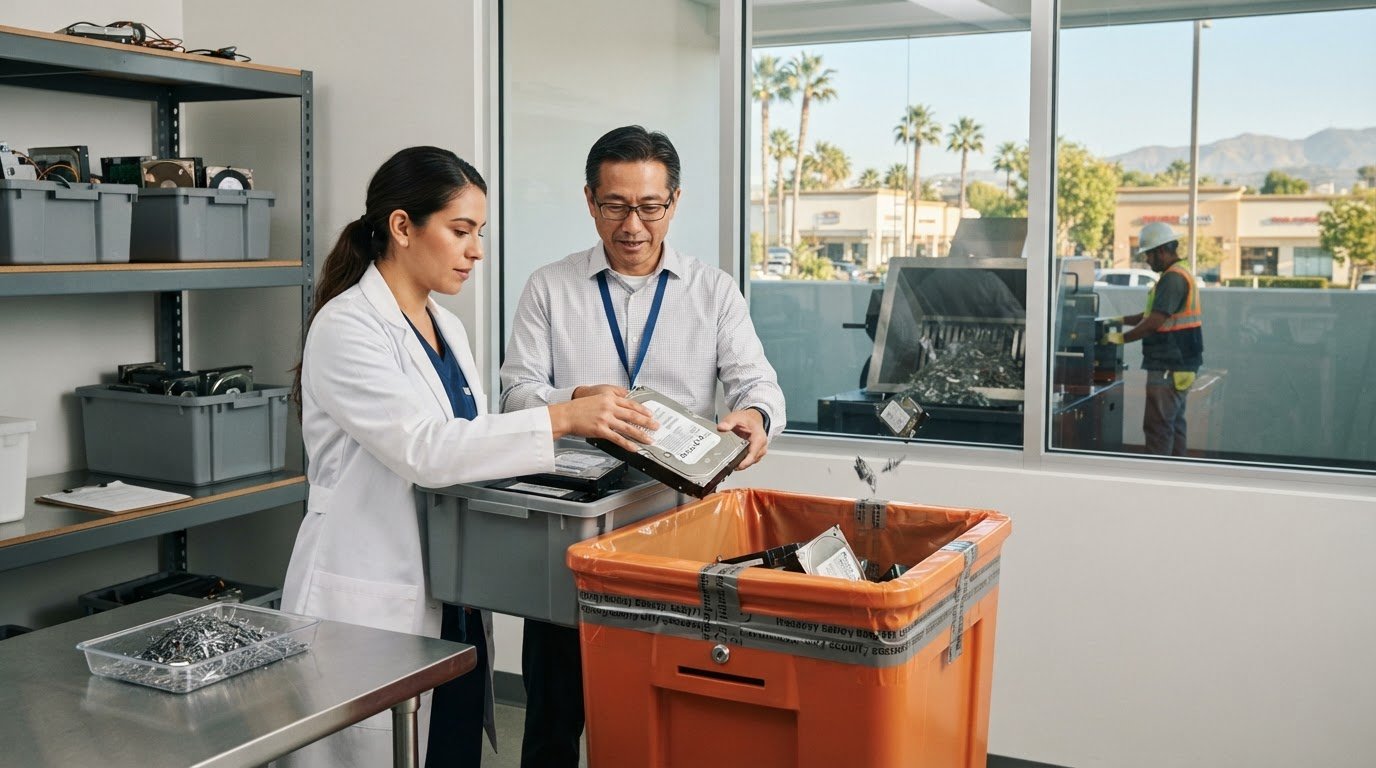
Hitting “format” or running basic disk-wiping software on retired medical storage devices does not satisfy federal privacy regulations. When legacy drives leave your facility containing electronic protected health information (ePHI), your organization remains directly liable for every unverified sector. Healthcare administrators across Orange County rightly worry about multi-million dollar OCR penalties and vendor custody lapses, which is why securing verified HIPAA compliant data destruction Tustin medical practices can depend on is no longer optional.
You already understand that protecting patient trust requires far more than generic recycling bins or vague vendor promises. You need absolute certainty that every hard drive, solid-state drive, and backup tape is permanently rendered unrecoverable before it ever leaves local custody. In this guide, you will discover how to safeguard patient privacy, satisfy stringent federal disposal mandates, and select the right certified data destruction provider in Tustin. We’ll examine the critical differences between software wipes and physical shredding, the documentation required for bulletproof audit defense, and how a vetted local specialist simplifies your ongoing hardware retirement pipeline.
Key Takeaways
- Understand federal media sanitization mandates to shield your medical practice from severe civil monetary penalties and breach liability.
- Learn why NIST 800-88 physical destruction protocols provide permanent security that basic software disk wiping cannot match.
- Discover the vital criteria for choosing HIPAA compliant data destruction Tustin partners, focusing on unbroken custody and serialized Certificates of Destruction.
- Follow a step-by-step preparation checklist to catalog, secure, and decommission patient data-bearing hardware before processing.
- Streamline your clinic’s hardware retirement pipeline by working directly with an established Orange County specialist for electronic waste recovery.
Understanding HIPAA Data Destruction Standards for Tustin Healthcare Facilities
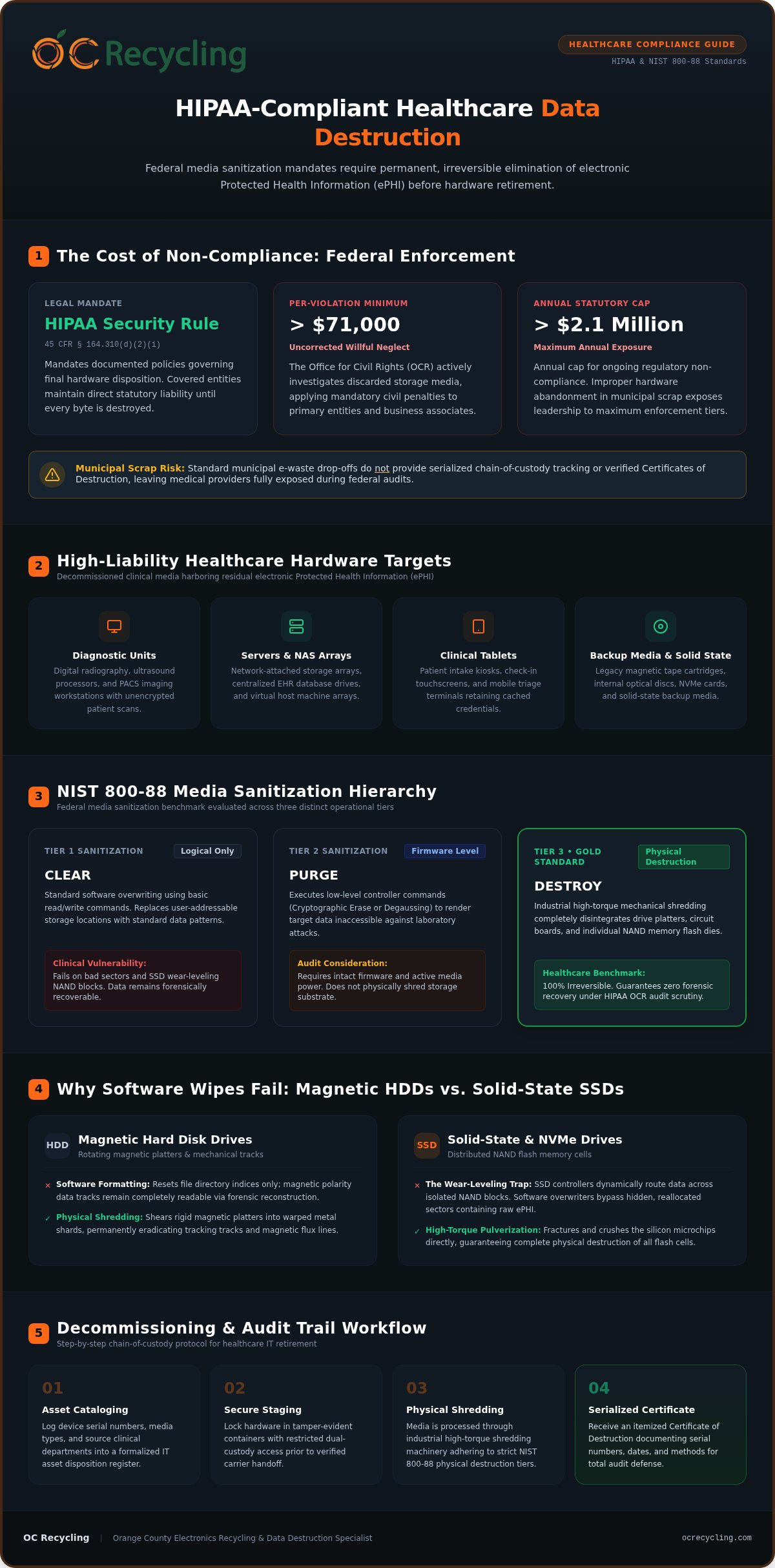
Federal healthcare regulations mandate the permanent, irreversible elimination of electronic protected health information (ePHI) before any storage medium leaves clinical control. Under HIPAA Security Rule 45 CFR § 164.310(d)(2)(i), covered entities must implement formal, documented policies governing the final disposition of hardware. Tustin medical practices, surgical centers, and billing contractors cannot simply abandon old drives in a storage closet; they carry direct statutory liability until every byte is completely destroyed.
Federal Legal Mandates: The HIPAA Security Rule and ePHI Disposal
The Department of Health and Human Services (HHS) treats improper hardware disposal as a severe regulatory breach. Under current civil monetary penalty tiers, uncorrected willful neglect triggers statutory fines exceeding $71,000 per violation, with annual caps surpassing $2.1 million. The Office for Civil Rights (OCR) actively investigates discarded storage media and unauthorized asset transfers, penalizing both primary covered entities and downstream business associates.
Satisfying federal audit standards demands verified data sanitization that completely eliminates the possibility of forensic data recovery. Investing in certified HIPAA compliant data destruction Tustin providers rely on ensures your organization maintains documented compliance, protecting your leadership from staggering enforcement actions.
The Hidden Vulnerabilities of Healthcare Hardware in Orange County
Clinical environments contain far more sensitive digital media than standard office workstations. As Tustin healthcare practices upgrade their electronic health record (EHR) platforms, decommissioned hardware quickly accumulates. Common risk-bearing assets include:
- Dedicated digital radiography and ultrasound processing units
- Local diagnostic workstations, PACS terminals, and network-attached storage arrays
- Integrated tablet devices used for patient intake, check-in, and triage
- Decommissioned clinic servers, solid-state system drives, and internal backup media
Relying on standard municipal disposal channels poses an acute security threat. While Orange County municipal collection centers handle standard electronic scrap, they never provide serialized asset tracking, chain-of-custody protocols, or verified destruction. For local practitioners, choosing verified HIPAA compliant data destruction Tustin specialists is the only dependable method to neutralize exposure and uphold complete patient confidentiality.
NIST 800-88 Guidelines vs. Standard Wiping: How Digital Health Data Must Be Destroyed
Medical IT hardware requires verifiable, irreversible methods to neutralize sensitive records. The federal benchmark recognized across the healthcare sector is outlined in the NIST 800-88 Guidelines for Media Sanitization. This framework establishes three distinct tiers of data sanitization: Clear, Purge, and Destroy. While “Clear” uses basic logical techniques and “Purge” executes firmware-level commands, only “Destroy” physically breaks media down to guarantee data recovery is impossible. For clinics handling high-liability health records, physical destruction remains the gold standard.
Physical Shredding vs. Software Overwriting for SSDs and Magnetic HDDs
Traditional hard disk drives record patient files onto rotating magnetic platters. Industrial shredding shears these platters into warped shards, destroying tracking tracks instantly. Modern solid-state drives (SSDs) and NVMe cards present a tougher hurdle. SSDs use wear-leveling algorithms that distribute data across isolated NAND flash cells. Software overwriting tools routinely miss hidden, reallocated sectors where legacy patient records persist. Physical high-torque shredding pulverizes these miniature memory chips directly. It eliminates residual risk entirely, providing dependable HIPAA compliant data destruction Tustin healthcare organizations can trust.
Non-Hard-Drive Storage: Backup Tapes, Optical Discs, and Embedded Devices
Data liabilities rarely stop at desktop workstations. Clinics routinely overlook auxiliary storage media tucked away in filing cabinets and server rooms. Critical vulnerabilities frequently include:
- Outdated LTO magnetic backup tapes housing legacy patient databases
- Optical diagnostic media, including patient CDs, DVDs, and digital X-ray discs
- Embedded flash controllers inside network printers, multi-function copiers, and ultrasound consoles
These secondary devices store unencrypted print caches and patient scans long after decommissioning. Arranging professional services with OC Recycling for verified data destruction ensures every auxiliary drive, tape, and embedded chip meets rigorous physical destruction protocols before recycling.
Key Criteria for Selecting a HIPAA Compliant Destruction Partner in Tustin
Any vendor handling decommissioned drives operates as your legal Business Associate under federal privacy statutes. Entrusting retired medical equipment to an unverified third party introduces massive regulatory liabilities. Vetting a partner for HIPAA compliant data destruction Tustin facilities demand requires evaluating custody protocols, operational transparency, and serialized verification.
Verifying Strict Chain of Custody and Secure Transport Protocols
Physical security begins on your clinical floor. Before pickup, retired media should sit inside locked, tamper-evident collection containers to prevent internal diversion. When transferring assets, technicians must complete a formal dual-custody transfer form alongside your IT staff. Dedicated transport vehicles then move hardware directly to regional processing centers, avoiding unmonitored transfers across Orange County surface routes.
Direct Local Processors vs. National Broker Networks
Many online search results lead directly to digital lead brokers rather than licensed processing plants. These national quote aggregators collect disposal requests, take a referral fee, and broker the pickup to unvetted third-party haulers. Subcontracting shatters your chain of custody. Partnering directly with an established Orange County processing facility keeps operations entirely accountable. You work straight with vetted technicians, access faster turnaround times for urgent clinic consolidations, and maintain clear visibility into who handles your media.
Certificate of Destruction Essentials for OCR and State Audit Defense
A generic recycling invoice doesn’t satisfy state regulators or federal privacy investigators. Defending an Office for Civil Rights audit requires official, serialized compliance records. Every valid Certificate of Destruction must specify:
- Individual drive and storage media serial numbers matching your internal decommission log
- The exact date, facility location, and physical shredding method utilized
- Printed names and authorized signatures of the processing technicians
Successful hardware retirement starts weeks before shredding equipment touches a drive. Without a disciplined internal workflow, decommissioned assets can linger in unlocked utility closets or slip into general trash bins. Establishing an organized staging process ensures your clinical team accounts for every electronic component before pickup.
Phase 1: Inventorying and Tagging ePHI Assets Across Clinical Departments
Accurate compliance documentation begins by mapping all hardware scheduled for retirement. Your IT staff or clinical compliance lead should build an itemized master log capturing internal property asset tags, device categories, and manufacturer model numbers.
- Verify and record individual drive serial numbers before detaching storage units from chassis or server racks.
- Cross-reference physical serial numbers directly against internal IT asset management databases.
- Inspect leased office equipment, including multi-function copiers and network fax gateways, to pull hidden internal hard drives.
Documenting these serial numbers upfront establishes an airtight baseline. You will later match this record directly against your destruction certificate.
Phase 2: Secure Staging, Commercial Bin Placement, and Custody Transfer
Once logged, hardware can’t sit in open administrative areas or unmonitored hallways. Patient privacy rules demand restricted physical access until pickup day. Consolidate decommissioned media inside dedicated, access-controlled rooms to prevent unauthorized access or internal loss.
For broad clinic upgrades or facility moves, you can schedule commercial bin placement with OC Recycling to stage lockable, tamper-evident security bins directly on your clinic floor. When collection day arrives, your compliance manager and the technician execute a dual-custody transfer form confirming container seals are intact. This structured workflow guarantees the verifiable HIPAA compliant data destruction Tustin medical centers rely on for uninterrupted audit defense.
Why Orange County Medical Providers Partner with OC Recycling
Protecting sensitive patient records demands a processing partner with proven local infrastructure. For over 15 years, OC Recycling has served commercial accounts throughout Orange County, delivering verified physical media shredding alongside full-scope electronics recycling. Healthcare administrators partner directly with our established regional processing center rather than risking unvetted sub-haulers. This direct connection ensures accountability from the instant retired drives leave your clinical office to their final material recovery.
Certified Destruction Protocols and Rapid Local Turnaround in Tustin
Proximity matters when medical equipment transitions out of active service. Headquartered in Santa Ana and serving neighboring Tustin, our direct local facility provides responsive, dependable scheduling for clinics along Newport Avenue, 17th Street, and Irvine Boulevard. By working straight with our technicians, your practice avoids third-party broker markups and uncertain transit delays. Every project concludes with an official, serialized Certificate of Destruction that links specific device serial numbers directly to your internal compliance records, delivering the verified HIPAA compliant data destruction Tustin healthcare providers require for complete audit defense.
Comprehensive E-Waste Reclamation Alongside High-Security Destruction
True end-of-life management extends beyond destroying storage platters. Once digital components are physically crushed, the remaining non-data materials require environmentally responsible handling. OC Recycling separates and routes shredded commodities into circular manufacturing streams, keeping heavy metals and electronic scrap out of California landfills.
Our comprehensive capabilities support healthcare operations through every phase of facility management:
- Specialized security solutions for obsolete, branded clinical hardware through our certified product destruction services
- Turnkey commercial bin placement designed to stage retired technology securely during departmental renovations and EHR migrations
- Sustainable electronics recycling programs that handle monitors, telecom switches, power backups, and clinic cabling
Shield your practice from data breach liabilities while supporting responsible local resource recovery. Contact OC Recycling today to schedule certified HIPAA compliant data destruction Tustin medical teams rely on.
Take Control of Your Medical Hardware Retirement Pipeline
Protecting sensitive patient data requires uncompromising destruction standards. Basic software formatting leaves residual exposure, while third-party brokers introduce dangerous custody gaps. Reliable compliance rests on complete physical shredding, meticulous serial logging, and verifiable documentation that withstands federal scrutiny.
With over 15 years of proven excellence serving commercial facilities across Orange County, OC Recycling provides the direct, licensed infrastructure healthcare administrators need. Our direct local facility eliminates intermediary broker risks and middleman surcharges, giving you clear visibility from initial pickup through complete material recovery. We back every project with serialized Certificates of Destruction designed for ironclad OCR compliance records. When you need dependable HIPAA compliant data destruction Tustin medical centers can stake their reputation on, our team delivers seamless execution and lasting peace of mind. Protect Your Practice with Certified Data Destruction from OC Recycling today.
Frequently Asked Questions
Does HIPAA require physical hard drive shredding or is software wiping legally acceptable?
HIPAA permits software sanitization if it renders ePHI indecipherable, but physical shredding remains the safest, most legally defensible approach. Software overwriting tools frequently fail on damaged drives, bad sectors, or reallocated flash storage cells. Physical shredding physically destroys the storage medium entirely, eliminating forensic recovery risks and providing bulletproof documentation that readily satisfies federal investigators during a privacy audit.
What critical information must be included on a HIPAA-compliant Certificate of Destruction?
A legally defensible certificate must detail individual drive serial numbers matching your facility’s internal inventory logs. It also needs to record the exact disposal date, physical destruction facility address, specific mechanical method used, and authorizing signatures from both the technician and your IT officer. Generic disposal receipts lacking serialized asset tracking won’t protect your practice during Office for Civil Rights compliance inquiries.
Can our Tustin medical practice use standard community electronics recycling drop-offs for old office PCs?
No, municipal drop-off sites and residential collection centers do not provide certified data sanitization or regulatory audit trails. California municipal programs focus strictly on basic materials diversion and universal waste recycling. They don’t provide chain-of-custody transfer logs, drive shredding, or serialized compliance certificates. Secure HIPAA compliant data destruction Tustin healthcare providers rely on requires a dedicated commercial partner with verified disposal workflows.
How does OC Recycling maintain an unbroken chain of custody for sensitive clinical hardware?
OC Recycling enforces direct physical accountability from the instant retired assets leave your office until final processing at our local facility. We utilize lockable staging bins, direct company transport, and documented dual-custody transfer manifests signed by our technicians and your staff. Because we process hardware locally in Santa Ana without passing jobs to third-party freight brokers, your media stays under strict, verifiable control.
Are digital photocopiers, printers, and diagnostic imaging equipment subject to HIPAA data disposal rules?
Yes, any clinical peripheral with internal digital storage falls squarely under HIPAA Security Rule mandates. Modern multi-function copiers, network printers, and specialized diagnostic consoles like ultrasound units contain internal hard drives that cache sensitive patient documents and scans. These internal media components must be physically removed and destroyed before the remaining hardware shell enters standard electronics recycling streams.
What is the practical difference between magnetic hard drive shredding and solid-state drive micro-shredding?
The difference lies in particle size and how each drive type stores information. Mechanical hard drives hold data across large spinning platters that standard commercial shredders easily snap and warp. Solid-state drives store records across compact, high-density NAND flash memory chips. SSD sanitization requires specialized fine-particle shredding to fracture every tiny silicon chip, guaranteeing the unrecoverable HIPAA compliant data destruction Tustin clinics need.
How quickly can OC Recycling stage secure collection bins or complete a pickup for a Tustin healthcare facility?
As a direct Orange County processor headquartered minutes away in Santa Ana, OC Recycling arranges prompt staging and collection tailored to your clinic’s operational schedule. Our local drivers serve medical accounts daily throughout Tustin, Irvine, and central Orange County. Whether you are managing an urgent EHR server decommissioning or need commercial bin placement for an upcoming facility remodel, our team delivers fast, dependable turnaround.
