
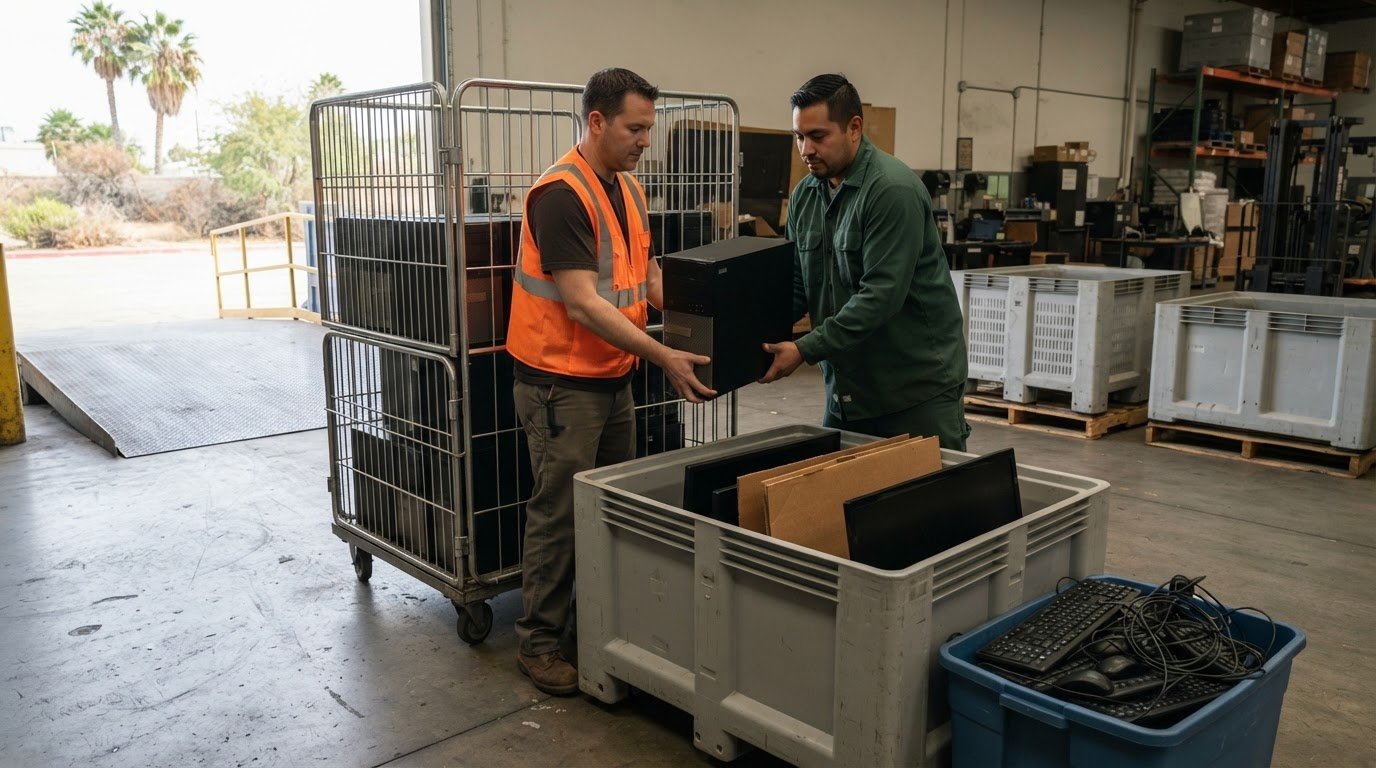
A household drop-off is not a school e-waste solution in Orange County: Household Hazardous Waste Collection Centers do not accept waste from schools. For e-waste disposal for schools in Santa Ana, arrange recycling suited to school electronics and commercial loads. Choose a service that accounts for the devices being retired and how their data will be handled.
Before arranging a school collection, clarify costs, accepted devices, service options, and logistics. Pickup charges depend on the materials and quantity, and the quote reflects the load and any requested data or product destruction. Share those details when requesting a quote so the scope fits the equipment.
This guide explains how to prepare school electronics for recycling, plan secure device handling, and understand the environmental risks of improper disposal. You’ll also learn which electronics schools commonly recycle and how responsible processing can recover useful materials instead of sending them to landfill.
Key Takeaways
- Assess a school recycling service by how its accepted materials, operating schedule, and charges fit the electronics and collection plan.
- Build data protection into device retirement, since deleting files may not fully remove sensitive information.
- Understand why responsible recycling matters and how improper disposal can create environmental risks.
- Identify the school’s device mix to plan a suitable recycling route and determine when professional electronics recycling or product destruction is relevant.
Evaluating e-waste facility services, hours, and charges
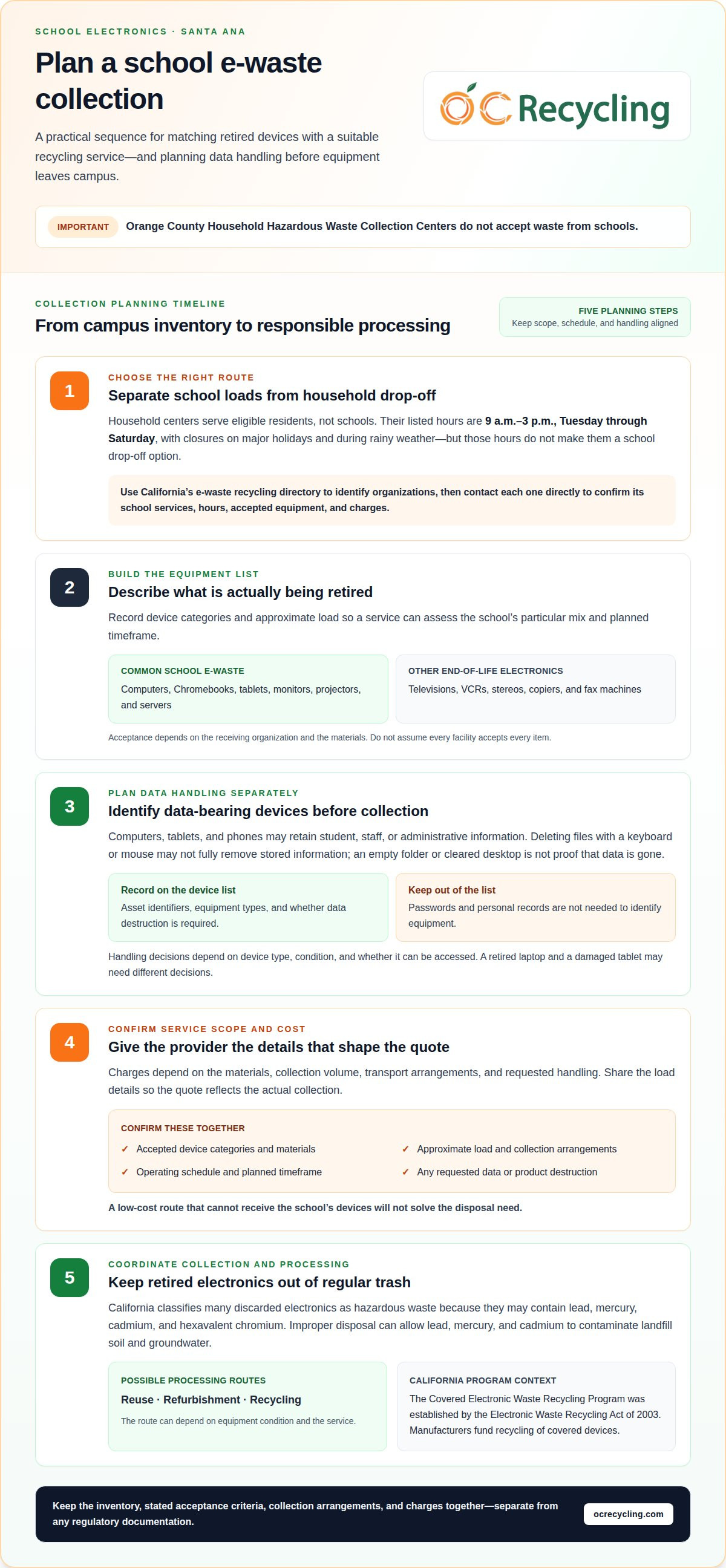
For a school collection, first distinguish facilities serving households from services equipped for institutional materials. Orange County Household Hazardous Waste Collection Centers accept electronics from eligible residents, but they do not accept waste from schools. Their hours are 9 a.m. to 3 p.m., Tuesday through Saturday, with closures on major holidays and during rainy weather. Those hours therefore don’t make them a drop-off option for a school’s retired computers or classroom devices.
California’s e-waste recycling directory can help identify organizations handling electronics. Directory users should contact a listed organization to confirm its services, hours, and any charges before bringing devices. For a school, this conversation should establish whether the facility accepts its particular mix of equipment and can process the volume in the planned timeframe. A campus with monitors, tablets, and servers needs a service scope that accounts for those materials, rather than an assumption that every electronics facility accepts every item.
Charges depend on the materials, collection volume, transport arrangements, and any requested handling, such as data or product destruction. A quote request should describe the device categories and approximate load, so the proposed scope reflects the actual collection. Ask for the operating schedule and accepted items together; a low-cost route that cannot receive the school’s devices won’t solve the disposal need. California Legislature states that a court shall impose a fine of not less than $5,000 nor more than $100,000 for each day of violation for a person convicted under subdivision (b), (c), or (d), except as further provided in that subdivision.
Keep regulatory documentation separate from the service quote. A directory listing alone does not establish an organization’s regulatory status or environmental performance. For practical planning, document the stated acceptance criteria, collection arrangements, and charges alongside the school’s inventory. This helps staff coordinate campus access, transport, and scheduling without confusing household collection rules with school disposal arrangements. Confirm the load details before moving equipment, especially when it includes mixed electronics or devices requiring secure data handling.
Professional data handling and device wiping
School computers can retain student, staff, and administrative information after they are no longer in use. Before devices enter the recycling stream, the school’s technology team should identify which ones store sensitive data. Computers, tablets, and phones may hold files, saved accounts, or device records. A clear inventory helps distinguish data-bearing equipment from items such as projectors that may not store the same information.
Deleting files with a keyboard or mouse may not completely remove personal information from a device’s memory. An empty folder or cleared desktop does not prove that stored data is gone. The school’s disposal plan should distinguish ordinary file deletion from deliberate data destruction. The right approach depends on the device type, its condition, and whether it can still be accessed.
For example, a retired laptop may still contain a user profile, while a damaged tablet may not start normally. These devices need different handling decisions. Identify which items require data destruction and include that requirement when arranging recycling. A professional process can then account for the equipment and requested handling, rather than treating every item alike.
Keep the information organized. A device list can record asset identifiers, equipment types, and whether data destruction is required. This connects the school’s inventory with the electronics presented for recycling and helps staff reconcile what leaves campus with what was designated for retirement. Do not include passwords or personal records in the equipment list; they are not needed to identify a device.
Once data concerns are separated from material recovery, the school can plan recycling for eligible electronics. Electronics recycling support gives schools a route for retired equipment while keeping data handling as a distinct planning need.
E-waste disposal guidance for Santa Ana
For e-waste disposal for schools in Santa Ana, household drop-off rules do not provide a school disposal route. Schools need a dedicated recycling arrangement that accounts for their equipment and California’s hazardous-material concerns.
Applicable California Disposal Rules
California’s Covered Electronic Waste Recycling Program was established by the Electronic Waste Recycling Act of 2003, according to CalRecycle. The program requires manufacturers to fund recycling of covered devices. This explains the state program’s funding approach, but household collection centers aren’t suitable for school loads.
The California Department of Toxic Substances Control classifies many discarded electronics as hazardous waste because they may contain lead, mercury, cadmium, and hexavalent chromium. Improper disposal can allow lead, mercury, and cadmium to contaminate landfill soil and groundwater. For a school, the practical takeaway is to keep retired electronics out of regular trash and arrange an authorized collection route.
Accepted School Electronics
School e-waste commonly includes computers, Chromebooks, tablets, monitors, projectors, and servers. Other end-of-life electronics include televisions, VCRs, stereos, copiers, and fax machines. For e-waste disposal for schools in Santa Ana, an inventory of these categories helps describe the collection, while acceptance depends on the receiving organization and materials.
Depending on their condition and the service, electronics may be reused, refurbished, or recycled. A working Chromebook and a damaged projector may follow different processing routes. List each item clearly to help plan the collection and avoid surprises when equipment is picked up.
Preparing and Sorting Electronics
Organize school electronics into identifiable categories before processing. A useful inventory separates computers, tablets, displays, servers, and peripherals instead of grouping everything as “electronics.” This gives the recycling organization a clearer picture of the load and supports appropriate processing.
For a mixed load of classroom Chromebooks, office copiers, and server equipment, providers can sort by device type and condition. School staff can keep the inventory aligned with staged equipment, so the list reflects the actual collection. This clear handoff supports orderly recycling and helps prevent confusion about the shipment’s contents.
What types of school electronics are accepted for recycling in Santa Ana?
A school’s electronics load can span classroom devices, office equipment, and network hardware. Common school e-waste includes computers, Chromebooks, tablets, monitors, projectors, and servers. These categories help describe the collection clearly, but acceptance depends on the receiving organization’s services and the materials involved.
Start with equipment used for instruction. List Chromebooks and tablets separately from desktop computers and monitors. Projectors may come from classrooms or meeting spaces, while servers typically come from technology rooms. Recording each group gives the recycling organization a clearer picture than describing everything as “old computers.”
Schools may also retire electronics beyond current classroom technology. Televisions, VCRs, stereos, copiers, and fax machines are common examples of end-of-life electronic products. A campus may have an administrative copier alongside a television used for presentations. Include these items in the inventory for a complete collection description.
Condition helps clarify the collection. Some electronics may be reused or refurbished, while others are recycled for materials. A working tablet and a damaged monitor show why an inventory should include both device type and general condition. This information helps the recycling organization understand the load and plan appropriate processing.
Build the collection list by recording categories such as computers, displays, tablets, projectors, servers, and office electronics. List unusual or older items, including VCRs and fax machines, separately. Where practical, group equipment physically by category. This makes the collection easier to describe and helps prevent items from being overlooked during handoff.
For a Santa Ana school retiring mixed electronics, arrange electronics recycling as a clear next step for the listed equipment.
OC Recycling
OC Recycling can help Santa Ana schools plan a practical route for retired electronics through its electronics recycling service. This is a useful next step when a campus has identified the devices for retirement and needs professional processing rather than household drop-off. For equipment that also requires destruction, Certified Product Destruction and Data Destruction address separate handling needs.
When arranging service, describe the device categories, collection volume, and data destruction needs. This helps define the work around the actual load, whether it includes classroom computers, displays, or office equipment. OC Recycling provides commercial recycling solutions, giving schools a local option for responsible end-of-life electronics management.
Contact OC Recycling to discuss your school’s electronics recycling needs.
Make the next retirement cycle easier to manage
A planned e-waste disposal process for schools in Santa Ana can be part of routine technology management, not a last-minute cleanout. Set regular review points for equipment no longer needed, then coordinate the inventory, data requirements, and collection timing with the school’s technology and facilities teams. Planning ahead makes future retirements easier to organize and helps keep usable equipment separate from devices ready for recycling.
When your school is ready to arrange electronics recycling, OC Recycling can help define a service plan around the equipment and handling needs. Contact OC Recycling about school e-waste to discuss a practical next step for your campus.
Frequently Asked Questions
Where can Santa Ana schools dispose of electronic waste?
Santa Ana schools can arrange electronics recycling through a service that handles commercial equipment. Orange County Household Hazardous Waste Collection Centers do not accept school waste, so they are not a school drop-off option. A district can organize campus collection with a recycling organization and share its equipment inventory and handling requirements. OC Recycling provides electronics recycling for commercial accounts, including schools and other organizations.
Does Santa Ana offer e-waste pickup or collection events for schools?
School districts can partner with recycling organizations to hold local e-waste collection events. OC Recycling also provides pickup services; charges depend on the materials and quantity. For a school event, specify participating campuses, device categories, and how equipment will be consolidated. This helps coordinate one organized handoff instead of treating each classroom or department as a separate collection.
Which e-waste recyclers serve schools in Santa Ana and Orange County?
OC Recycling provides electronics recycling for commercial accounts across Orange County, including Santa Ana, Anaheim, Costa Mesa, Huntington Beach, Orange, Irvine, Garden Grove, Westminster, Fountain Valley, and Tustin. Schools can use the service when retiring campus equipment or organizing a district collection. OC Recycling recycles more types of material than any other local center, giving schools a local option for routing electronics into material recovery rather than regular waste.
Are there fees for school e-waste pickup or recycling in Santa Ana?
Pickup may incur a charge based on the materials and quantity. When requesting a quote, describe the school’s equipment mix and load size, since those details shape the service scope. OC Recycling does not publish a fixed pickup price for every school load, so budget using the quote for the specific collection rather than assuming every arrangement costs the same.
How can schools ensure an e-waste provider securely erases or destroys data on computers and devices before recycling?
Make data handling an explicit part of the collection scope, separate from electronics recycling. OC Recycling offers Data Destruction and Certified Product Destruction for relevant equipment. Schools can identify which computers and devices contain sensitive information, then arrange the appropriate destruction service for those items. File deletion alone may leave information in device memory, so it shouldn’t be treated as equivalent to professional data destruction.
How can schools ensure batteries, lamps, and other hazardous electronic components are handled by an e-waste provider?
List batteries, lamps, and other components separately in the school’s collection inventory instead of grouping them with computers and monitors. Include their types and quantities when describing the service scope so handling requirements are clear. OC Recycling provides electronics recycling; hazardous waste disposal is a separate category. Keep components requiring hazardous-waste handling out of an electronics collection unless the appropriate service covers them.
