
Why can a scrap-metal price chart show one value while a local recycler’s quote comes in lower? If you’ve wondered how are scrap metal prices determined, the key is that a market benchmark and a scrap payout are not the same thing. Benchmarks track commodities, while a recycler’s quote also reflects the material’s grade, condition, and the work needed to prepare it for reuse.
That difference can make quotes confusing, especially when metal types are mixed, contamination affects quality, or weighing practices vary. A headline price alone won’t tell you what your load is worth. Comparing quotes is easier when you know what material is being assessed and how its weight is calculated.
This guide explains how market movements, metal type and grade, contamination, and local processing can shape a scrap quote. You’ll learn what details to confirm, how sorting and preparation support industrial reuse, and what to ask a recycling facility in Orange County. With that context, you can better understand an assessment and compare quotes on a like-for-like basis.
Key Takeaways
- Learn how are scrap metal prices determined by following the path from commodity markets to a recycler’s assessment.
- Understand why metal type, alloy, coatings, attachments, and mixed materials can affect how a load is classified.
- Compare Orange County quotes more fairly by confirming the grade, weight basis, and condition being assessed.
- Use a simple identify, sort, describe, and ask process to prepare for a current material assessment.
How are scrap metal prices determined? The short answer
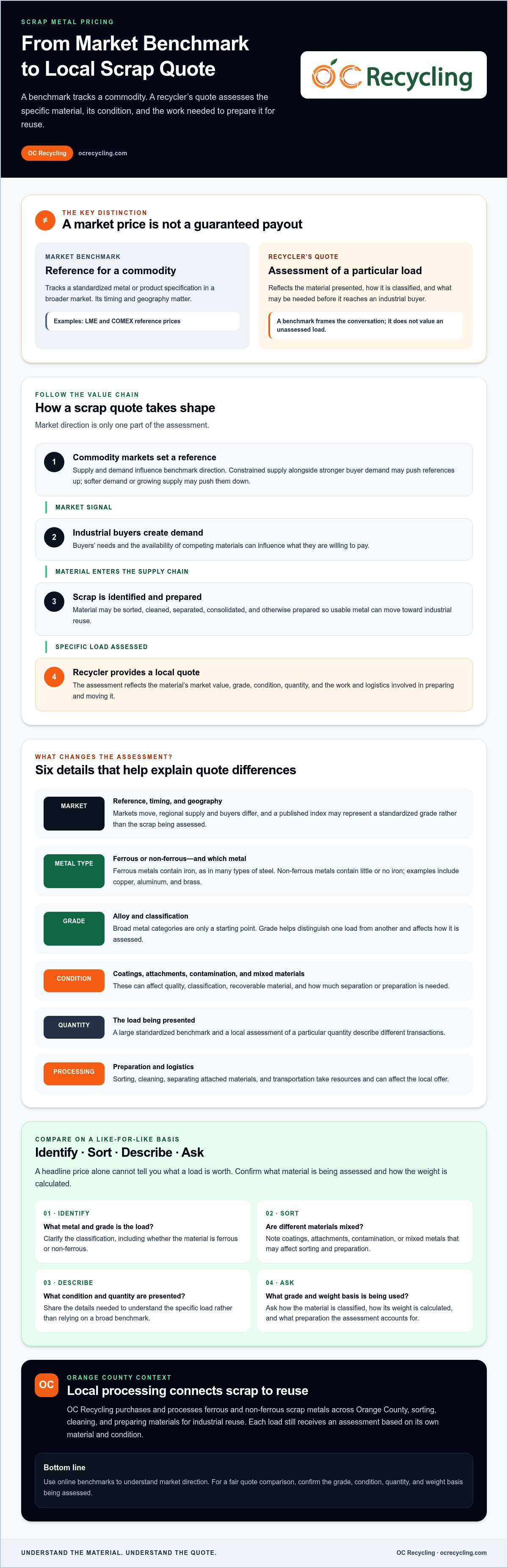
A scrap quote reflects the recoverable value of material after it has been identified, graded, and considered for processing. To understand how are scrap metal prices determined, follow the value chain: commodity markets provide benchmarks, industrial buyers create demand for processed metal, and recyclers sort and prepare scrap to meet that demand. A recycler then assesses the specific material a seller brings in and provides a quote.
A scrap quote depends on the metal’s market value, grade, condition, quantity, and the work needed to prepare it for industrial reuse.
What does a scrap metal price actually represent?
A commodity benchmark tracks a standardized metal in a broader market. A recycler’s offer applies to a particular load of scrap, which may not be ready to sell as refined metal. The load may need to be identified, sorted, cleaned, or otherwise prepared before it moves to the next stage of the supply chain. For a useful foundation on what scrap is and how it is reused, see Scrap.
Quotes are commonly expressed by weight, but the amount offered depends on the material and how it is classified. Ferrous metals contain iron, as in many types of steel. Non-ferrous metals, such as copper, aluminum, and brass, contain little or no iron. These broad categories are only a starting point. Grade and condition help distinguish one load from another.
Why can a published price differ from a local quote?
A published index is a reference, not a guaranteed local payout. Its date matters because metal markets move, and its geography matters because regional supply and buyers differ. The index may represent a standardized commodity or a particular grade, while a seller may bring in a mixed load with attachments, coatings, or uncertain composition. Those differences affect what can be recovered and how much preparation may be needed.
Transaction scale can matter, too. A benchmark may describe large, standardized market activity, while a local quote assesses the quantity and condition presented. Sorting and preparation are part of connecting that material to industrial reuse. Use online prices to understand market direction, then ask a local recycler how grade, condition, and weight basis affect its current assessment. A benchmark can frame the conversation, but it cannot tell you the value of an unassessed load.
How metal markets and supply chains influence scrap prices
Global metal markets help set the direction, but scrap passes through a physical supply chain before reaching an industrial buyer. After collection, material is identified, sorted, cleaned, and prepared for reuse. Similar materials may also be consolidated so buyers can handle them efficiently. Each step connects a commodity’s market value to the value of scrap a recycler can recover and sell.
Market benchmarks signal where metal values are heading; a seller’s quote reflects the specific material and the preparation and logistics involved in moving that load to a buyer.
What role do commodity benchmarks play?
The London Metal Exchange (LME) and COMEX publish prices used as references for metals such as copper and aluminum. These benchmarks vary by metal, product form, contract specification, and timing. They help market participants follow price movements, but a benchmark may represent a standardized commodity rather than scrap in the form a seller brings to a recycler.
Supply and demand influence reference prices. If industrial buyers need more of a metal while supply is constrained, benchmarks may rise. If demand softens or supply grows, they may fall. The availability of competing materials can also affect what buyers are willing to pay. The Recycled Materials Association (ReMA) offers broader industry context on the recycling materials sector, but a benchmark alone won’t show how a particular scrap load will be assessed.
How does the recycling supply chain affect a quote?
At the processing stage, the key question is how much usable material can be recovered from the load. Mixed or attached materials may need separation, which takes time and capacity. Transportation to buyers is another part of the supply chain. If preparing or moving a material requires more resources, that can affect the local offer even when the broader benchmark is unchanged.
OC Recycling purchases and processes ferrous and non-ferrous scrap metals across Orange County, sorting, cleaning, and preparing materials for industrial reuse. That local role connects sellers’ materials with downstream buyers, but it doesn’t mean every load receives the same assessment. To understand how scrap metal prices are determined for your material, consider both market direction and the work needed to prepare it for its next use. For a current local assessment, review OC Recycling’s scrap metal purchasing information.
How metal type, grade, and contamination change scrap value
Two items that look like “scrap metal” can receive different assessments because their composition, condition, or ease of recovery may differ. A broad label such as copper, aluminum, steel, or brass is a useful starting point, not a complete grade. If you’re asking how are scrap metal prices determined, identifying what the material is made of and what is attached to it can help explain why its assessment differs from another load’s.
Why do copper, aluminum, steel, and brass receive different assessments?
These metals have different compositions and downstream uses, and they don’t all enter the same recycling process. Steel is ferrous, meaning it contains iron; copper, aluminum, and brass are non-ferrous. Even within one broad category, alloy composition and the item’s form can affect its classification. A copper-colored part, for example, isn’t necessarily solid copper. A metal name alone doesn’t establish a grade or guarantee a particular quote.
Commodity references, including those published by the London Metal Exchange (LME), can help show broader metal-market movements. But an exchange benchmark describes a market reference, not the grade or condition of a particular scrap item. For copper-specific selling considerations, see this scrap copper pricing guide.
How do cleanliness, sorting, and mixed loads matter?
Coatings, attached hardware, non-metal parts, and residue can make it harder to identify or recover usable metal. A load containing several metal types may also need closer assessment than a clearly separated batch. When it’s safe and practical, sort recognizable materials into separate groups so the recycler has a clearer picture of the load. Keep uncertain items separate rather than guessing at their composition.
Before disassembling an unfamiliar or potentially unsafe item, ask the recycler how they want it presented. Removing attachments isn’t always appropriate, and you shouldn’t take unnecessary risks to prepare a load. Instead, note what you know about the material and describe any coatings, mixed components, or uncertainty during assessment. That context helps the recycler evaluate the load rather than treating every item with the same broad metal label as identical.
Why scrap metal quotes vary between recyclers in Orange County
The same broad metal category doesn’t always receive the same quote at every recycling facility. A “steel load” or “copper load” could include different grades, attachments, levels of sorting, and amounts of recoverable material. Facilities may also differ in handling procedures, processing capacity, routes to industrial buyers, and logistics. These factors can influence an offer without indicating a broader local rate trend.
Comparing quotes takes more than checking the amount offered. To understand how are scrap metal prices determined for your load, compare the same material, condition, weight basis, and assessment date. A quote for clean, separated metal isn’t directly comparable to one for a mixed or unidentified load.
What should you compare when checking scrap metal quotes?
Ask which grade the quote applies to and how the recycler assesses mixed material. Confirm whether the amount is based on pounds, tons, or another stated unit, and check that each quote is current. For a larger or commercial load, ask what details the facility needs, such as metal types, approximate quantity, and condition. Clear answers make a like-for-like comparison easier.
How can you prepare for a local assessment?
Separate recognizable metal types and remove obvious non-metal attachments only when it’s safe and practical. Keep unfamiliar or potentially unsafe items intact until a recycler advises whether dismantling is appropriate. Before bringing in a load, confirm that the facility accepts the materials and ask what information it needs to provide a current assessment.
OC Recycling serves the general public and commercial accounts across Orange County, with four local locations. The company purchases and processes ferrous and non-ferrous scrap metals, sorting and preparing material for industrial reuse. Whether you’re in Santa Ana, Anaheim, Costa Mesa, Huntington Beach, Orange, Irvine, Garden Grove, Westminster, Fountain Valley, or Tustin, describe your load consistently when comparing facilities. Note the assessment date and quoted weight basis. You can contact OC Recycling about scrap metal purchasing to ask about accepted materials and current assessment details.
How to understand a scrap metal quote and choose your next step
A clear quote starts with clear information about the material. Follow a simple sequence: identify what you have, sort recognizable metals when safe, describe the load honestly, ask how it will be assessed, then compare answers on the same basis. This turns the question of how are scrap metal prices determined into practical steps you can take before contacting a recycler.
What questions should you ask a scrap metal recycler?
Ask which material category or grade the facility thinks your load fits and how it assesses mixed metals, coatings, or attached parts. Confirm that the material is currently accepted and ask what details are needed for an assessment. If you’re comparing quotes, check the weight unit and whether each quote is current. Don’t assume two offers cover the same material just because both use a broad label such as “copper” or “steel.”
Reach out when you’re unsure whether a material is accepted, can’t confidently identify its grade, or need to understand how mixed components may affect its assessment. Before contacting a facility, make a short record of:
- Material type, or your best description if it’s uncertain
- Approximate quantity and whether the load is sorted
- Condition, including visible coatings or attached non-metal parts
- The date you requested or received the assessment
This information gives you a consistent basis for follow-up and comparison. It also helps distinguish a current assessment of your specific load from an online market reference. For business material, include relevant handling or site logistics in your questions rather than assuming every facility uses the same process.
OC Recycling purchases and processes ferrous and non-ferrous scrap metals for industrial reuse across Orange County. If the material or next step is unclear, contact OC Recycling about scrap metal recycling to ask about accepted materials and assessment details.
Use What You’ve Learned to Compare Scrap Quotes
Understanding how are scrap metal prices determined starts with separating a market benchmark from an assessment of your actual load. Metal type, grade, condition, and the work needed to prepare material for reuse all help shape a quote. For a fair comparison, confirm the material classification, weight basis, and assessment date with each recycler.
Before asking for an assessment, note which metals you have, their approximate quantity, and whether the load is sorted or mixed. If you’re unsure about an item, ask before taking it apart. A clear description makes the conversation more useful.
OC Recycling purchases and processes scrap metal across Orange County, with four local locations and sorting and preparation that support industrial reuse. To discuss accepted materials and assessment details, contact OC Recycling about scrap metal recycling. With a few details ready, you can ask informed questions and decide on your next step.
Frequently Asked Questions
How are scrap metal prices determined?
Scrap metal prices reflect market benchmarks, the metal’s type and grade, its condition, and the work required to prepare it for reuse. A recycler assesses the recoverable material in your load rather than simply applying a commodity-market price. Sorting, contamination, mixed components, quantity, and local processing needs can all affect the quote. For a fair comparison, confirm the grade, weight basis, and assessment date.
Why do scrap metal prices change from day to day?
Scrap metal prices can change as commodity markets respond to shifts in supply, industrial demand, energy costs, trade conditions, and broader economic or geopolitical events. Those influences don’t affect every metal in the same way. A published benchmark may also update on a different schedule from a local recycler’s assessment. Check the date and material category behind any online price, and ask whether a local quote is current.
Why is my scrap metal quote lower than the price online?
An online price may refer to a standardized metal commodity, while your quote applies to scrap with a particular grade, condition, and recoverable content. The recycler may also need to sort, clean, process, or transport the material before industrial reuse. Check whether the online figure and quote use the same metal grade, unit, date, and transaction basis. A market reference can show direction, but it isn’t a guaranteed local payout.
Which scrap metals are usually worth more?
There’s no fixed ranking that applies to every load. Non-ferrous metals such as copper, brass, and aluminum may be assessed differently from ferrous metals such as steel because their composition, recoverability, and downstream uses vary. Grade and condition matter, too. A broad label like “copper” doesn’t establish the specific material classification. Ask a recycler to identify the grade and assess your actual material instead of relying on a general comparison.
Does separating scrap metal increase its value?
Separating clearly identifiable metals can make a load easier to assess and help prevent different materials from being treated as one mixed category. It doesn’t guarantee a higher quote, since the outcome still depends on grade, condition, and the facility’s assessment. Remove obvious non-metal attachments only when it’s safe and practical. Keep unfamiliar or potentially unsafe items intact, and ask the recycler whether they should be dismantled.
How is scrap metal weighed at a recycling center?
Weighing procedures can differ by facility and transaction, so ask how the weight for your load is established before comparing quotes. Confirm whether the figure is based on pounds or another unit, how mixed materials are handled, and whether the quote applies to the assessed weight. If you’re unsure what a weight figure includes, ask the recycler to explain its basis. Don’t assume every facility uses an identical process.
Can I get a scrap metal quote before visiting a recycler?
You can ask a recycler what information it needs to discuss your material before a visit. Be ready to describe the metal type, approximate quantity, condition, and whether the load is sorted. Photos may help if the facility accepts them. Any early estimate may change after an in-person assessment. OC Recycling serves Orange County communities including Santa Ana, Anaheim, Costa Mesa, Huntington Beach, Orange, Irvine, Garden Grove, Westminster, Fountain Valley, and Tustin.
